


Listen to the article
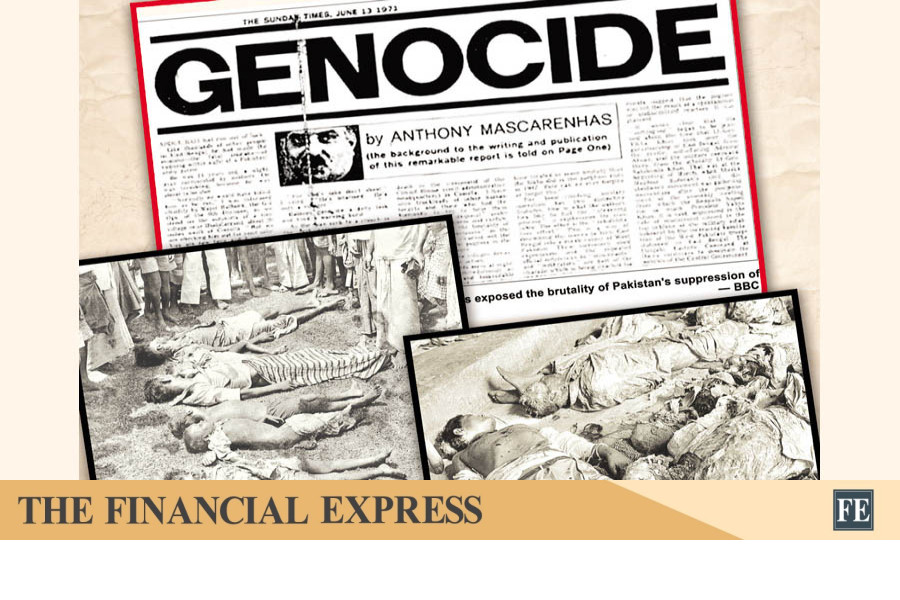
The night Pakistani forces unleashed genocide in East Pakistan began with an abrupt departure. On the afternoon of March 25, 1971, President Yahya Khan suddenly flew back to West Pakistan, ending weeks of political uncertainty. Just before midnight, as the residents of Dhaka prepared for sleep, the Pakistani military launched a coordinated assault against the Bengali population—an event that would mark the beginning of what historians now recognize as genocide.
The operation, codenamed “Operation Searchlight,” was executed by Pakistan’s Eastern Command, which consisted of approximately 40,000 troops strategically positioned throughout East Pakistan (now Bangladesh). Though relatively small in number, these forces were deployed against approximately 5,000 Bengali police officers headquartered at Rajarbagh in Dhaka and roughly 1,000 members of the East Pakistan Rifles stationed at Pielkhana.
“It is tonight,” Lieutenant-General Tikka Khan, Chief of Eastern Command, reportedly told Major General Khadim Hussain Raja, the General Officer Commanding of the 14th Division, in a phone call earlier that day. Tikka Khan, later nicknamed “The Butcher Khan,” chose to monitor the operation from Martial Law Headquarters, watching as his forces ravaged Dhaka and surrounding areas.
The Pakistani military had been methodically preparing for this crackdown. Weeks earlier, during a February conference of Brigade Commanders in Dhaka, military leadership had strategically weakened Bengali units by reassigning and disarming Bengali officers and dispersing Bengali regiments across the country on various civil duties.
The attack was executed with clinical precision. Army tanks rolled through Dhaka’s streets in multiple directions toward predetermined targets. One contingent moved from the airport toward the city center, attacking a newspaper office before seizing control of Radio Pakistan’s Dhaka station. Another group targeted Dhaka University, specifically the student dormitories.
The brutality of the university attack was captured on video by a professor from East Pakistan University of Engineering and Technology, footage that would later be smuggled out of the country as evidence of the atrocities. Historian Stanley Wolpert later described the scene: “US M-24 tanks led the Punjabi-Baluchi assault upon student dormitories on the campus of the University of Dacca. Iqbal and Jagnath halls were filled with sleeping students and faculty when the tanks opened fire and continued shooting at least five minutes.”
The assault didn’t stop there. After the initial bombardment, soldiers with fixed bayonets charged into the damaged dormitories, executing all survivors—students, professors, caretakers, and servants alike. The military also conducted targeted killings at faculty residences, where several professors were murdered.
The events of March 25 didn’t occur in isolation. Pakistani authorities had been planning potential military action since at least March 1, when they postponed the meeting of the newly elected National Assembly. The situation escalated after March 7, when Sheikh Mujibur Rahman launched a non-cooperation movement against central rule, frustrating Pakistani leadership who could not charge him with treason as he had carefully avoided declaring independence.
By August 1971, the Pakistani military had established auxiliary forces known as Al-Badr and Al-Shams, recruiting from local political parties like Jamat-e-Islam and Muslim League. According to Lieutenant General A.A.K. Niazi’s own writings, these forces were trained for “specialized operations”—a euphemism for targeting and killing Bengalis. Most recruits were drawn from the Urdu-speaking Bihari population, creating a further social divide between Biharis and the Bengali majority.
The Pakistani military attempted to frame their actions as targeting only “Bengali separatists” rather than all Bengalis. However, American diplomat Archer Blood contested this characterization, describing the conflict as one “between West Pakistan Armed Forces and non-Bengali civilians on one side and Bengalis on the other side,” making it what scholars have termed a “selective genocide” based on ethnic identity.
Survivors later recounted how some Bengalis escaped the initial attack by speaking Urdu loudly, creating the impression they were non-Bengali. Tellingly, no Urdu-speaking people were targeted by Pakistani forces during the operation.
Despite attempts by some to minimize or recharacterize these events for political purposes, March 25, 1971, remains a defining moment in Bangladesh’s history—the night a calculated military operation became genocide and sparked a war that would ultimately lead to the birth of an independent nation.
Fact Checker
Verify the accuracy of this article using The Disinformation Commission analysis and real-time sources.

11 Comments
The details of the military operation against the Bengali population are chilling. It’s crucial that we don’t forget such horrific chapters in history, and that we continue to shed light on the truth, no matter how uncomfortable it may be.
Agreed. Addressing misinformation and educating people about these events is the only way to ensure they are not repeated. We must remain vigilant against attempts to distort or downplay such grave human rights abuses.
The scale and brutality of the Pakistani military’s assault on the Bengali population is truly horrifying. I’m grateful for the detailed account provided in this article, as it helps to counter the misinformation and revisionism that can sometimes surround these events.
Yes, it’s crucial that we have a clear, factual understanding of the Bangladesh Liberation War and the genocide that occurred. Maintaining an honest and nuanced historical record is essential for preventing such tragedies from happening again.
While the content is deeply disturbing, I appreciate the effort to provide a factual account of the Bangladesh Liberation War and the genocide that occurred. Honest and transparent discussions about these historical tragedies are essential.
Absolutely. Only by confronting the hard truths of the past can we hope to prevent such atrocities from happening again in the future. This type of informed, thoughtful coverage is so important.
This is a difficult but necessary article to read. Addressing misinformation and shedding light on the realities of the 1971 genocide is important work. I commend the efforts to ensure these tragic events are not forgotten or distorted.
I agree. It’s vital that we confront the hard truths of our history, no matter how uncomfortable they may be. Only by doing so can we work towards a more just and equitable future.
This is a sobering account of the atrocities committed during the Bangladesh Liberation War. It’s important to understand the full history and scale of the genocide, and to honor the victims. I hope this helps address misinformation around these tragic events.
This is a powerful and important article that sheds light on a dark chapter in history. I commend the efforts to provide a comprehensive and accurate account of the events surrounding the Bangladesh Liberation War and the genocide that took place.
The details provided in this article are a sobering reminder of the immense human suffering and loss of life that occurred during the Bangladesh Liberation War. It’s crucial that we continue to educate ourselves and others about these historical events.