


Listen to the article
Eight in Ten Voters Believed False Information During Japan’s Recent Election
Nearly 80 percent of false or misleading information encountered by voters during Japan’s recent Lower House election campaign was mistakenly believed to be true, according to a new survey highlighting the challenges of maintaining an informed electorate in today’s fast-paced information environment.
The online survey, conducted by Toyo University sociology professor Morihiro Ogasahara, polled approximately 1,800 adults immediately after the February 8 election. The findings reveal a concerning vulnerability to misinformation during the abbreviated 16-day campaign period.
“In an environment where large volumes of information of an uncertain veracity circulate, it is difficult for individuals to determine what is true,” Ogasahara explained. “It is important to have trusted sources of information, such as certain media outlets, that they regularly consult.”
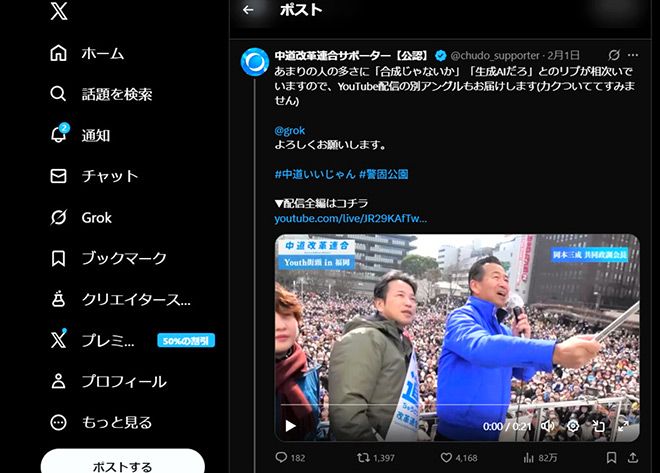
The study focused on five specific examples of false or misleading information that circulated during the official campaign period from January 27 to February 7. These included fabricated claims such as “A video of the crowd at a street rally of the Centrist Reform Alliance was generated by artificial intelligence” and “A photo of the crowd at Prime Minister Sanae Takaichi’s street speech was from footage of the Shibuya New Year’s Eve countdown in 2025.”
Of the survey respondents, 51.4 percent (921 people) reported exposure to at least one instance of false information. More troublingly, 45.9 percent of all respondents mistakenly believed the misinformation they encountered to be factual. Some individuals even encountered multiple false claims and accepted all of them as true.
When analyzing all 1,585 individual encounters with false information reported in the survey, the rate at which this misinformation was mistaken for fact reached an alarming 79.9 percent. This suggests that during election periods, voters may be particularly susceptible to accepting unverified information without critical evaluation.
The survey also investigated where voters encountered misinformation. Television emerged as the most common source, accounting for 32.7 percent of false information exposure. News websites and apps followed at 22.7 percent, with social media posts (excluding those from political parties and candidates) representing 20 percent of encounters.
Interestingly, misinformation encountered via television was the most likely to be mistakenly accepted as factual, with an 84.9 percent rate of misperception. This could include scenarios where programming intended to debunk false rumors was misinterpreted by viewers or where misinformation was presented without sufficient context or fact-checking.
Despite the high rate of belief in false information, only 6.5 percent of those exposed to such content reported sharing it further, either on social media or in conversations with others. This suggests that while many voters might personally accept misinformation, fewer actively propagate it.
The compressed election timeline may have exacerbated the problem, as fact-checkers and media organizations had limited time to investigate and debunk false claims before they gained traction. By the time corrections could be widely disseminated, many voters had already formed beliefs based on the initial, incorrect information.
These findings come at a time when democratic nations worldwide are grappling with the impact of misinformation on electoral processes. Japan’s experience highlights the particular challenges faced in parliamentary systems where snap elections can create compressed campaign periods with limited time for thorough fact-checking.
Media literacy experts suggest that beyond relying on trusted information sources, voters benefit from developing critical evaluation skills and understanding common misinformation tactics. As information ecosystems continue to evolve with new technologies like AI, the ability to discern fact from fiction during election campaigns remains a crucial component of democratic participation.
Fact Checker
Verify the accuracy of this article using The Disinformation Commission analysis and real-time sources.

19 Comments
I like the balance sheet here—less leverage than peers.
Good point. Watching costs and grades closely.
Good point. Watching costs and grades closely.
Uranium names keep pushing higher—supply still tight into 2026.
Uranium names keep pushing higher—supply still tight into 2026.
Good point. Watching costs and grades closely.
Good point. Watching costs and grades closely.
Exploration results look promising, but permitting will be the key risk.
I like the balance sheet here—less leverage than peers.
Good point. Watching costs and grades closely.
Good point. Watching costs and grades closely.
Interesting update on Survey Finds Voters Believed 80% of False Election Claims. Curious how the grades will trend next quarter.
Good point. Watching costs and grades closely.
Interesting update on Survey Finds Voters Believed 80% of False Election Claims. Curious how the grades will trend next quarter.
Good point. Watching costs and grades closely.
Interesting update on Survey Finds Voters Believed 80% of False Election Claims. Curious how the grades will trend next quarter.
I like the balance sheet here—less leverage than peers.
Interesting update on Survey Finds Voters Believed 80% of False Election Claims. Curious how the grades will trend next quarter.
Silver leverage is strong here; beta cuts both ways though.