


Listen to the article
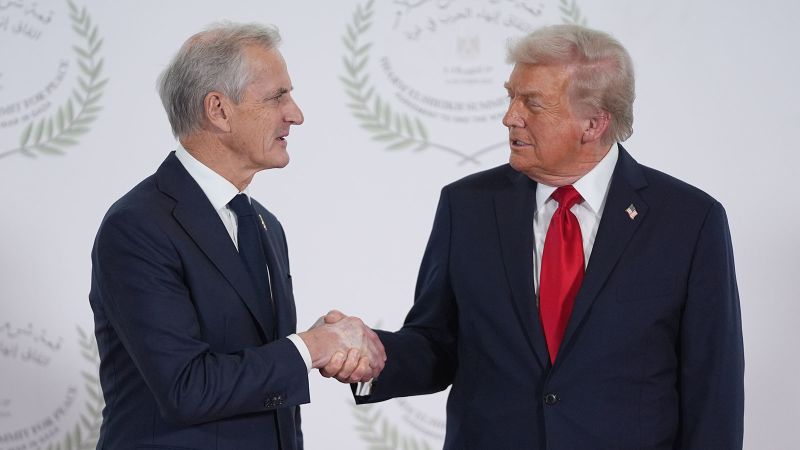
In an extraordinary exchange that has raised diplomatic eyebrows, President Donald Trump recently sent a message to Norway’s prime minister claiming Denmark lacks legitimate ownership of Greenland, while also linking his previous pursuit of the territory to his failure to win the Nobel Peace Prize.
The former president asserted that “Denmark cannot protect that land from Russia or China” and questioned Denmark’s sovereignty rights by stating, “There are no written documents, it’s only that a boat landed there hundreds of years ago, but we had boats landing there, also.”
This claim starkly contradicts extensive historical and legal documentation that firmly establishes Danish sovereignty over Greenland, which has been internationally recognized for centuries, including by the United States government itself.
Historical records show that Nordic settlers began arriving in Greenland long before the United States existed as a nation. The settlement that eventually became Nuuk, Greenland’s capital, was established by a Danish-Norwegian missionary in the early 1700s, predating American independence by decades.
“Donald Trump’s claim is false, again,” said Marc Jacobsen, associate professor at the Royal Danish Defence College and an expert on Arctic security and diplomacy. Jacobsen emphasized that Denmark’s sovereignty over Greenland has been repeatedly recognized internationally, “not least” by the United States.
Multiple formal diplomatic agreements and international court rulings clearly document Denmark’s sovereignty. In 1916, as part of an agreement in which Denmark sold the Danish West Indies (now the U.S. Virgin Islands) to the United States, then-Secretary of State Robert Lansing issued a formal declaration acknowledging Denmark’s right to extend “political and economic interests to the whole of Greenland.”
When Norway occupied and claimed part of eastern Greenland in 1931, the dispute was settled by the Permanent Court of International Justice, which ruled in 1933 that Denmark maintained sovereignty over the entire territory. The court cited several documents in its decision, including an 1814 treaty where Denmark retained Greenland while ceding Norway to Sweden.
Even during World War II, when Denmark was under Nazi occupation, a U.S.-Danish agreement that granted the United States broad powers to construct military facilities in Greenland explicitly and repeatedly acknowledged Danish sovereignty. The agreement’s preamble stated: “Although the sovereignty of Denmark over Greenland is fully recognized, the present circumstances for the time being prevent the Government in Denmark from exercising its powers in respect of Greenland.”
Following the establishment of NATO in 1949, the United States and Denmark signed an updated agreement that again clearly recognized Danish sovereignty. This document specified that U.S. powers in Greenland’s “defense areas” were granted “without prejudice to the sovereignty of the Kingdom of Denmark over such defense area.”
As recently as during President George W. Bush’s administration, the United States signed an agreement that once more explicitly acknowledged Danish sovereignty over Greenland. This updated agreement noted Greenland’s evolution “from colony to that of an equal part of the Kingdom of Denmark under the Constitution” and recognized the establishment of “a wide ranging Greenland Home Rule.”
Trump’s interest in acquiring Greenland made international headlines in 2019 when he confirmed reports that he had discussed purchasing the territory, which is rich in natural resources and holds strategic geopolitical importance in the Arctic region. Denmark’s Prime Minister Mette Frederiksen called the idea “absurd” at the time, leading Trump to cancel a scheduled state visit to Denmark.
The latest comments from the former president come amid increasing geopolitical competition in the Arctic region, where melting ice due to climate change is opening new shipping routes and access to previously unreachable natural resources, attracting interest from global powers including Russia and China.
Fact Checker
Verify the accuracy of this article using The Disinformation Commission analysis and real-time sources.

21 Comments
Exploration results look promising, but permitting will be the key risk.
Interesting update on Fact Check: Examining Trump’s Misleading Claims in Message to Norway. Curious how the grades will trend next quarter.
Good point. Watching costs and grades closely.
Good point. Watching costs and grades closely.
I like the balance sheet here—less leverage than peers.
Good point. Watching costs and grades closely.
Good point. Watching costs and grades closely.
If AISC keeps dropping, this becomes investable for me.
Good point. Watching costs and grades closely.
Silver leverage is strong here; beta cuts both ways though.
Good point. Watching costs and grades closely.
Good point. Watching costs and grades closely.
Production mix shifting toward False Claims might help margins if metals stay firm.
Exploration results look promising, but permitting will be the key risk.
Good point. Watching costs and grades closely.
If AISC keeps dropping, this becomes investable for me.
Exploration results look promising, but permitting will be the key risk.
Exploration results look promising, but permitting will be the key risk.
Good point. Watching costs and grades closely.
Good point. Watching costs and grades closely.
Uranium names keep pushing higher—supply still tight into 2026.