


Listen to the article
Thai authorities have charged a 72-year-old woman for spreading false information claiming American mercenaries were traveling from a southern Thai island to assist Cambodian forces against Thailand, police officials announced this week.
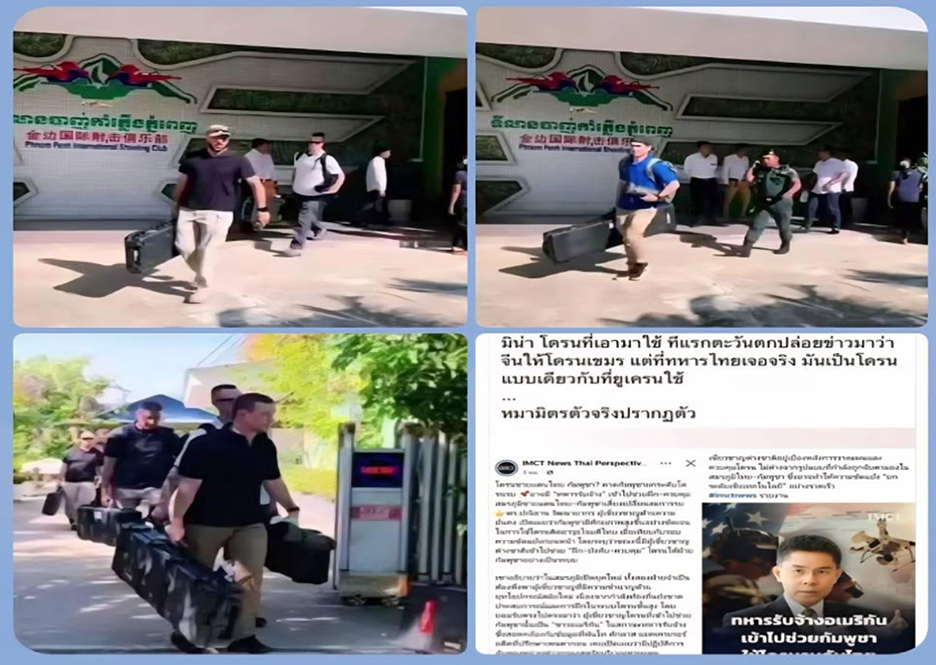
The woman, identified only by the initials T.H., allegedly circulated messages in several LINE groups claiming that Jewish American soldiers were among groups of foreign mercenaries being transported by boat from Koh Phangan island to Cambodia’s Sihanoukville province to join combat operations against Thai troops.
According to police investigators on Koh Phangan, the misinformation included specific claims that 180 foreigners had hired Thai boat operators to transport them to Cambodia, while another 200 foreigners remained on the island. The false reports suggested these individuals were specialists in military drone operations working for Cambodia’s influential Hun family.
The social media posts included photos purportedly showing foreigners carrying luggage in front of a building with Khmer-language signage, attempting to add credibility to the unfounded claims.
“Our investigation found these claims to be entirely false and unsupported by any evidence,” said a police spokesperson from the Koh Phangan district. “This type of misinformation can cause unnecessary panic and damage to international relations.”
Authorities began investigating on December 13 after the posts began circulating widely across social media platforms. Digital forensic teams traced the origin of the messages to a house in Koh Phangan district, determining they were first shared around 1 p.m. on December 12 via a LINE messaging group with 270 members. The content was subsequently forwarded to two additional LINE groups with 24 and 29 members, respectively.
When questioned by police, T.H. admitted to sharing the messages and images without verifying their accuracy or knowing their original source. She now faces charges under Thailand’s computer crime law for importing distorted or false information into a computer system in a manner likely to cause public harm. If convicted, she could face significant penalties under Thailand’s strict cyber laws.
The timing of the false information coincided with a televised discussion on December 12 featuring prominent political science and security expert Panitan Wattanayagorn, who discussed military drone use on Channel 3’s popular talk show “Hone Krasae.”
During the program, when asked about unidentified fighters in the conflict, Panitan mentioned that Thai authorities were detaining some individuals connected to military consulting companies. He noted that these companies legitimately provide training and operation services for military drones, and that all such operations must be conducted under military command systems.
“These companies operate within legal frameworks, though security agencies continue to investigate their activities,” Panitan explained during the broadcast. His nuanced comments were later distorted on social media to falsely claim he had confirmed American mercenaries were helping Cambodia attack Thailand.
The case highlights the growing challenge of misinformation in Southeast Asia, where border tensions and historical rivalries can quickly inflame public sentiment. Thailand and Cambodia have experienced periodic border disputes over the years, making such false claims particularly sensitive.
Digital security experts point to this incident as an example of how quickly misinformation can spread through messaging applications like LINE, which is immensely popular in Thailand with limited content moderation compared to public social media platforms.
“Private messaging groups often become echo chambers where false information can spread rapidly with little external scrutiny,” said Dr. Pirongrong Ramasoota, a digital media researcher at Chulalongkorn University. “This case demonstrates how even elderly users can inadvertently become vectors for potentially dangerous misinformation.”
Thai police have urged the public to verify information from official sources before sharing content related to national security matters.
Fact Checker
Verify the accuracy of this article using The Disinformation Commission analysis and real-time sources.

7 Comments
Interesting story. Spreading false information about foreign mercenaries is a serious offense. I wonder what the motivation was behind these fabricated claims. Fact-checking is so important these days to avoid the spread of misinformation.
This false reporting about American mercenaries in Cambodia is quite puzzling. I wonder what the woman’s motivations were and whether she had any connections to groups pushing this kind of disinformation. Rigorous investigations are needed to get to the truth.
It’s good to see the Thai authorities taking action against this woman for disseminating these unfounded claims. Spreading misinformation, especially about military activities, can have serious consequences. Fact-checking is so important these days.
Claiming the presence of foreign mercenaries when there is no evidence to support it is extremely irresponsible. I hope the authorities can determine the source of these fabricated stories and take appropriate legal action to prevent the spread of such dangerous misinformation.
This seems like a concerning trend of spreading misinformation, even in faraway places like Cambodia. I hope the authorities are able to get to the bottom of who was behind these false reports and hold them accountable.
Agreed. Fabricating stories about foreign military involvement is dangerous and can create unnecessary tensions. Proper investigation is crucial to uncover the truth.
While I’m glad the authorities are taking this woman to task for her false claims, it’s troubling to see such blatant misinformation being circulated, especially about potential military involvement. We need to be vigilant against the spread of these kinds of unsubstantiated rumors.