


Listen to the article
Federal prosecutors have filed a major fraud lawsuit against a contractor accused of defrauding the government of millions in a broadband expansion project on the Rosebud Sioux Reservation in South Dakota.
U.S. Attorney Ron Parsons announced Thursday that the Federal False Claims Act suit targets Paul and Julie Brandenburg and their son, Matthew Brandenburg. The family allegedly stole more than $2.1 million through fraudulent invoicing practices and price inflation while working on a $19 million high-speed internet infrastructure project intended to benefit the tribal community.
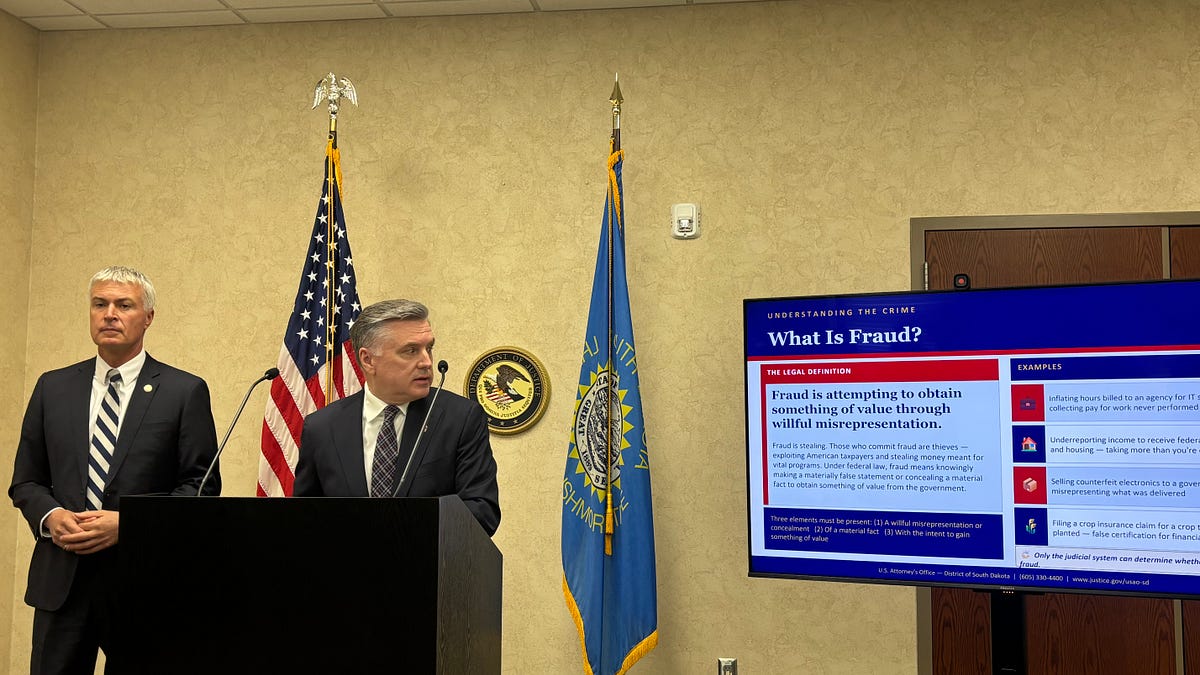
The legal action comes as part of a broader joint federal-state initiative to combat government program fraud, which Parsons unveiled alongside South Dakota Attorney General Marty Jackley. During their announcement, both officials pointed to recent fraud discoveries in neighboring Minnesota as evidence of a growing national problem requiring coordinated intervention.
“This case represents exactly the type of fraud that undermines critical infrastructure projects in underserved communities,” Parsons said during the announcement. “The allegations describe a systematic effort to exploit government funding that was specifically designated to bring essential connectivity to tribal lands.”
The broadband project was particularly significant for the Rosebud Sioux Reservation, where reliable internet access has long been a challenge for residents, businesses, and educational institutions. Rural broadband expansion has been a priority for federal infrastructure initiatives, with tribal lands often facing some of the most severe digital divides in the country.
According to court documents, the Brandenburgs’ company secured the nearly $19 million contract to install high-speed broadband infrastructure across the reservation. However, investigators allege the family engaged in multiple fraudulent practices, including submitting invoices for equipment never purchased and dramatically inflating costs for materials actually used in the project.
The case highlights growing concerns about oversight in government infrastructure programs, particularly those aimed at bridging the digital divide. Recent years have seen significant federal investment in rural broadband initiatives, with billions allocated through various programs to expand internet access in underserved communities.
The complaint seeks to recover the stolen funds plus penalties under the False Claims Act, which allows for treble damages in cases of fraud against government programs. If successful, the government could recover more than $6 million from the defendants.
Attorney General Jackley emphasized that the joint task force represents a new approach to combating fraud that crosses jurisdictional boundaries. “What we’re seeing in Minnesota and now here in South Dakota points to a broader problem that requires coordination between federal and state authorities,” Jackley said. “This partnership allows us to pool resources and expertise to better protect taxpayer dollars.”
The Minnesota fraud cases referenced by the officials involve widespread misappropriation of federal funds in various government assistance programs, which has led to multiple prosecutions and increased scrutiny of program administration nationwide.
For the Rosebud Sioux Tribe, the alleged fraud represents more than just financial harm. The incomplete or substandard broadband infrastructure affects essential services, including healthcare, education, and economic development opportunities that depend on reliable internet access.
The case will proceed in federal court, with prosecutors indicating that additional charges could follow as the investigation continues. The defendants have not yet filed a formal response to the allegations.
Fact Checker
Verify the accuracy of this article using The Disinformation Commission analysis and real-time sources.

7 Comments
Defrauding a tribal community of millions in funding intended for vital broadband infrastructure is a particularly egregious offense. I hope the legal process holds the accused parties fully accountable.
This is a troubling case of alleged fraud targeting a vulnerable tribal community. While the details are still emerging, it’s critical that government funds earmarked for vital infrastructure projects are used responsibly and transparently to benefit those in need.
While the details are troubling, I’m encouraged to see the government taking decisive action to root out this kind of fraud. Protecting vulnerable communities and taxpayer dollars should be a top priority.
This case highlights the importance of robust fraud detection and prevention mechanisms. Increased coordination between different levels of government can help identify and stop such abuses more effectively.
Absolutely. Effective collaboration and information-sharing between federal, state, and local authorities is key to combating fraud schemes that cross jurisdictional lines.
It’s heartening to see federal and state authorities working together to combat fraud in government programs. Protecting taxpayer dollars and ensuring equitable access to resources like broadband is essential, especially in underserved areas.
Agreed. Fraud undermines public trust and diverts resources from important community needs. Rigorous oversight and accountability measures are crucial to safeguard these kinds of critical infrastructure investments.