


Listen to the article
Americans’ Trust in News Media Rebounds, Largely Driven by Republicans
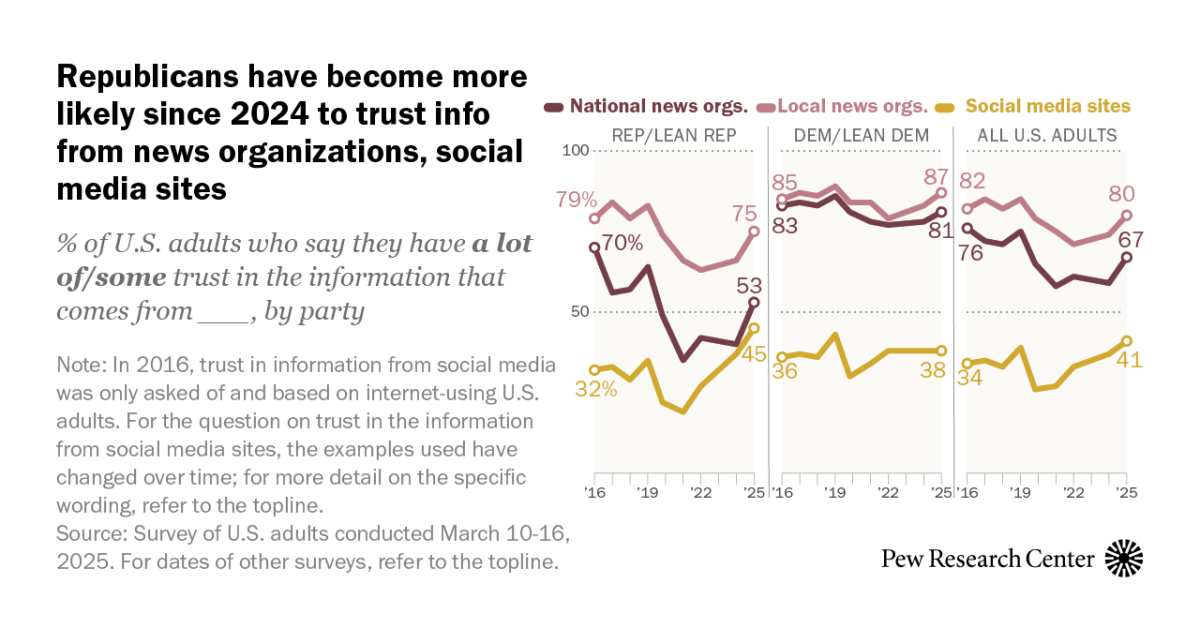
Trust in news organizations and social media has significantly increased among Americans over the past year, according to a new Pew Research Center survey. This upswing is primarily fueled by Republican voters, coinciding with President Donald Trump’s return to the White House.
The survey of nearly 9,500 U.S. adults reveals that 53% of Republicans and Republican-leaning independents now express at least some trust in national news organizations, marking a substantial 13 percentage point increase from September 2024, when only 40% reported similar confidence. This reverses a years-long trend of declining media trust among Republicans observed between 2016 and 2024.
Republicans are also increasingly trusting information from local news outlets (75%, up from 66%) and social media platforms (45%, up from 37%). The growing Republican confidence in social media continues a steady climb that began in 2021, when just 19% expressed trust in information from these platforms.
Despite these gains, a significant partisan trust gap persists. Democrats remain far more likely than Republicans to trust national news sources, with 81% of Democrats expressing confidence in these outlets—a figure that has remained relatively stable over the past decade. Democrats also place more trust in local news organizations than Republicans (87% versus 75%).
However, the pattern flips regarding social media, where Republicans now show greater confidence than Democrats (45% versus 38%), representing a notable shift in information consumption patterns along party lines.
Within the Republican Party, ideological divisions continue to shape media trust. Conservative Republicans remain more skeptical of mainstream news, with 49% expressing trust in national news outlets, compared to 61% of moderate or liberal Republicans. Nevertheless, trust has increased among Republicans of all ideological stripes.
Age demographics also play a significant role in media trust patterns. The oldest Americans (65+) have shown the most dramatic increase in trust toward national news organizations, jumping from 61% to 74% over the past year. Similar upticks were observed among those aged 50-64 (from 62% to 68%) and 30-49 (from 57% to 66%). The youngest adults (under 30) showed the smallest increase, with 60% now trusting national news organizations compared to 56% in 2024.
Local news continues to enjoy the highest trust levels across all age groups. However, the trust gap between different information sources is notably narrower among younger Americans. For those 18-29, social media trust (54%) nearly matches their confidence in national news organizations (60%), with local news only moderately higher at 76%.
By contrast, older Americans maintain much sharper distinctions between these sources. Among those 65 and older, only 28% trust information from social media, compared to 74% who trust national news organizations and 84% who trust local news outlets.
This evolving media landscape reflects the increasingly complex interplay between political affiliation, age, and information consumption in today’s polarized environment. The connection between Trump’s return to the White House and increased Republican media trust raises important questions about how political leadership influences perceptions of news credibility and how these shifts might affect public discourse moving forward.
The findings suggest that Americans’ relationship with news sources remains highly dynamic and susceptible to political influences, with significant implications for how information is consumed and evaluated across different segments of the population.
Fact Checker
Verify the accuracy of this article using The Disinformation Commission analysis and real-time sources.

11 Comments
This survey highlights the complex and dynamic nature of media trust. As the information landscape continues to evolve, it will be crucial to understand the factors driving these changes and their implications for democratic discourse.
It’s interesting to see the shift in Republicans’ trust in media, but I wonder how this will impact their information-seeking and sharing behaviors going forward. Continued monitoring and analysis of these trends will be important.
This survey highlights the complex and evolving landscape of media trust. It will be important to further examine the factors driving these trends and their potential impacts on political discourse and decision-making.
I agree, the dynamics of media trust are crucial to understand, especially as they relate to political polarization. Continued research and analysis in this area will be valuable.
The partisan divide in media trust is concerning, as it can contribute to the echo chamber effect and make it more challenging to have informed, constructive dialogues across different viewpoints. Finding ways to build greater mutual understanding and trust in institutions could be valuable.
The growing trust in social media among Republicans is a noteworthy finding. It raises questions about the role of these platforms in shaping political narratives and the potential for the spread of misinformation. Careful study of these trends is warranted.
This survey provides interesting insights into the evolving media landscape. It will be important to continue monitoring these trends and their potential impacts on how information is consumed, evaluated, and shared across different political affiliations.
Interesting to see the shift in trust in media among Republicans. While the partisan divide remains, it’s noteworthy that Republican trust in national news and social media has increased. This could have implications for how information is consumed and shared across the political spectrum.
The partisan divide in media trust is a concerning phenomenon that deserves further examination. Understanding the underlying drivers and finding ways to bridge these divides could be an important step in fostering more constructive political dialogue.
This data points to the need for ongoing efforts to improve media literacy and critical thinking skills, so that individuals can navigate the information landscape more effectively, regardless of their political affiliation.
The growing trust in social media among Republicans is a notable development that merits closer examination. It raises questions about how information is being evaluated and shared on these platforms, and the potential implications for the spread of misinformation.