


Listen to the article
The claim that President Ferdinand Marcos Jr. plans to shut down social media platforms in the Philippines has been debunked as false information, according to fact-checking efforts that surfaced this week.
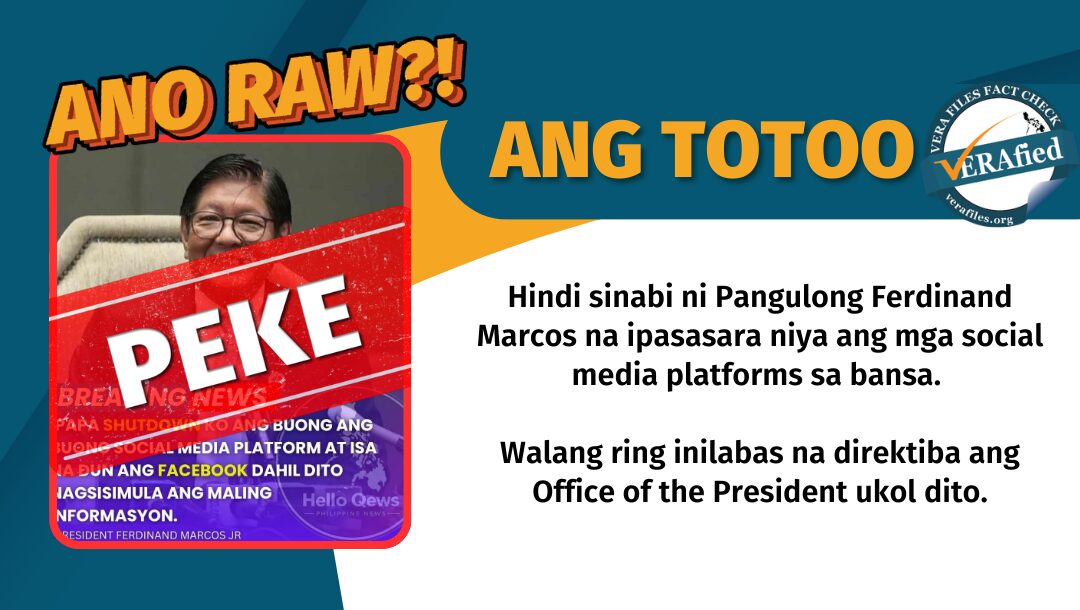
On February 14, a fabricated news graphic began circulating on Facebook featuring an image of President Marcos alongside a quote attributed to him stating: “I will shut down all social media platforms, including Facebook, because this is where wrong information starts.”
The fake announcement quickly gained traction, with at least three Facebook users sharing the misleading content. The fabricated news item suggested that the supposed shutdown would target platforms disseminating “wrong information” about flood control projects in the Philippines.
Many social media users appeared to believe the false information, with some commenters expressing concern that such measures signaled a return to martial law—a particularly sensitive topic in the Philippines given the country’s history under Ferdinand Marcos Sr.’s administration.
The Office of the President has issued no such directive regarding social media platforms, and there is no evidence that President Marcos made any statement about shutting down Facebook or other platforms.
The misinformation emerged against the backdrop of legitimate government discussions about online disinformation. On February 10, the Legislative-Executive Development Advisory Council approved House Bill 2697, also known as the Anti-Fake News and Digital Disinformation Act, as one of 21 priority measures.
The bill, filed by Rep. Ferdinand Alexander Marcos, does propose sanctions for spreading misinformation online, including potential imprisonment and fines for violators. It also contains provisions requiring social media platforms operating in the Philippines to designate liaison officers to work with the Department of Information and Communications Technology on content moderation issues.
However, the proposed legislation contains no provisions authorizing the government to completely shut down social media platforms. Rather, it focuses on accountability mechanisms for both users and platform operators.
The timing of this false claim appears strategic, coming just days after a February 11 hearing by the Senate Committee on Public Information and Mass Media. That hearing, which included testimony from representatives of Facebook and TikTok, examined proposed legislation aimed at countering online disinformation.
Digital misinformation continues to be a significant concern in the Philippines, where social media penetration is among the highest in Asia. According to recent studies, approximately 89 percent of Filipinos are active social media users, making the population particularly vulnerable to online falsehoods.
The fabricated announcement gained significant engagement on Facebook, with one post alone receiving 6,800 reactions, 1,600 comments, and 210 shares. Two additional copies shared by other Facebook users collectively garnered over 12,000 reactions, 3,400 comments, and 342 shares before fact-checkers could intervene.
Media literacy experts have expressed concern about the spread of such claims, noting that false information about government censorship can undermine public trust in institutions and contribute to political polarization.
The incident highlights the ongoing challenges facing both government regulators and social media platforms in combating misinformation in the digital age, particularly on issues of public policy and governance.
Fact Checker
Verify the accuracy of this article using The Disinformation Commission analysis and real-time sources.

7 Comments
While I’m relieved the social media shutdown claim was false, this incident highlights the need for robust fact-checking and digital literacy efforts. Preventing the spread of misinformation should be a top priority for both the government and the public.
I’m curious to learn more about the fact-checking efforts that uncovered this fake news. It’s important for the public to have access to accurate, reliable information, especially around sensitive political topics like this.
Agreed. Transparency around the debunking process is crucial for building public trust. I hope the authorities continue to vigilantly monitor and address misinformation.
The Philippines’ history under Marcos Sr. is a complex and often controversial topic. Any measures that could be perceived as a return to authoritarian rule would understandably concern citizens. I’m glad the officials swiftly clarified this was just a fabrication.
This seems like a concerning case of disinformation. It’s good the officials clarified that the supposed social media shutdown was fabricated. Spreading false information can have serious consequences, so I’m glad they addressed this rumor quickly.
This seems like a concerning attempt to sow discord and undermine faith in the government. I’m glad the officials were quick to address the false claim and reassure the public. Maintaining an open, transparent dialogue is crucial during these times.
Fabricated news stories like this one can be highly disruptive and erode public trust. I hope the authorities continue to proactively debunk such misinformation and educate the public on how to spot and report suspicious content.