


Listen to the article
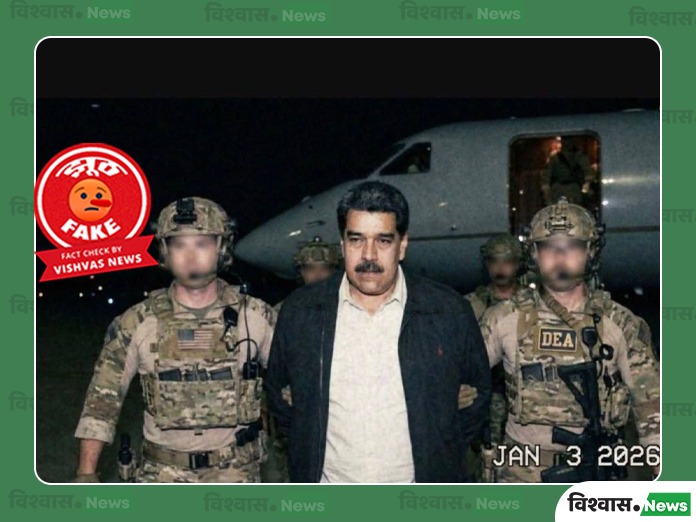
The image showing Venezuelan President Nicolas Maduro in U.S. DEA custody has been debunked as an AI-generated fake, despite appearing in several mainstream news outlets’ reporting on the controversial capture operation.
What initially appeared to be a dramatic first photo of Maduro detained by American authorities following “Operation Absolute Resolve” turned out to be entirely artificial. The deceptive image showed the Venezuelan leader flanked by officers wearing Drug Enforcement Administration uniforms, and spread rapidly across social media platforms before being picked up by news organizations.
Multiple fact-checking tools confirmed the synthetic nature of the image. Analysis by Google’s SynthID technology detected an invisible digital watermark embedded in the file, a signature element of AI-generated content. Additional verification from Image Whisperer, another AI detection service, reinforced these findings.
Notably, several reputable news outlets including The Times of India, Republic World, India TV News, Moneycontrol, and Oneindia published the fabricated image, attributing it to “social media sources” without adequate verification. This incident highlights the increasing challenge media organizations face in verifying visual content during breaking news situations.
The timing further exposes the deception. The fake image was dated January 3, 2026, while authentic footage of Maduro’s appearance in Manhattan federal court wasn’t available until January 5. When legitimate photos were released through official White House and presidential channels, they showed a markedly different scene—Maduro in a blue sweatshirt surrounded by U.S. officials with an aircraft visible in the background.
Foreign affairs journalist Umashankar Singh confirmed to investigators that the viral image did not match any official documentation of Maduro’s capture. “The verification process is often less rigorous during breaking news situations,” Singh noted, “but errors should be corrected once identified.”
According to verified reports, Maduro and his wife Cilia Flores were apprehended at their Caracas residence on January 3 during the U.S. military operation announced by President Donald Trump. The couple now faces serious charges related to arms and drug trafficking in an American court.
At his arraignment in Manhattan federal court, the 63-year-old Maduro pleaded not guilty through an interpreter, declaring: “I am innocent. I am not guilty. I am a decent man. I am still the president of my country.”
This incident represents a concerning evolution of misinformation, where AI-generated content has become sophisticated enough to fool not just social media users but also established news organizations. As visual manipulation technology advances, the need for rigorous verification processes becomes increasingly critical for maintaining journalistic integrity, especially during high-profile international events.
The case underscores the growing challenge for media consumers and professionals alike in distinguishing between authentic imagery and increasingly realistic synthetic content in today’s information environment.
Fact Checker
Verify the accuracy of this article using The Disinformation Commission analysis and real-time sources.

9 Comments
This is a sobering reminder of the dangers of AI-generated misinformation. While the technology continues to advance, so must our methods of detecting and verifying media content. Fact-checking is crucial to maintaining public trust and preventing the spread of deception.
The ability of AI to create indistinguishable fakes is truly alarming. This incident underscores the critical importance of source verification and fact-checking, especially for high-impact visual content. We must stay vigilant to prevent the spread of misinformation.
Absolutely. AI-generated fakes pose a significant threat to the integrity of news reporting. Robust verification processes and public education are essential to combat this growing challenge.
I’m glad the image was ultimately debunked as an AI-generated fake. It’s disconcerting to see how easily manipulated visuals can spread, even through reputable news channels. Fact-checking is critical in this era of sophisticated digital deception.
Agreed. The speed at which this fake image spread highlights the urgent need for better tools and processes to detect AI-generated content. Vigilance is key to maintaining public trust in media.
While it’s concerning that such a convincing fake image could proliferate, I’m encouraged to see the fact-checking efforts that ultimately exposed it as AI-generated. Maintaining trust in media will require constant improvement of detection tools and verification practices.
This is a sobering example of the challenges we face with the rise of AI-powered visual manipulation. It’s a stark reminder that even seemingly credible images cannot be taken at face value anymore. Rigorous verification is essential to combat the spread of misinformation.
Fascinating that an AI-generated image could fool so many mainstream news outlets. This really underscores the need for robust verification processes to combat the spread of misinformation, especially when it comes to high-profile political events.
Absolutely, the ability of AI to create such convincing fakes is quite alarming. News outlets need to be extremely diligent in verifying the authenticity of any visual content before publishing.