


Listen to the article
President Trump Adjusts Gas Price Claims After Iowa Fact-Check
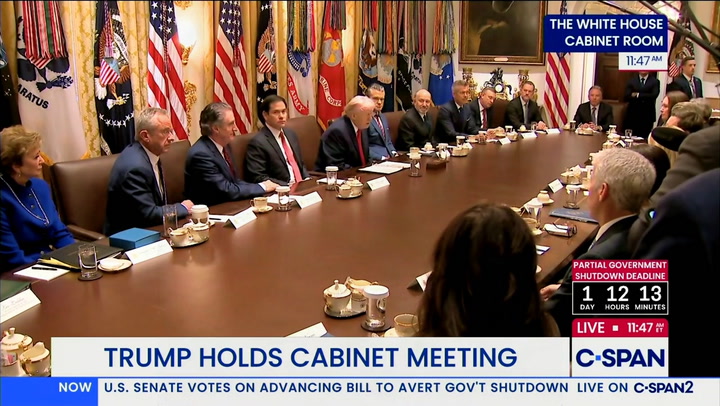
Former President Donald Trump has revised his statements about Iowa gas prices following a public correction during his recent visit to the state. During Thursday’s Cabinet meeting, Trump claimed he was corrected by two farmers who shouted that they had purchased gasoline at a lower price than he had initially stated.
“I was in Iowa, and they had $1.85, because I had it at $1.99 a gallon,” Trump, 79, said at the beginning of the meeting. “And I was corrected by two farmers that said, ‘I just bought my gasoline for $1.85.'”
This new narrative emerges after an Iowan attendee at one of Trump’s events reportedly challenged his statements about gas prices in the state. The interaction, described by observers as a “brutal fact-check,” appears to have prompted the former president to adjust his figures.
The debate over gas prices has been a consistent theme in political discourse as the nation continues to navigate economic concerns. Fuel costs remain a particularly sensitive issue in agricultural states like Iowa, where farmers depend heavily on gasoline and diesel for their operations and transportation needs.
Iowa, with its first-in-the-nation caucuses, holds significant political importance in presidential campaigns. As a key battleground state with a substantial agricultural sector, discussions about commodity prices and input costs like fuel resonate deeply with local voters.
Energy analysts note that gas prices vary considerably across states due to differences in taxes, distribution costs, and proximity to refineries. According to AAA data, the current national average for regular unleaded gasoline is significantly higher than the $1.85 or $1.99 figures mentioned by the former president.
During Trump’s administration, gas prices did indeed reach lower levels than current averages, particularly during the early pandemic period when demand plummeted amid lockdowns. However, experts point out that presidential policies have limited short-term impact on fuel prices, which are primarily driven by global supply and demand dynamics, OPEC+ decisions, refining capacity, and international conflicts affecting oil-producing regions.
The agricultural community in Iowa and other farming states has been particularly vocal about the impact of fuel costs on their operations. Farm equipment, from tractors to harvesters, consumes substantial amounts of diesel fuel, making agricultural producers especially sensitive to energy price fluctuations.
Trump’s willingness to revise his statements after being publicly corrected highlights the scrutiny facing political figures when discussing economic metrics that voters can easily verify through their daily experiences. Price claims about everyday essentials like gasoline can quickly become flashpoints when they don’t align with consumers’ reality.
As the 2024 presidential campaign season intensifies, energy policy and fuel prices are expected to remain central topics of debate. Political candidates from both parties will likely continue emphasizing their plans to address energy costs, particularly in states where agricultural and manufacturing sectors represent significant portions of the economy.
The incident also underscores the importance of Iowa in presidential politics. Candidates’ interactions with Iowans often receive outsized national attention, as the state’s caucuses traditionally serve as the first major test in the presidential nomination process, though the Democratic Party has recently revised this longstanding arrangement.
For Iowa farmers facing multiple economic pressures including input costs, commodity price volatility, and weather challenges, fuel prices represent just one aspect of their complex financial calculations. Their willingness to publicly challenge political figures on these issues demonstrates the practical, rather than purely partisan, concerns driving many rural voters.
Fact Checker
Verify the accuracy of this article using The Disinformation Commission analysis and real-time sources.

10 Comments
It’s good to see politicians willing to correct themselves based on facts, rather than sticking to inaccurate claims. Transparency and accountability are important, especially on issues like gas prices that impact so many people.
Absolutely. Admitting mistakes and adjusting positions based on new information shows integrity. Fact-checking is crucial for voters to make informed decisions.
It’s encouraging to see the former president update his gas price claims after being challenged by local farmers. Maintaining accuracy and integrity on economic issues like this is crucial for building trust with the public.
Agreed. Acknowledging and correcting inaccurate statements, even on a sensitive topic like gas prices, demonstrates a commitment to honesty and transparency that should be the standard for all elected officials.
Interesting to see the former president update his gas price statements after being challenged by local farmers. Staying grounded in reality on economic issues like this is important for public trust.
Agreed. It’s refreshing when politicians demonstrate a willingness to acknowledge and correct inaccurate claims, rather than stubbornly sticking to false narratives.
The gas price debate is a prime example of how important it is for politicians to be held accountable and transparent, even if it means admitting mistakes. Fact-checking and course-correction should be the norm, not the exception.
The debate over gas prices is a complex and sensitive issue, especially in agricultural states like Iowa. It’s good to see the facts being checked and corrected, even if it means revising earlier statements.
This back-and-forth over gas price claims highlights the importance of robust fact-checking, especially on issues that significantly impact people’s daily lives and livelihoods. Kudos to the Iowa farmers for speaking up.
Absolutely. Fact-based discourse is essential for voters to make informed decisions. Kudos to the former president for acknowledging the correction, even if it meant adjusting his earlier statements.