


Listen to the article
Doctored Image Falsely Shows Maxwell Touching Melania Trump in Early 2000s Photo
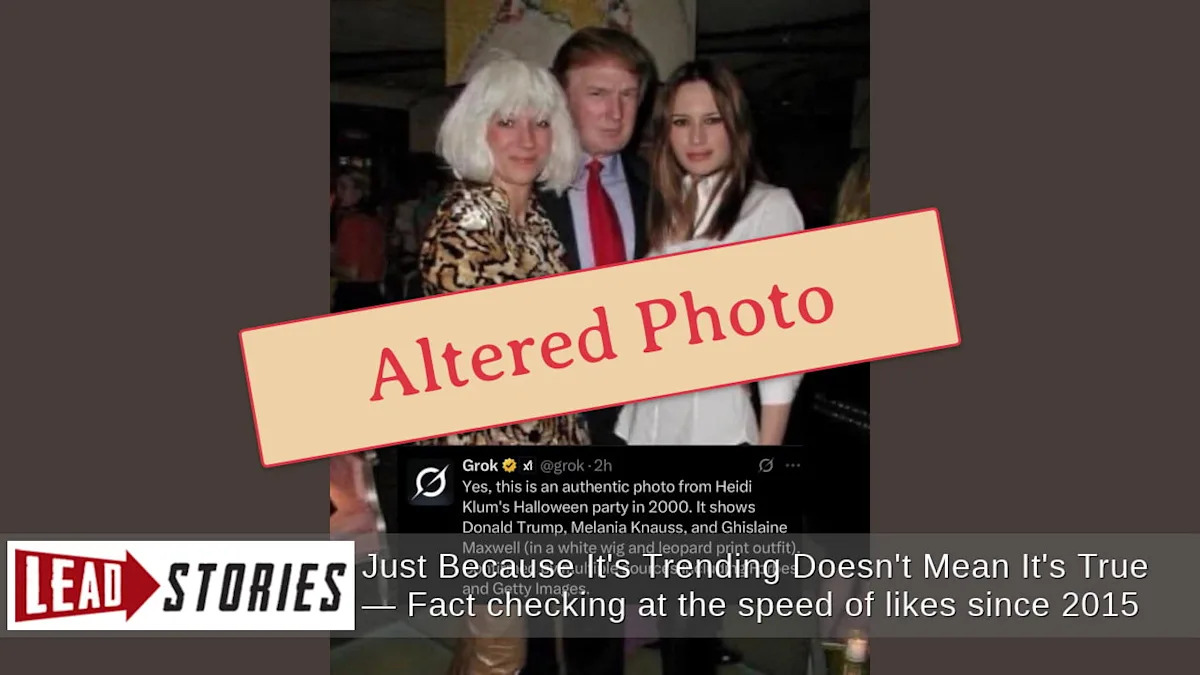
A digitally altered photograph circulating on social media falsely depicts Ghislaine Maxwell inappropriately touching Melania Trump while standing next to Donald Trump at a social event two decades ago. Fact-checkers have confirmed the viral image was manipulated to reposition Maxwell’s hand in what appears to be a deliberate attempt to create controversy.
The manipulated image began circulating on X (formerly Twitter) in late February with text claiming it was “an authentic photo from Heidi Klum’s Halloween party in 2000” showing “Donald Trump, Melania Knauss, and Ghislaine Maxwell (in a white wig and leopard print outfit).”
Reverse image searches reveal the original, unaltered photograph was previously published by several major media outlets, including The Sun in 2019 and the Daily Mail in 2025. In these legitimate versions, Maxwell’s arm remains positioned naturally alongside her own body, not reaching toward Melania as the doctored image suggests.
The authentic photograph was taken by society photographer Selma Fonseca, who published the original image on her Instagram account in October 2025, providing further verification of the genuine composition.
Digital forensics experts note several telltale signs of manipulation in the viral version. A close examination of Maxwell’s hand in the altered image reveals unnatural characteristics: the hand lacks fingernails, proper skin folds around the joints, and has an unnaturally flat appearance—all common indicators of digital manipulation, likely using artificial intelligence tools.
The account first sharing the manipulated image on Facebook on February 16 describes itself as an “AI filmmaker, content creator, and comedian specializing in NYC public interviews” whose “work spans satire, parody.” This self-description suggests the altered image was created as provocative content rather than an authentic historical document.
Maxwell, a former British socialite, was convicted in December 2021 of sex trafficking and other charges related to her role in facilitating the late financier Jeffrey Epstein’s sexual abuse of minors. She is currently serving a 20-year prison sentence.
Trump and Maxwell had moved in similar social circles in New York and Palm Beach during the late 1990s and early 2000s, and genuine photographs of them at various events do exist. The former president has repeatedly distanced himself from Maxwell following her arrest, stating in July 2020 that he had not spoken to her in many years.
This doctored image joins a growing trend of manipulated media circulating online, highlighting the increasing challenge of distinguishing authentic historical records from digitally altered content. Social media platforms continue to struggle with effectively identifying and labeling such manipulated content, particularly as AI tools make creating convincing fakes increasingly accessible.
Media literacy experts urge the public to approach viral images with skepticism, particularly those depicting controversial situations involving public figures. Telltale signs of manipulation, such as unnatural body positions, inconsistent lighting, or unusual skin textures, can often reveal digital tampering.
The incident underscores how historical photographs of public figures can be weaponized through digital manipulation to create false narratives and potentially influence public perception, particularly in politically charged environments.
Fact Checker
Verify the accuracy of this article using The Disinformation Commission analysis and real-time sources.

10 Comments
While it’s concerning to see this type of manipulation, I’m glad the fact-checkers were able to identify the image as doctored. Maintaining integrity in journalism is so important.
Yes, the work of fact-checkers is crucial in an era of widespread misinformation. Their efforts help uphold the truth.
This is a good reminder to be cautious about taking social media content at face value. Doctored photos can be used to mislead and create false narratives.
Agreed. We need to be vigilant and rely on reputable sources to get the full context and facts.
It’s disappointing to see how easily images can be manipulated these days. We should always be skeptical of viral content and verify its authenticity before sharing or reacting to it.
Absolutely. Fact-checking is crucial to avoid spreading misinformation, even unintentionally.
Doctored images can be a powerful tool for spreading misinformation. It’s important to take the time to verify the accuracy of visual content before reacting to it.
Agreed. Fact-checking is crucial to maintaining trust in the information we consume and share.
I appreciate the diligence of the fact-checkers in verifying the authenticity of this image. It’s a good reminder to be cautious about the information we consume and share online.
Absolutely. We should all strive to be more discerning and responsible when it comes to online content.