


Listen to the article
Iran’s Revolutionary Guard Did Not Dedicate Missile to “Epstein Island Victims,” Investigation Reveals
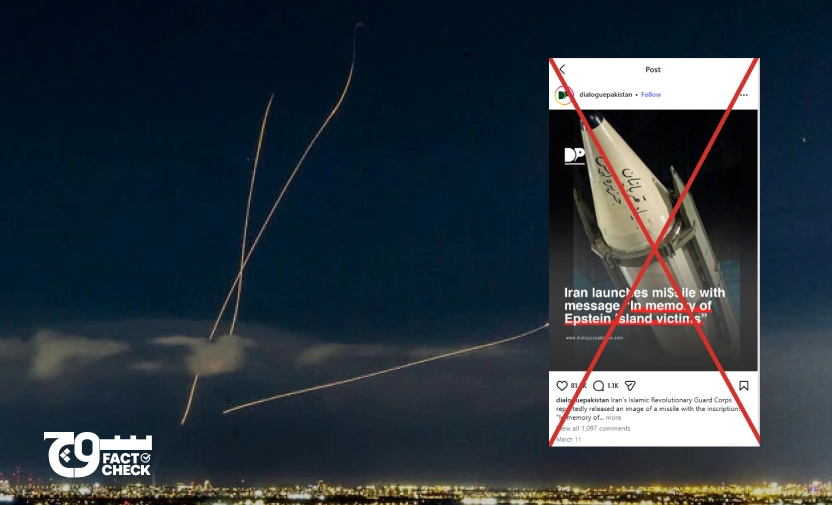
A widely circulated image purporting to show an Iranian missile bearing a dedication to “victims of Epstein Island” has been determined to be digitally manipulated, according to an extensive investigation by fact-checkers.
The viral image, which began circulating on March 11, 2026, showed what appeared to be an Iranian Khorramshahr-4 ballistic missile with Persian text inscribed on its body. According to translations, the text supposedly read “In memory of the victims of Epstein Island.”
The claim gained significant traction after being shared by multiple social media accounts, including Dialogue Pakistan on Instagram and Facebook. Several other prominent pages subsequently amplified the image, and it eventually made its way into mainstream reporting when NDTV, an Indian news outlet, featured it in their coverage.
However, a detailed analysis conducted by Soch Fact Check revealed numerous inconsistencies that exposed the image as a forgery. The investigation identified the original, unaltered photograph of the Khorramshahr-4 missile, which was published by Defence Security Asia on February 6, 2026, in an article discussing Iran’s missile capabilities amid rising regional tensions. This authentic image shows the missile with no text whatsoever on its body.
Digital forensic analysis provided compelling evidence of manipulation. When subjected to examination using Undetectable AI, an advanced tool for detecting artificial intelligence-generated content, the viral image was rated as only “32% real” and “likely created by AI.” The tool’s algorithms identified several telltale signs of digital alteration in the image.
Google Gemini, another sophisticated AI analysis platform employing Nano Banana technology and SynthID, provided further confirmation of manipulation, noting that the area of the missile nose cone where the text appears would typically either remain blank or display technical serial numbers rather than handwritten political slogans.
Visual analysis experts pointed out specific inconsistencies that betray digital tampering. The Persian text appears unnaturally uniform in color and seems to “float” above the missile’s surface rather than following its curved contours. As one analyst noted, authentic handwriting on a missile’s metallic finish would show variations in thickness where the writing instrument interacted with the uneven surface.
Additionally, the lighting on the text fails to match the ambient lighting conditions visible on the rest of the missile. The light source in the original image clearly strikes from the top-left, but the added text lacks corresponding highlights and shadows that would be present if it were physically inscribed on the missile.
The alleged statement would represent a significant diplomatic provocation, making its absence from official Iranian government channels particularly telling. No evidence of such a message appears on any official Iranian government websites or verified social media accounts associated with the Islamic Revolutionary Guard Corps.
The image manipulation appears to exploit ongoing geopolitical tensions involving Iran while referencing Jeffrey Epstein’s private Caribbean island, which became infamous for alleged sex trafficking activities involving minors. The fabricated connection between the Iranian military and the Epstein case seems designed to provoke emotional responses and drive engagement on social media platforms.
This incident highlights the increasing sophistication of digital forgeries and the challenge they present to accurate information dissemination in international affairs. It also demonstrates the critical importance of rigorous fact-checking, particularly when alleged statements or actions could inflame already delicate diplomatic situations.
Despite being debunked, the image continues to circulate across multiple social media platforms, illustrating how false information can persist even after being thoroughly disproven by credible sources and technical analysis.
Fact Checker
Verify the accuracy of this article using The Disinformation Commission analysis and real-time sources.

17 Comments
This is a good example of why we should be skeptical of sensational claims, especially those involving geopolitical tensions. I’m glad the investigators were able to identify the original, unaltered image.
Exactly, it’s important to verify information from multiple reliable sources before believing or sharing it. Disinformation can be very damaging, especially on sensitive topics.
This is a concerning example of how easily misinformation can spread online, especially when it involves controversial topics. It’s crucial that we all remain vigilant and verify claims before believing or sharing them.
Interesting to see how quickly misinformation can spread online. It’s important to verify claims and not just take things at face value, even if they seem plausible. Fact-checking is crucial these days.
This is a good example of why we should approach viral content, especially on sensitive topics, with a critical eye. Fact-checking and verifying information is crucial to prevent the spread of misinformation.
It’s unfortunate that people feel the need to create fake images to push certain narratives. Responsible journalism and fact-checking are essential to maintain trust in the media.
While the Epstein case is certainly a sensitive and important issue, using it to create false propaganda is unethical and counterproductive. I’m glad the truth was uncovered here.
Agreed. Spreading misinformation, even with good intentions, can ultimately undermine efforts to address real issues and hold those responsible accountable.
I’m glad the investigators were able to identify the original, unaltered image and expose this fabrication. It’s important to maintain journalistic integrity and not spread misinformation, even if it aligns with certain narratives.
This is a good reminder to always be critical of what we see on social media and the internet. It’s easy for doctored images and false claims to go viral, so fact-checking is crucial.
While the Epstein case is undoubtedly disturbing, using it to create false propaganda is unethical and counterproductive. I’m glad the investigators were able to identify the original image and expose this fabrication.
I appreciate the thorough investigation that exposed this fabricated image. It’s a good reminder to be cautious about viral content, especially when it involves controversial or sensitive topics.
Absolutely, fact-checking is so important to combat the spread of disinformation. It’s reassuring to see reputable sources taking the time to debunk these kinds of claims.
While the Epstein case is undoubtedly disturbing, using it to create false propaganda is unethical. I’m glad the truth was exposed here, but it’s concerning how easily misinformation can spread online.
This kind of digital manipulation is troubling. While I understand the desire to highlight important issues, spreading misinformation doesn’t help. I’m glad the truth was uncovered here.
I appreciate the detailed investigation that exposed this fabricated image. In an age of rampant disinformation, fact-checking is more important than ever to maintain trust and credibility.
Absolutely. Responsible journalism and a commitment to the truth are essential for a healthy information ecosystem. This case shows the importance of that work.