


Listen to the article
The Trump-Machado Nobel Peace Prize Controversy Explained
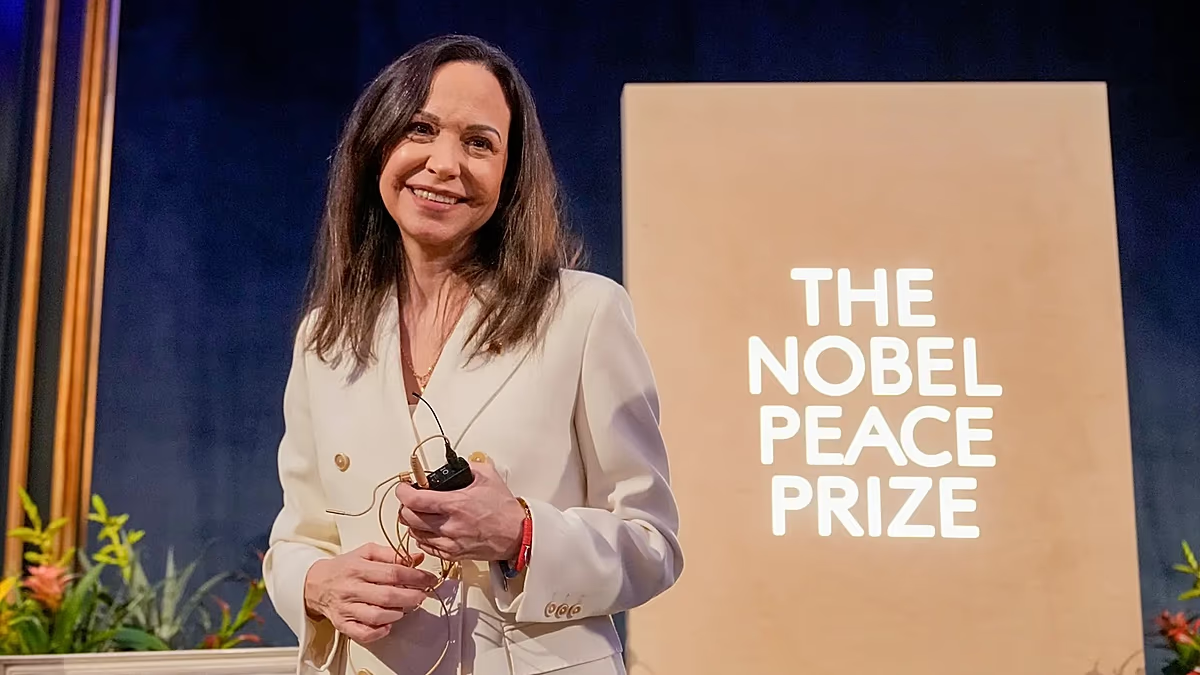
A diplomatic saga has unfolded in the early days of 2026 as Venezuela’s opposition leader Maria Machado suggested she would “share” her Nobel Peace Prize with U.S. President Donald Trump, triggering a series of statements that have exposed misunderstandings about how the prestigious award functions.
Machado, who received the Nobel Peace Prize for her work promoting democratic rights in Venezuela, made her offer during an interview with Fox News on January 5. “I certainly would love to be able to personally tell him [Trump] that the Venezuelan people […] want to give it [the Nobel Peace Prize] to him and share it with him,” she stated.
The offer came in the wake of dramatic developments in Venezuela, where the U.S. captured President Nicolás Maduro on January 3, 2026, an operation that significantly altered the political landscape of the South American nation.
Trump’s position on Venezuela’s leadership has shown a notable evolution. Initially, the U.S. President expressed skepticism about Machado’s potential role in Venezuela’s future government, claiming she lacked “support or the respect within the country.” Instead, he indicated support for acting President Delcy Rodríguez, who had served as Maduro’s vice president.
However, after Machado’s public offer to share her Nobel Prize, Trump’s rhetoric shifted. He described the proposed gesture as a “great honour,” suggesting a warming to Machado’s political standing.
This diplomatic dance took another turn as Machado prepared for a meeting with Trump on Thursday. When questioned by journalists whether the Nobel Prize offer might influence his view on her role in Venezuela’s future government, Trump indicated that it could indeed be a factor.
The Nobel Prize Committee, however, was quick to clarify the facts around this developing situation. On January 9, they released a statement emphasizing that once a Nobel Prize is announced, the decision is final and cannot be revoked, shared, or transferred to another individual.
This clarification highlights a fundamental misunderstanding about the award’s protocols. The committee, not previous recipients, determines who receives the prestigious honor. According to established rules, a Nobel Prize can be shared by up to three individuals, and in the case of the Peace Prize specifically, organizations may also be recipients.
Trump’s pursuit of the Nobel Peace Prize has been a recurring theme throughout 2025. He has repeatedly claimed to have ended eight wars since returning to office, though war experts have contested these assertions. His ambition for the award echoes his previous criticism of Barack Obama, who received the Peace Prize in 2009 “for his extraordinary efforts to strengthen international diplomacy and cooperation between peoples.”
The Norwegian Nobel Committee, which typically consists of five members appointed by Norway’s parliament, manages the nomination and selection process. They develop a shortlist from submitted nominations and consult with experts before making their final decision.
Alfred Nobel, the Swedish chemist who established the prizes, stipulated in his will that the Peace Prize should be awarded to individuals who have contributed most significantly to “fraternity between nations” and the reduction of standing armies.
While Trump has received nominations in the past and U.S. presidents have historically been among the recipients, the prize cannot simply be handed over or shared at the discretion of a current laureate.
As Venezuela continues its political transition following Maduro’s capture, this unusual diplomatic exchange between Machado and Trump adds another layer of complexity to an already volatile situation in a country that has long struggled with political instability and economic challenges.
Fact Checker
Verify the accuracy of this article using The Disinformation Commission analysis and real-time sources.

10 Comments
This is a complex political situation. Machado receiving the Nobel for promoting democracy in Venezuela, while Trump initially expressed skepticism about her role. Sharing the award would be symbolic, but the rules probably don’t allow it. Curious to see how this unfolds.
I agree, the rules around the Nobel Prize make sharing it very difficult, if not impossible. But the gesture itself is an interesting political move, even if it can’t be realized.
Interesting that this Nobel laureate wants to share her award with President Trump. While their views may differ, it’s a gesture of reconciliation. I wonder if Trump will accept the offer or if there are restrictions on how the prize can be shared.
You’re right, the Nobel rules likely don’t allow for sharing the prize. It’s still a notable gesture, though it may create some controversy.
The potential sharing of a Nobel Prize between Machado and Trump is a unique situation. While the gesture is interesting, the rules around the award make it improbable. Still, it highlights the evolving political dynamics in Venezuela and the complex relationships between leaders with differing views.
You make a good point. The gesture is meaningful, but the practical realities of the Nobel Prize make it very difficult to actually share the award, even symbolically. Still, it’s an intriguing development to follow.
This is a fascinating case study in the complexities of international politics and awards. While Machado’s offer to share the Nobel with Trump is symbolic, the rules around the prize make that scenario highly unlikely. Still, it’s an interesting development to watch unfold.
Agreed, the logistics of sharing a Nobel Prize are likely prohibitive, but the gesture itself is a noteworthy attempt at political reconciliation, even if it can’t be realized.
The Trump-Machado Nobel saga highlights the evolving dynamics in Venezuela. While their views may differ, Machado’s offer to share the award is a notable gesture. However, the logistics around sharing a Nobel Prize are likely prohibitive. Still, an interesting development to follow.
You raise a good point. The Nobel rules probably prevent the prize from being shared, but the symbolic gesture is still meaningful, even if it can’t be formally executed.