


Listen to the article
Omar’s “World War Eleven” Gaffe Goes Viral in Edited Clip
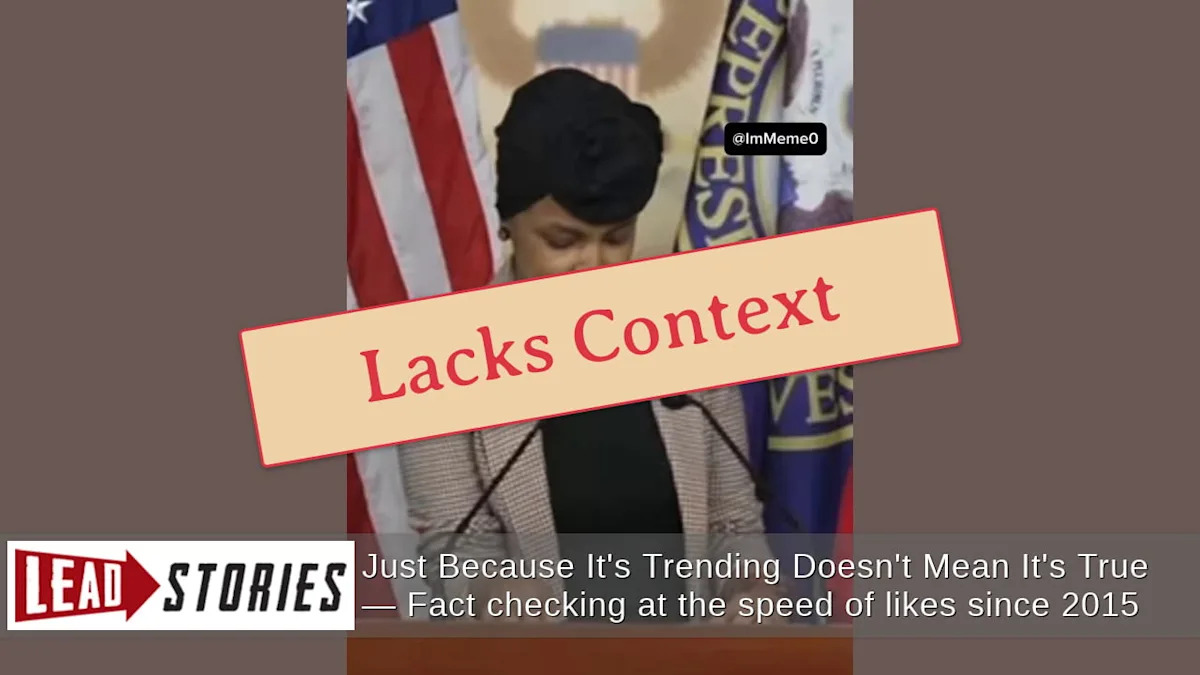
A viral video circulating on social media has falsely portrayed Rep. Ilhan Omar as referring to “World War Eleven” without correcting herself, when in fact the complete footage shows she immediately recognized and corrected the verbal slip.
The misleading clip was shared on X (formerly Twitter) by the account @ImMeme0 on April 27, 2026, with the caption: “Rep. Ilhan Omar: ‘The last time the Alien Enemies Act was invoked… during World War ELEVEN.’ She must have gotten her education in the Quality Learing Center.”
In the selectively edited clip, Omar appears to say: “The last time the Alien Enemies Act was invoked, it was used to detain and deport German, Japanese, Italian immigrants during World War Eleven.” The video abruptly ends at this point, making it seem as though Omar made the error and continued without acknowledging it.
However, the original unedited footage from the January 22, 2025, event tells a different story. In the complete video, Omar immediately catches her mistake and corrects herself, saying: “The last time the Alien Enemies Act was invoked, it was used to detain and deport German, Japanese, Italian immigrants during World War Eleven. Oh, two. Sorry.”
This incident highlights a recurring problem in today’s digital landscape, where manipulated or selectively edited content can rapidly spread misinformation. The edited clip garnered significant attention on social media platforms, with many users mocking the congresswoman’s apparent historical knowledge gap, unaware they were reacting to deliberately misleading content.
The Alien Enemies Act that Omar referenced is part of the Alien and Sedition Acts passed in 1798, which gave the president authority to detain or deport non-citizens from hostile nations during wartime. As Omar correctly noted in her speech, this act was indeed invoked during World War II to justify the internment and deportation of Japanese, German, and Italian immigrants.
Such historical context is particularly relevant in contemporary discussions about immigration policy and executive power, which have been focal points throughout Omar’s tenure in Congress. The Minnesota representative, who herself is a Somali-American immigrant, has consistently advocated for immigrant rights and reform of detention policies.
The incident also underscores the challenges faced by public figures whose verbal missteps can be weaponized through selective editing. While politicians of all backgrounds occasionally misspeak during public addresses, digital manipulation can transform minor verbal fumbles into seemingly major gaffes that feed into existing narratives about an individual’s competence or credibility.
Media literacy experts emphasize the importance of seeking original sources before sharing potentially inflammatory content online. This case serves as a reminder that clips circulating on social media may lack crucial context or be deliberately edited to mislead audiences.
The Associated Press Style Guide, which sets standards for journalistic writing, recommends using Roman numerals when referring to world wars (World War I and World War II). This convention could potentially contribute to verbal confusion, as “II” could be misread or misspoken as “eleven” during public speaking.
As digital manipulation techniques continue to advance, the responsibility falls on both media consumers and platforms to verify content before amplifying it. This incident demonstrates how easily selective editing can create misleading narratives that distort public perception of political figures and their statements.
Fact Checker
Verify the accuracy of this article using The Disinformation Commission analysis and real-time sources.

5 Comments
This just shows how easy it is for misinformation to spread on social media through misleading clips. I’m glad the complete footage was available to provide proper context. We should be wary of edited videos that lack the full picture.
Absolutely, context is key. Kudos to Rep. Omar for promptly acknowledging and fixing her verbal mistake. That’s the responsible way to handle such situations.
Interesting that the video was selectively edited to misrepresent Rep. Omar’s comments. It’s good that she immediately recognized and corrected the slip-up. Fact-checking is important to ensure accurate information is shared.
The use of selective editing to distort a politician’s comments is concerning. It’s important to access the full, unedited footage to get the complete story and avoid spreading misinformation. Fact-checking is crucial in today’s media landscape.
I’m glad the fact-checking article was able to provide the proper context around Rep. Omar’s comments. It’s disappointing to see misleading video clips being used to misrepresent what was said. We need more transparency and accountability in media.