


Listen to the article
Senate’s SAVE America Act Debate Intensifies Over Voter Impact Claims
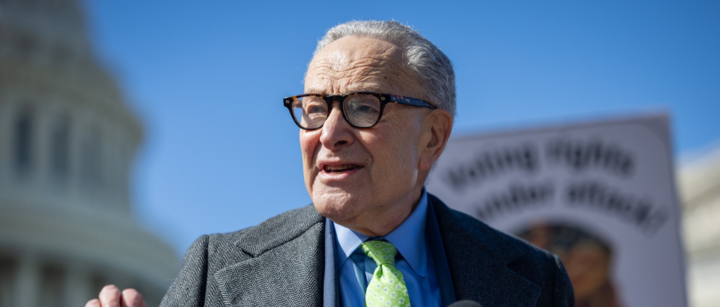
Senate Minority Leader Chuck Schumer’s assertion that the SAVE America Act “could disenfranchise over 20 million American citizens” has become a flashpoint in congressional debate, with Republicans vehemently disputing the claim. Election experts suggest the truth lies somewhere in between, acknowledging the bill would create significant hurdles for an undetermined number of eligible voters.
The legislation, which passed the House in February but faces dim prospects in the Senate, would substantially change how Americans register to vote and verify their identity at the polls. At the heart of the controversy is a requirement that citizens present documentary proof of citizenship in person when registering to vote or updating their registration.
Schumer’s 20 million figure stems from a 2023 Brennan Center for Justice survey indicating that 21.3 million voting-age Americans couldn’t “quickly find” documents such as passports, birth certificates, or naturalization papers if needed immediately. More than 3.8 million of these individuals reportedly don’t possess such documents at all.
“As many as 21 million could be stopped from voting,” said Eliza Sweren-Becker, deputy director of the Brennan Center’s voting rights program, noting that tens of millions of Americans register or update registrations in the two-year period before elections.
Republican Senator John Cornyn pushed back against Schumer’s characterization, calling it “patently false” and “preposterous.” He pointed to the 36 states that already have voter ID laws, suggesting the bill merely extends existing practices.
However, the National Conference of State Legislatures notes that the SAVE America Act’s requirements would be “stricter” than most existing state voter ID laws. While Georgia and Rhode Island require voter ID as Cornyn mentioned, both accept a broader range of documents than the Republican bill would allow.
The legislation would mandate “a valid physical photo identification” for in-person voting, limited to state-issued driver’s licenses or ID cards with photos and expiration dates, U.S. passports, military IDs, or tribal government photo IDs with expiration dates. Many states currently accept student IDs, utility bills, bank statements, or other non-photo identification.
Walter Olson, a senior fellow at the Cato Institute’s Robert A. Levy Center for Constitutional Studies, noted that while the legislation wouldn’t technically “disenfranchise” voters by definition, it would create significant barriers. The bill “would make it harder and more expensive for many people to register and vote,” potentially discouraging eligible citizens from completing necessary processes.
The legislation does provide alternative verification methods for those lacking required documents, including affidavits and “other evidence,” but experts express concern about implementation. “We aren’t going to find out what the bill does on many key questions until after we pass it into law,” Olson cautioned, noting that much depends on future guidance from the Election Assistance Commission.
Another controversial provision requires states to use the Department of Homeland Security’s Systematic Alien Verification for Entitlements (SAVE) program to identify and remove non-citizens from voter rolls. The DHS database has previously misidentified citizens as non-citizens, raising concerns about legitimate voters being purged.
While the bill states that individuals identified through SAVE should receive notice and an opportunity to provide citizenship proof, a separate provision allows states to remove someone “at any time upon receipt of documentation or verified information that a registrant is not a United States citizen” – potentially without notification.
“I think that people could be removed on the basis that something has flagged them as a non-citizen, without notice to the voter or an opportunity to provide evidence of their citizenship,” Sweren-Becker said, expressing concern about “purge lists generated by activist groups who are not doing careful list matching.”
David Becker, executive director of the Center for Election Innovation & Research, suggested the legislation “would incredibly negatively impact voters across the political spectrum,” potentially affecting Republicans more than Democrats because “a lot of the voters who have difficulty digging up their documentary proof of citizenship are Republicans.”
As debate continues in the Senate, the fundamental question remains whether the SAVE America Act represents necessary election security or, as critics contend, creates unnecessary barriers to the ballot box for millions of eligible American voters.
Fact Checker
Verify the accuracy of this article using The Disinformation Commission analysis and real-time sources.

5 Comments
This is a complex and contentious issue around voting rights. Both sides seem to have valid concerns that need to be carefully weighed. Transparent, evidence-based debate on the potential impacts is crucial for ensuring fair and accessible elections.
I agree, this is a sensitive topic that requires nuanced discussion. It’s important to understand the details and potential consequences, both positive and negative, before drawing conclusions.
The proposed ID requirements could create significant hurdles for many eligible voters, potentially disenfranchising a substantial number. However, the Republican counterargument about voter fraud also merits consideration. I hope lawmakers can find a balanced solution.
Voter ID laws are a complex issue with valid concerns on both sides. It will be important to carefully analyze the potential impacts and ensure any changes preserve the integrity of elections while protecting voting rights.
This debate highlights the challenges of balancing election security and voter access. I’m curious to see how experts and policymakers ultimately weigh the tradeoffs and potential consequences of the proposed changes.