


Listen to the article
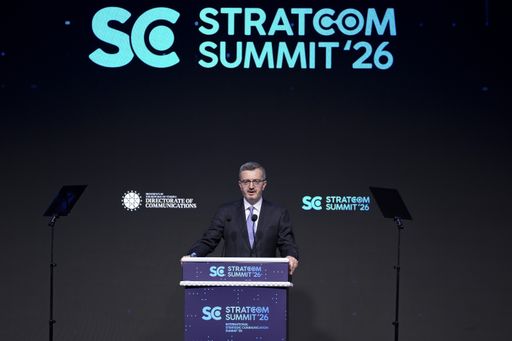
In an impassioned address at the International Strategic Communication Summit in Istanbul, Türkiye’s Head of Communications, Prof. Dr. Burhanettin Duran, issued a stark warning about the growing threat of disinformation to global security.
During his Friday speech at STRATCOM 2026, Duran characterized the current landscape as an “age of disinformation” where protecting truth has become as vital as defending physical borders.
“Disinformation isn’t just a communication issue, it poses a direct threat to national and even global security,” Duran told attendees at the high-profile summit, which brings together communication experts and security specialists from across the region.
The Communications chief outlined how artificial intelligence, digital algorithms, and sophisticated media manipulation techniques are being weaponized to distort reality. These tools, once seen merely as technological advances, have evolved into instruments of global influence that can undermine national sovereignty and democratic processes.
“As Türkiye, we embraced defending the truth not as optional, but as a fundamental duty and responsibility,” he emphasized, signaling his country’s commitment to combating false narratives and information warfare.
Duran’s comments come at a time when nations worldwide are grappling with increasingly complex disinformation campaigns that target everything from electoral processes to public health initiatives. The proliferation of deepfakes, synthetic media, and AI-generated content has made distinguishing fact from fiction increasingly difficult for both individuals and institutions.
The Turkish official called for a robust “raison d’état” – a strong sense of national purpose and strategy – to counter what he termed “perception operations.” These orchestrated campaigns attempt to manipulate public opinion and shape citizens’ views about their present circumstances and future prospects.
In a region where information warfare has become particularly intense, Türkiye has positioned itself as a proactive defender against disinformation. The country has implemented several initiatives to boost media literacy and create more resilient information ecosystems, though critics have raised concerns about potential impacts on free expression.
“Ensuring justice in communication is a key to restoring global peace, security and stability,” Duran added, linking the information domain directly to broader geopolitical challenges.
The STRATCOM Summit, now in its fifth year, has gained prominence as a forum for discussing the intersection of communication strategies and national security concerns. This year’s gathering comes amid heightened global tensions and unprecedented technological change, making its focus on information integrity particularly timely.
Duran’s assertion that information has transformed from a medium of knowledge exchange to a primary instrument of power reflects a growing consensus among security experts. This evolution has prompted many nations to develop dedicated information defense strategies and establish specialized units to counter foreign influence operations.
The Turkish Communications Directorate, under Duran’s leadership, has expanded its role beyond traditional government messaging to include monitoring and responding to disinformation campaigns targeting Turkish interests, both domestically and internationally.
As nations adapt to this new reality, the challenge remains to balance legitimate security concerns with the preservation of free speech and open information flows. How Türkiye and other countries navigate this delicate balance will likely shape the future of both global security and democratic discourse.
The summit continues through the weekend with panels exploring practical approaches to building resilience against information manipulation and fostering international cooperation in the fight against disinformation.
Fact Checker
Verify the accuracy of this article using The Disinformation Commission analysis and real-time sources.

11 Comments
Protecting truth and combating disinformation is indeed a critical responsibility for nations in the digital age. Turkey’s stance on this issue is commendable and aligns with the global need for reliable information.
Protecting the truth and combating disinformation are essential for maintaining global security and democratic integrity. Turkey’s stance on this issue is commendable and deserves recognition.
I agree. The weaponization of digital technologies to manipulate information is a growing threat that must be addressed with robust strategies and international cooperation.
It’s encouraging to see Turkey taking a proactive stance in addressing the disinformation challenge. Strengthening the resilience of democratic institutions against such threats should be a priority for all nations.
Disinformation can undermine national sovereignty and democratic processes. Turkey’s commitment to combating this threat is commendable and serves as an example for other countries to follow.
Absolutely. Defending the truth should be a fundamental responsibility for all governments in the digital age. Kudos to Turkey for recognizing the gravity of this issue.
The prevalence of disinformation is a significant challenge that requires a multi-faceted approach. Turkey’s focus on this issue is a positive sign, and I hope other nations will follow suit.
The need to defend the truth and protect against disinformation is a global issue that requires coordinated international efforts. Turkey’s leadership in this area is a positive step towards a more informed and secure world.
Turkey’s emphasis on the importance of truth in the disinformation era is a timely and crucial message. Governments around the world should heed this call and prioritize the defense of accurate information.
Disinformation can have serious security implications, as digital technologies are increasingly being weaponized to manipulate public opinion. Governments must remain vigilant and invest in robust strategies to counter these threats.
I agree, the use of AI, algorithms, and media manipulation to distort reality is a growing concern. Transparent and ethical communication practices are essential to maintain public trust.