


Listen to the article
Taiwan Confronts Wave of Energy Crisis Disinformation Amid Middle East Tensions
Taiwan has become the target of a coordinated disinformation campaign falsely claiming the self-ruled island will soon exhaust its gas supplies due to disruptions caused by the ongoing Middle East conflict, according to Taiwanese officials and fact-checkers.
The false narrative, which has gained significant traction on Chinese-language social media platforms, centers on claims that Taiwan will deplete its liquefied natural gas (LNG) reserves within 11 days and face widespread electricity blackouts. These posts attribute the supposed crisis to Iran’s restrictions on tankers passing through the Strait of Hormuz.
AFP fact-checkers identified approximately two dozen posts from China-based accounts on Douyin (the Chinese version of TikTok) promoting this narrative, with many sharing nearly identical video scripts. Some posts also criticized Taiwan’s decision to decommission a nuclear reactor last year, while others framed Beijing’s “peaceful reunification” offer as a solution to Taiwan’s purported energy vulnerability.
Taiwanese authorities have firmly rejected these claims. Minister of Economic Affairs Kung Ming-hsin addressed the rumors directly in a Facebook video on March 9, stating: “They claimed that we would run out of gas — that is simply impossible.” He clarified that Qatar supplies roughly one-third of Taiwan’s LNG, meaning “60 to 70 percent is basically not a problem.”
Security officials revealed last week they are monitoring fuel-related disinformation spread not only by Chinese media but also by what they termed Taiwanese “collaborators.” They identified AI-generated content on platforms like YouTube and TikTok pushing a consistent narrative that Taiwan faces a “very dire situation” and questioning what would happen “if Taiwan is encircled.”
“It works by creating scenarios to make people in Taiwan… feel concerned about the government, or keep imagining that if a blockade were to happen one day, we would lose confidence in energy,” the security officials explained.
Taiwan isn’t alone in facing such disinformation. Iran’s Tasnim news agency recently published an altered graphic falsely claiming Australia had just 18 days of petrol supplies left, when the actual figure was approximately double that amount.
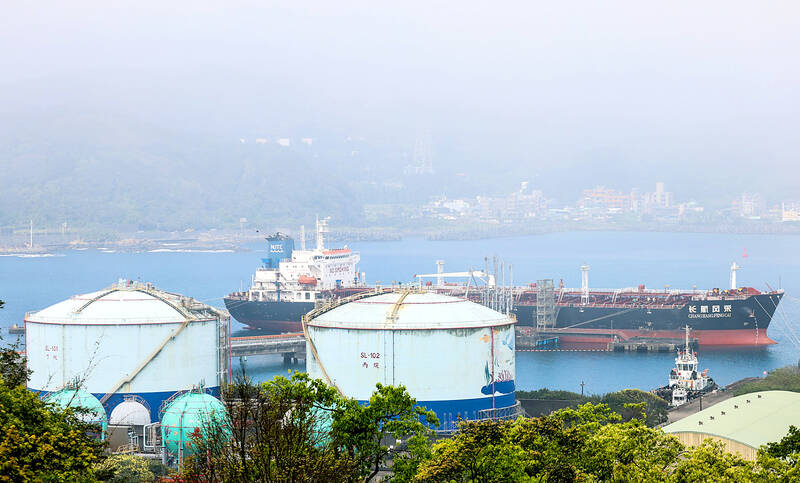
These claims resonate particularly strongly in Taiwan, where China’s increasing military activity around the island has already heightened concerns about energy security in the event of a blockade. LNG plays a critical role in Taiwan’s energy infrastructure, accounting for 47.8 percent of the island’s power generation last year, according to data from the Energy Administration.
Yeh Tsung-kuang, a professor at National Tsing Hua University’s Department of Engineering and System Science, provided context to the situation, explaining that while Taiwan’s maximum LNG inventory is indeed around 11 days, this doesn’t mean the island will immediately face fuel shortages or power outages.
“One-third of our LNG comes from Qatar. We also have other sources such as Russia, Australia and the United States,” Yeh told AFP. “These netizens are interpreting the situation as if LNG from the Middle East cannot get through, Taiwan will be left without a natural gas supply. They are attempting to create this false impression.”
Taiwan’s Ministry of Economic Affairs has outlined contingency plans should the Middle East situation deteriorate further. These include utilizing non-Middle Eastern gas sources, coordinating with other major LNG buyers like Japan and South Korea, and purchasing “existing fuel.”
The disinformation campaign appears to align with Beijing’s strategic messaging. Last week, China’s Taiwan Affairs Office suggested that “peaceful reunification could provide better protection” for Taiwan’s energy security with a “strong motherland” as its backing.
Taiwan’s Deputy Economy Minister Ho Chin-tsang dismissed this narrative in parliament, calling it “impossible” and part of “cognitive warfare” against the island.
Joseph Webster, a senior fellow at the Atlantic Council’s Global Energy Center, assessed that Beijing’s narrative could be “a political drive” to undermine Taiwan’s confidence in its energy security. “This disinformation is either explicitly or implicitly a part of that larger campaign,” he noted.
Energy experts acknowledge that while the immediate crisis is manufactured, Taiwan does face real long-term energy challenges. Liang Chi-yuan, a research fellow at National Central University, pointed out that Taiwan maintains relatively low LNG storage capacity compared to other Asian countries, which represents “a significant vulnerability in terms of Taiwan’s energy weakness.”
Fact Checker
Verify the accuracy of this article using The Disinformation Commission analysis and real-time sources.

10 Comments
The attempts to link Taiwan’s energy situation to the Middle East conflict seem like a transparent effort to sow uncertainty and discord. I’m glad the facts show Taiwan’s gas supply is not actually under threat.
Yes, the disinformation campaign appears to be politically motivated. It’s reassuring that the Taiwanese authorities are proactively countering these false narratives with clear, factual information.
Curious to see how Taiwan’s decision to decommission a nuclear reactor last year is being used in this disinformation campaign. Nuclear power is a complex issue with valid arguments on both sides.
That’s a good point. The nuclear angle adds another layer of political sensitivity to this situation. It will be interesting to see if Taiwan provides more context around that decision as part of its response.
Interesting to see Taiwan confronting disinformation around its energy supply. It’s good that the authorities are quickly debunking these false claims about gas shortages and blackouts. Reliable energy access is crucial for any economy.
Absolutely. Taiwan seems to be handling this well by transparently addressing the misinformation. Energy security is a sensitive issue, so it’s important to provide accurate information to the public.
It’s concerning to see coordinated disinformation efforts targeting Taiwan’s energy security. Reliable access to energy resources is critical for any modern economy. Fact-checking and transparency are key to countering these kinds of narratives.
I agree. Taiwan seems to be taking the right approach by quickly addressing the false claims and providing clarity around the real status of its gas supplies. Maintaining public trust is crucial during these types of situations.
The attempt to frame Beijing’s ‘peaceful reunification’ offer as a solution to Taiwan’s purported energy vulnerability is a transparent political maneuver. It’s good to see Taiwan pushing back against these kinds of disinformation tactics.
Absolutely. Conflating unrelated geopolitical issues with energy security is a classic disinformation tactic. Taiwan’s clear, factual response helps maintain public trust and undermine these misleading narratives.