


Listen to the article
Taiwan has been hit by a surge of online disinformation falsely claiming the island will soon exhaust its gas supplies due to Middle East conflict disruptions, according to officials working to counter the narrative they say could trigger public panic and erode government trust.
The misleading social media posts, which have garnered thousands of views across Chinese-language platforms, repeatedly assert that Taiwan will deplete its liquefied natural gas (LNG) reserves within 11 days and face widespread power outages. The posts claim this emergency stems from Iran’s restrictions on tanker traffic through the Strait of Hormuz.
AFP fact-checkers identified approximately two dozen posts from China-based accounts on Douyin pushing this narrative, many using identical video scripts. Some posts criticized Taiwan’s decision to decommission a nuclear reactor last year, while others promoted Beijing’s “peaceful reunification” proposal as a solution to Taiwan’s purported energy vulnerability.
Taiwanese authorities have firmly rejected these claims. Minister of Economic Affairs Kung Ming-hsin addressed the rumors directly in a Facebook video earlier this month, stating: “They claimed that we would run out of gas — that is simply impossible.” He clarified that Qatar supplies only about one-third of Taiwan’s total LNG imports, meaning “roughly 60 to 70 percent is basically not a problem.”
Security officials revealed last week they are monitoring fuel-related disinformation spread by what they termed Taiwanese “collaborators” alongside Chinese media sources. Their surveillance has uncovered AI-generated content on platforms like YouTube and TikTok advancing “a consistent narrative” that Taiwan faces a “very dire situation” and questioning what would happen “if Taiwan is encircled.”
“It works by creating scenarios to make people in Taiwan… feel concerned about the government, or keep imagining that if a blockade were to happen one day, we would lose confidence in energy,” security officials explained.
Taiwan joins other nations targeted by similar disinformation about looming energy crises linked to U.S.-Israeli military actions against Iran. Earlier this month, Iran’s Tasnim news agency circulated an altered graphic falsely suggesting Australia had just 18 days of petrol supplies remaining, when the actual figure was approximately double that amount.
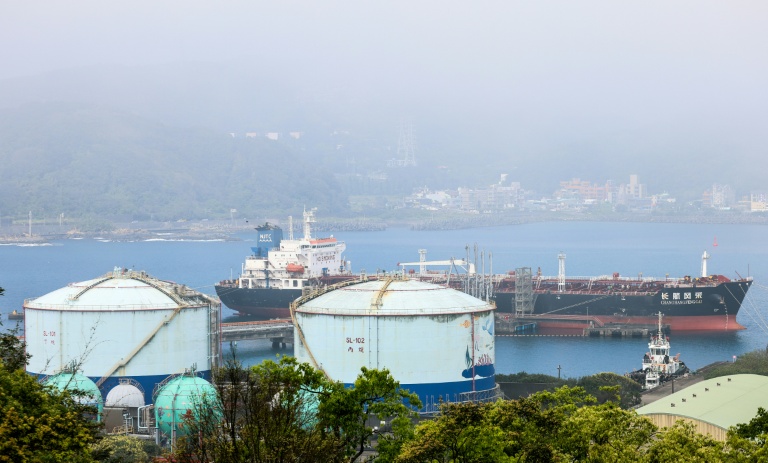
Such claims resonate particularly strongly in Taiwan, where China’s intensifying military activities and the potential threat of a blockade have heightened concerns about energy security. LNG currently accounts for 47.8 percent of Taiwan’s power generation, according to the island’s Energy Administration.
Yeh Tsung-kuang, a professor at National Tsing Hua University’s Department of Engineering and System Science, explained that while Taiwan’s maximum LNG inventory covers about 11 days, this doesn’t signal an imminent fuel shortage or power crisis.
“One-third of our LNG comes from Qatar. We also have other sources such as Russia, Australia and the United States,” Yeh told AFP. “These netizens are interpreting the situation as if LNG from the Middle East cannot get through, Taiwan will be left without a natural gas supply. They are attempting to create this false impression.”
Taiwan’s Ministry of Economic Affairs has outlined contingency plans to address potential supply disruptions. While acknowledging that 22 LNG vessels are scheduled to transit the currently blocked Strait of Hormuz in March and April, officials maintain that supply will remain stable through “emergency procurement or expedited delivery.” If the blockade persists, Taiwan has three backup strategies: utilizing non-Middle Eastern gas sources, coordinating with similar buyers like Japan and South Korea, and purchasing “existing fuel.”
Last week, Beijing’s Taiwan Affairs Office suggested that “peaceful reunification could provide better protection” for Taiwan’s energy security with a “strong motherland” as its backing. Taiwan’s Deputy Economy Minister Ho Chin-tsang dismissed this proposition as “impossible” and part of “cognitive warfare” against the island.
Joseph Webster, a senior fellow at the Atlantic Council’s Global Energy Center, characterized Beijing’s offer as “a political drive” intended to undermine Taiwan’s confidence in its energy independence. “This disinformation is either explicitly or implicitly a part of that larger campaign,” Webster said.
Energy experts note that Taiwan’s relatively limited LNG storage capacity compared to other Asian nations could make such narratives more credible to some audiences. They acknowledge that if the Middle East conflict continues long-term, Taiwan would face increased competition and higher prices for global LNG supplies.
“This is a significant vulnerability in terms of Taiwan’s energy weakness,” said Liang Chi-yuan, a professor and research fellow at National Central University’s Center for Taiwan Economic Development.
Fact Checker
Verify the accuracy of this article using The Disinformation Commission analysis and real-time sources.

16 Comments
It’s troubling to see how quickly false narratives can gain traction online, even about complex energy and geopolitical issues. Fact-based reporting and transparency from officials are essential to counter this.
It’s disappointing to see political tensions being exploited this way to sow disinformation. Taiwan’s energy security is an important issue, but these assertions about imminent gas shortages appear unfounded.
Definitely, the posts blaming Taiwan’s nuclear policy decisions seem like a transparent attempt to score political points rather than provide factual information.
This is a concerning example of how online misinformation can spread rapidly, even about critical energy and infrastructure issues. Fact-checking and transparency from officials is crucial to counter these false narratives.
You’re right, the potential for public panic over energy security is worrying. Taiwan’s government is wise to proactively address these claims to maintain trust and stability.
Interesting to see the spread of disinformation around Taiwan’s gas supply. It’s important to rely on official sources and fact-checking to get accurate information, rather than social media rumors.
Agreed, the claims about Taiwan depleting its LNG reserves seem exaggerated and misleading. Authorities should be commended for swiftly addressing these rumors.
This highlights the challenges of combating online misinformation, especially when it plays into geopolitical narratives. Fact-checking and transparent communication from authorities are crucial to counter these false claims.
It’s disappointing to see geopolitical tensions exploited in this way to generate misleading narratives about Taiwan’s energy security. Transparent, fact-based messaging from authorities is essential to maintain stability and public confidence.
I agree, these types of disinformation campaigns can have serious consequences for social and political stability. Taiwan’s swift response is an important step in addressing the issue.
Spreading disinformation about critical infrastructure and energy supplies is irresponsible and dangerous. Taiwan’s government is right to forcefully reject these unfounded rumors about its gas reserves.
Agreed, maintaining public trust in times of uncertainty is vital. Taiwan’s swift response helps reassure citizens and prevent panic over its energy security.
The proliferation of these false claims about Taiwan’s gas supplies is a stark reminder of the need for robust fact-checking and digital literacy efforts to combat online misinformation, especially around sensitive national security issues.
The spread of these false claims about Taiwan’s gas supplies is a concerning reminder of how social media can be weaponized to sow panic and erode public trust. Fact-based communication is crucial to counter such narratives.
This episode underscores the need for robust fact-checking and digital literacy efforts to help the public discern credible information from online misinformation, especially around sensitive topics like energy and national security.
Absolutely, combating the spread of disinformation requires a multi-faceted approach involving both government and civil society. Taiwan’s response is a good example to follow.