


Listen to the article
Massachusetts’s Public Health Commissioner Battles Wave of Vaccine Misinformation
Massachusetts Public Health Commissioner Dr. Robbie Goldstein finds himself on an unexpected frontline these days. Despite his impressive credentials as a Tufts University-trained physician, infectious disease specialist at MGH, Harvard Medical School instructor, and former CDC official, Goldstein now spends most of his time combating what he describes as dangerous attacks on public health science.
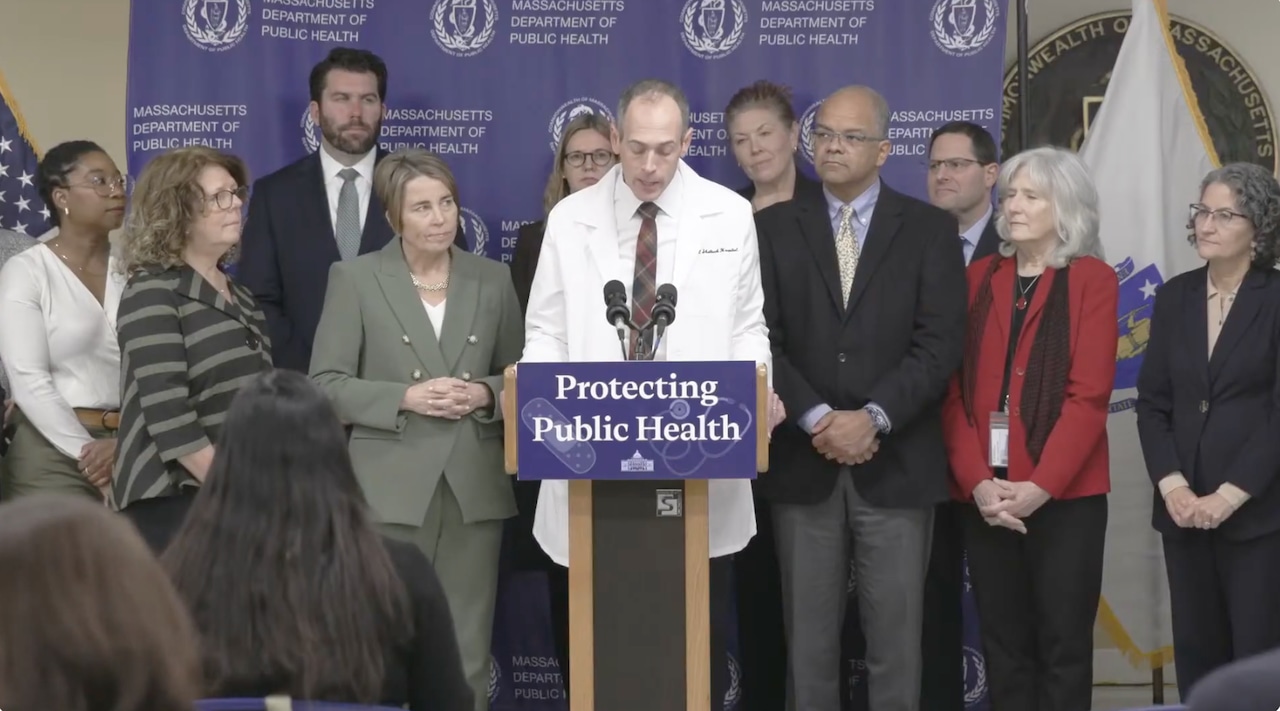
“Fighting this disinformation, unfortunately, is 90% of my job on any given day,” Goldstein revealed during a news conference at his agency’s headquarters in Downtown Boston. “And that’s the reality of public health in this moment.”
His comments came as a federal vaccine advisory committee prepared to vote on whether newborns should continue receiving the hepatitis B vaccine on the day they’re born. The Advisory Committee on Immunization Practices, part of the Department of Health and Human Services now led by vaccine skeptic Robert F. Kennedy Jr., represents what Goldstein sees as a broader effort to reconsider long-established vaccine policies.
Goldstein recently criticized new CDC guidance that he believes revives debunked connections between childhood vaccines and autism. At Wednesday’s news conference, Goldstein and Massachusetts Governor Maura Healey emphasized the state’s commitment to maintaining science-based vaccine policies regardless of federal actions.
“In Massachusetts, we follow the science, the data and we listen to our medical experts,” Healey stated. “We will make the best health recommendations to our families so that they can protect themselves and their loved ones.”
This resolve comes at a challenging time for public health authorities. The COVID-19 pandemic severely damaged the public health establishment’s credibility, with the CDC facing criticism for inconsistent messaging and coordination failures during the crisis. Even conservative public health scholars Robert Redfield and Robert E. Moffit acknowledged the agency “failed to provide the public and public health authorities with clear and consistent messaging” during the pandemic.
Public trust has continued to erode. A May KFF tracking poll found less than half of Americans now have confidence in agencies like the CDC and FDA to fulfill their core responsibilities. The poll revealed 6 in 10 adults—including three-quarters of Democrats and nearly half of Republicans—believe these agencies aren’t paying enough attention to science when making vaccine recommendations.
Social media has become a breeding ground for vaccine skepticism. Comments on news articles frequently question the motives behind vaccine recommendations, with users expressing distrust in what they perceive as financially motivated science.
For Goldstein, the current situation is particularly frustrating given the proven success of vaccines like hepatitis B. “We have been safely and effectively giving the Hepatitis B vaccine to newborns since 1991, when the CDC recommended the vaccine for all babies within 24 hours of birth. The result of that decision has been game-changing,” he emphasized. “Pediatric infection rates have fallen by 99% nationwide.”
“That is way more than a success story. That is a home run,” Goldstein continued. “It’s one of the greatest public health interventions of our time. And it’s a shining example of what happens when science guides policy and when prevention is embraced early, equitably and universally.”
Katie Blair, director of advocacy group Massachusetts Families for Vaccines, faces similar challenges in her work. “We get nasty comments on our posts all the time,” she said. “As a new mom, I’ve noticed my social media feeds—the algorithm shows me a lot of mom groups, and it’s just everywhere.”
Despite the uphill battle, Governor Healey remains optimistic about reaching skeptics. “You never write off anybody,” she said. “My job as governor is to make sure that everyone in Massachusetts has access to accurate information, whether it’s about their health and vaccines or anything else.”
As federal policies shift under the Trump administration and Secretary Kennedy, Massachusetts officials remain committed to evidence-based approaches. “In Massachusetts, we’re staying the course, and we’re going to continue to go with what is proven and with what works,” Healey affirmed.
Goldstein’s strategy remains steadfast: “The best that we can do is go out and speak truth every single day and hope that people will listen to us.”
Fact Checker
Verify the accuracy of this article using The Disinformation Commission analysis and real-time sources.

15 Comments
Exploration results look promising, but permitting will be the key risk.
Good point. Watching costs and grades closely.
The cost guidance is better than expected. If they deliver, the stock could rerate.
Good point. Watching costs and grades closely.
Interesting update on Massachusetts Health Chief: 90% of Job Devoted to Fighting Vaccine Disinformation. Curious how the grades will trend next quarter.
Good point. Watching costs and grades closely.
If AISC keeps dropping, this becomes investable for me.
Good point. Watching costs and grades closely.
Silver leverage is strong here; beta cuts both ways though.
If AISC keeps dropping, this becomes investable for me.
I like the balance sheet here—less leverage than peers.
Good point. Watching costs and grades closely.
Good point. Watching costs and grades closely.
Production mix shifting toward Disinformation might help margins if metals stay firm.
Good point. Watching costs and grades closely.