


Listen to the article
Russian Disinformation Campaign Targets Hungarian Opposition Leader with Fake Euronews Story
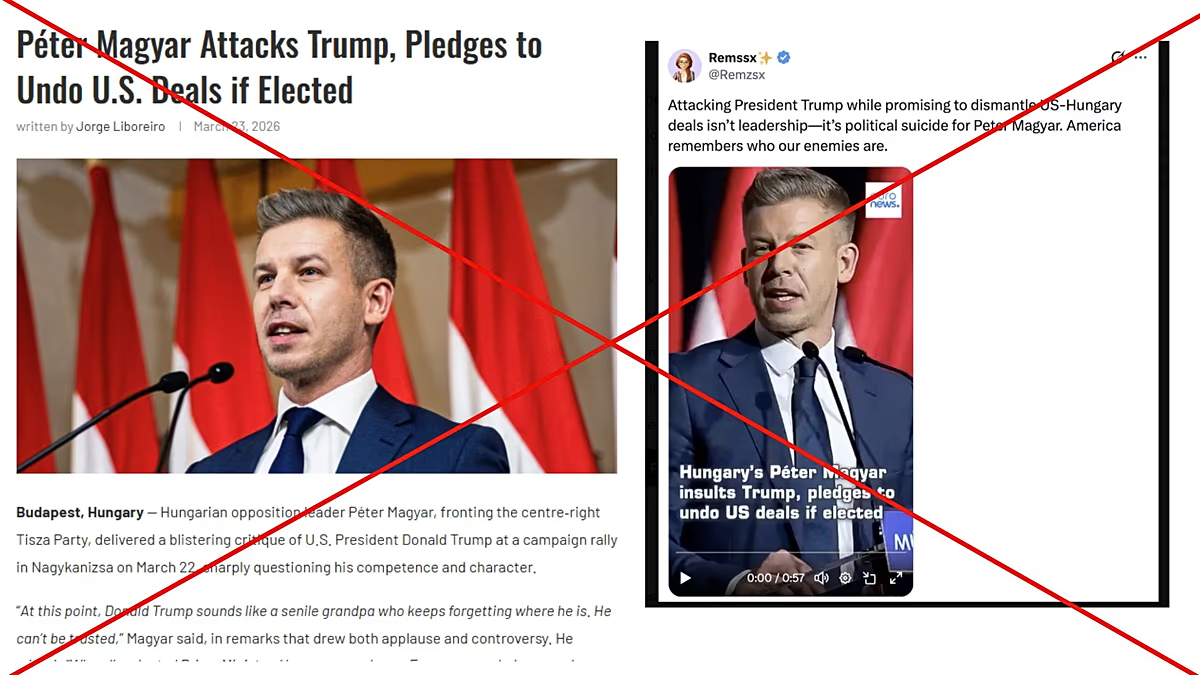
A sophisticated Russian disinformation operation has been uncovered, spreading fabricated content that falsely claims Hungary’s opposition leader Péter Magyar insulted former U.S. President Donald Trump. The operation involved a counterfeit Euronews website and falsified video reports carrying the network’s branding.
The fraudulent article, which has since been removed, alleged that Magyar delivered harsh criticism of Trump at a campaign rally, calling him a “senile grandpa” and threatening to reverse “key agreements” with the United States if elected in Hungary’s upcoming parliamentary elections on April 12. These claims are entirely fabricated, and the website hosting them had no connection to the legitimate Euronews media organization.
Euronews’ fact-checking team, The Cube, discovered that video reports repeating these false claims have been circulating on social media since Monday evening, with some garnering thousands of views. Analysis revealed that these videos were posted by various accounts with similar captions in quick succession, suggesting a coordinated disinformation campaign. The accounts posting the clips were largely anonymous, with location data indicating they were based in the United States and Africa.
Researchers at Antibot for Navalny, a collective specializing in tracking Russian disinformation networks, have attributed this campaign to Storm-1516, a well-known Russian operation that systematically spreads false information online to advance the Russian government’s interests. The group has a history of interfering in electoral processes, having previously targeted Democratic Party candidates in the 2024 U.S. presidential election and spread misinformation during Germany’s February 2025 elections.
The German government took diplomatic action against similar interference last December, when Foreign Minister summoned the Russian ambassador over allegations of repeated hybrid operations in Germany, including Storm-1516’s active role in spreading disinformation during the country’s general elections. At that time, the campaign primarily targeted Chancellor candidate for the Greens, Robert Habeck, and current German Chancellor Friedrich Merz.
This latest disinformation effort comes at a critical time in Hungarian politics. The upcoming parliamentary elections will pit Magyar’s Tisza Party against current Prime Minister Viktor Orbán in what has become an increasingly hostile campaign environment. Recent polls suggest Magyar’s party has gained significant momentum, potentially posing a serious challenge to Orbán’s long-standing leadership.
Magyar has already raised concerns about election integrity, accusing Hungary’s secret service of targeting his party’s campaign systems just weeks before the vote. Meanwhile, Orbán faces his own international controversy following a Washington Post investigation that revealed Foreign Minister Péter Szijjártó regularly leaked sensitive information from high-level European Union meetings to Moscow.
The timing of this disinformation campaign aligns with broader geopolitical tensions, as Orbán has maintained notably close ties with the Kremlin despite widespread resistance from other European leaders. Hungary under Orbán has repeatedly used its veto power to block critical decisions regarding European aid to Ukraine, frustrating EU efforts to present a unified front against Russian aggression.
This incident highlights the evolving nature of international disinformation campaigns, particularly those targeting democratic processes. As Hungary approaches its election day, the spread of such fabricated content serves as a reminder of the increasing sophistication of foreign influence operations and the challenges they pose to electoral integrity across Europe and beyond.
Fact Checker
Verify the accuracy of this article using The Disinformation Commission analysis and real-time sources.

11 Comments
This story highlights the ongoing threat of foreign actors using social media and forged media content to sow division and confusion. Rigorous fact-checking and media literacy education are essential to combat these manipulative tactics.
It’s deeply concerning to see a respected media brand like Euronews being exploited to peddle fabricated claims. This underscores the need for robust source verification and fact-checking, especially around sensitive political issues.
It’s troubling to see a major media outlet like Euronews being targeted with a sophisticated forgery designed to undermine the political opposition in Hungary. Fact-checking is crucial to expose these kinds of deceptions.
Absolutely, the public deserves accurate and unbiased information, not doctored content meant to mislead. I hope the authorities can trace the origins of this disinformation campaign.
This disinformation campaign is a stark reminder of the vulnerabilities in our information ecosystem. We must strengthen our defenses against foreign interference and ensure the public has access to reliable, trustworthy news sources.
This story highlights the ongoing threat of foreign actors using social media and forged media content to sow division and confusion. Rigorous fact-checking and media literacy education are essential to combat these manipulative tactics.
While I’m not surprised to see Russia engaging in these kinds of disruptive tactics, it’s still troubling to witness the scale and coordination of this disinformation effort targeting the Hungarian opposition. We must remain vigilant.
This is a concerning case of Russian disinformation aimed at influencing Hungarian elections. We must be vigilant against such coordinated propaganda campaigns that spread fabricated content and misinformation.
This is a prime example of why we need stronger safeguards against foreign interference in democratic elections. Voters should be able to make informed choices without being bombarded by fabricated smear campaigns.
I agree, it’s critical that we protect the integrity of the electoral process. Disinformation tactics like this erode public trust and undermine the foundations of democracy.
While I’m not surprised to see Russia engaging in these kinds of disruptive tactics, it’s still troubling to witness the scale and coordination of this disinformation effort targeting the Hungarian opposition. We must remain vigilant.