


Listen to the article
Nigeria’s Political Climate Heats Up as 2027 Elections Approach
By Kelvin Ololo
As Nigeria moves toward the 2027 general elections, political activities across the country are intensifying, marked by strategic realignments, party defections, and emerging ambitions among politicians. The electoral landscape is already showing signs of the typical pre-election maneuvering that characterizes Nigerian politics.
In Cross River State, Governor Bassey Otu recently issued a directive requiring political appointees with 2027 electoral ambitions to resign by March 26, 2026. Despite this early announcement, no appointees have publicly declared their intentions or submitted resignations, suggesting a wait-and-see approach typical in Nigeria’s political environment.
These political calculations reflect the democratic framework through which Nigerians select representatives at both state and federal levels. While elections remain fundamental to Nigeria’s democracy, pre-election periods have historically brought heightened tensions, partisan rivalries, and intensified political competition that sometimes overshadow policy discussions.
Election seasons in Nigeria traditionally feature emotional attachments to political figures and parties. Supporters flood both traditional media and increasingly important digital platforms with information designed to sway public opinion. However, experts warn that the quality and accuracy of this information often suffer as election dates draw closer.
“The race to promote candidates often gives rise to election disinformation,” notes a political analyst familiar with Nigeria’s electoral landscape. This disinformation ecosystem involves deliberately spreading false or misleading information aimed at damaging opponents’ reputations, manipulating voters, and influencing election outcomes.
Political messaging in Nigeria, as elsewhere, naturally includes elements of propaganda shaped by competing ideologies. While political persuasion represents a legitimate aspect of democratic engagement, it becomes problematic when actors intentionally craft distorted narratives to deceive voters and undermine opponents through false claims.
Disinformation takes various forms in the Nigerian context, including satire misinterpreted as news, content presented in misleading contexts, manipulated media, entirely fabricated reports, and imposter content claiming to be from legitimate sources. The proliferation of artificial intelligence tools has made producing and disseminating such deceptive content increasingly sophisticated and difficult to detect.
Though AI offers legitimate benefits across sectors, its misuse by political actors has accelerated the spread of false information throughout election cycles. The scale and speed at which misinformation now circulates in Nigeria have reached unprecedented levels, particularly on platforms like WhatsApp, Facebook, and Twitter where verification mechanisms struggle to keep pace.
Security experts warn that unchecked falsehoods can trigger election violence, particularly in already volatile regions. Additionally, disinformation contributes to voter apathy, disrupts electoral processes, and undermines democratic institutions by eroding public trust. In today’s connected Nigeria, unverified claims can reach thousands within minutes, potentially fueling confusion and instability.
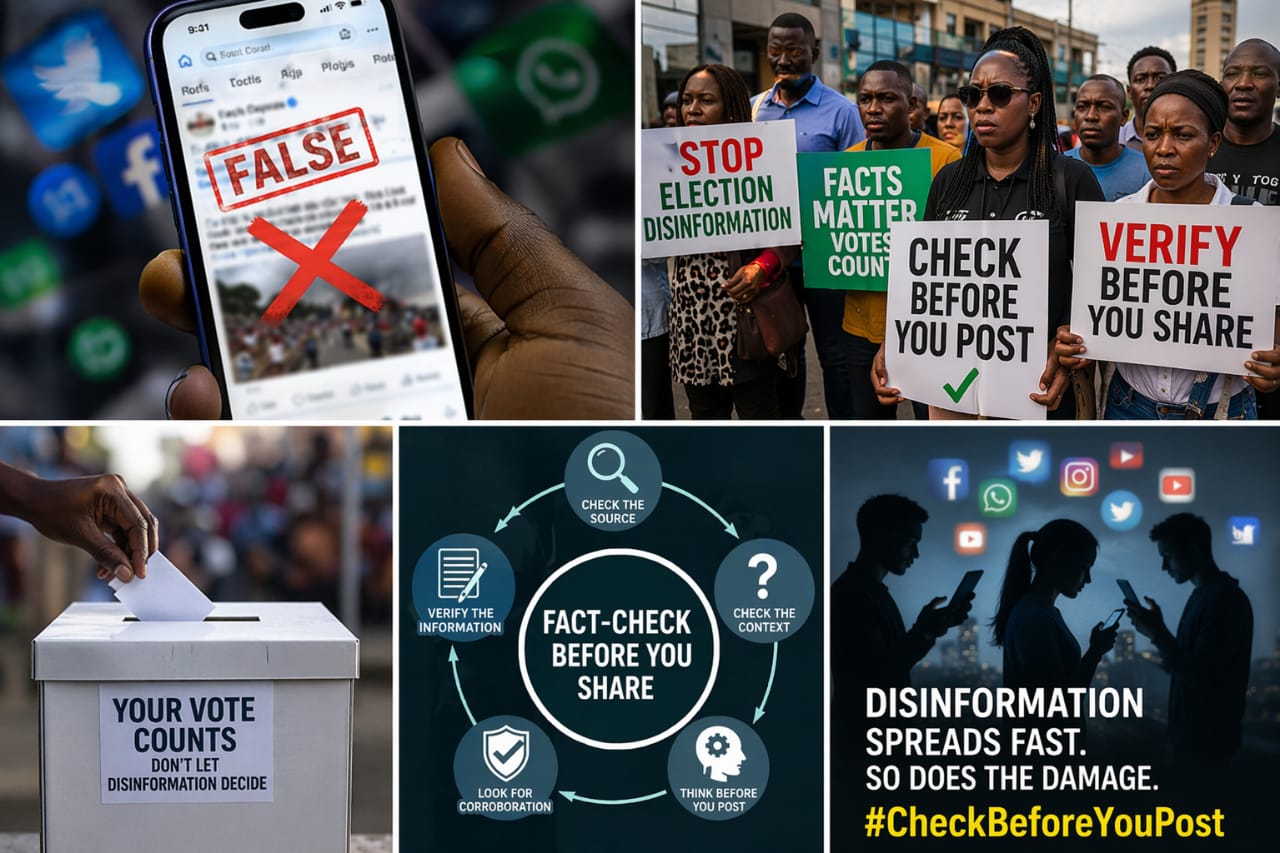
This evolving threat landscape has prompted calls for citizens to confront election disinformation through campaigns like #CheckBeforeYouPost. Media literacy advocates note that false narratives are already circulating widely across social media platforms and occasionally infiltrating mainstream media outlets.
“Citizens become unwitting accomplices when they fail to challenge falsehoods or, worse, help spread them by forwarding unverified information,” explains a digital rights activist working to combat online misinformation in Nigeria.
The spread of disinformation poses a particular challenge in Nigeria’s diverse society, where regional, religious, and ethnic tensions can be easily inflamed. Every citizen has a responsibility to defend electoral integrity by practicing fact-checking, questioning suspicious claims, and verifying source credibility before sharing information.
Political analysts observe that those who fabricate and spread falsehoods during election periods typically aim to distract public attention from substantive issues, manipulate voter perception, and ultimately undermine democratic processes for partisan advantage.
While Nigeria’s electoral commission and civil society organizations are developing countermeasures against disinformation, experts emphasize that institutional responses alone cannot solve the problem. Individual responsibility and digital citizenship will play crucial roles in securing credible elections and responsive leadership as 2027 approaches.
As Nigeria prepares for another electoral cycle, the message from democracy advocates is clear: before posting, forwarding, or sharing political content, citizens should verify its accuracy and source credibility. In Nigeria’s evolving democracy, electoral integrity depends not only on ballots cast but also on the quality of information circulating in the public sphere.
Fact Checker
Verify the accuracy of this article using The Disinformation Commission analysis and real-time sources.

8 Comments
I appreciate the governor’s directive requiring political appointees to resign if they have 2027 electoral ambitions. This helps promote transparency and reduces potential conflicts of interest.
I wonder if the governor’s directive will have the intended effect of encouraging political appointees to be more transparent about their electoral ambitions. Time will tell how this plays out.
It’s concerning to hear that pre-election periods in Nigeria have historically brought heightened tensions and partisan rivalries. Hopefully the 2027 elections can set a new standard for civility and focus on substantive issues.
The article provides a useful overview of the current political climate in Nigeria. As the 2027 elections approach, it will be important for citizens to stay engaged and vigilant against the spread of disinformation.
What specific steps can citizens take to identify and debunk election-related disinformation? Building public awareness and critical thinking skills will be key.
Interesting to see how Nigeria’s political landscape is heating up ahead of the 2027 elections. It will be important for citizens to stay informed and engaged to ensure a fair and transparent process.
The article highlights the need for citizens to take an active role in combating disinformation during elections. An informed and engaged electorate is crucial for the health of Nigeria’s democracy.
Increased political tension and competition during election seasons can sometimes overshadow important policy discussions. Voters should focus on the candidates’ platforms and vision for the country’s future.