


Listen to the article
Bangladesh Calls for Regional Cooperation to Combat Disinformation
Regional cooperation with shared verification networks and truth mechanisms is essential in fighting against misinformation and disinformation, according to Apurba Jahangir, Deputy Press Secretary to Bangladesh’s Chief Adviser.
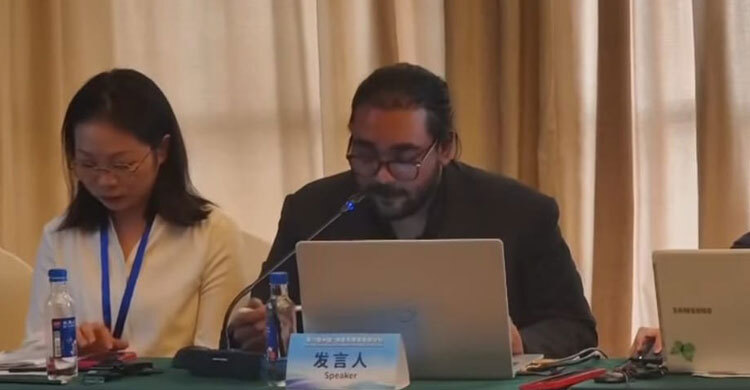
“The fight against disinformation can no longer be waged alone. We need regional cooperation, not in sentiment, but in structure,” Jahangir said while presenting a paper at the 10th China-South and Southeast Asian Think Tank Forum in Kunming, China.
In his presentation titled “Securing Truth: Regional Cooperation and the Fight Against Disinformation in Bangladesh,” Jahangir questioned why regional organizations like BRICKS, SAARC, and BIMSTEC that have established trade mechanisms couldn’t also create truth mechanisms.
The scale of the problem in Bangladesh is substantial. Between January and September this year, independent fact-checkers identified 2,754 pieces of verified misinformation—approximately 10 false stories daily. Last year’s figures were even higher at 2,919. Of particular concern, 148 pieces originated from outside Bangladesh’s borders, primarily from 72 southeast regional outlets spreading distortions about the country roughly every two and a half days.
Jahangir emphasized that misinformation has real-world consequences. He cited an incident in May when a rumor about a madrasah teacher allegedly desecrating scripture led to mob violence, police attacks, and nearly cost a man his life.
“For every lie, there is a consequence. A market shutters. A protest begins. A rumor turns into a riot,” he noted, adding that “what is most dangerous is not the falsehood itself—it is how quickly people want to believe it.”
Since Bangladesh’s interim government took office on August 8 last year, it has faced numerous misinformation challenges, including a fabricated resignation letter of the Chief Adviser that was shared thousands of times before corrections could be made.
The interim government has developed a five-pillar strategy to combat disinformation: a National Fact-Check Coordination Unit connecting verification bodies free from political interference; curriculum reform to introduce fact-checking and digital literacy into education; public campaigns utilizing television and community media to teach verification; a legal help desk supporting victims of online misinformation; and a volunteer network of “Digital First Responders” trained to flag falsehoods in real time.
Jahangir stressed these measures are “not tools of censorship but tools of trust,” and emphasized that responsibility must be shared among those who produce misinformation, those who share it without verification, and the platform owners where this content circulates.
Bangladesh is seeking partnerships with neighboring countries including India, China, Pakistan, and Southeast Asian nations to develop a shared regional database of verified claims, AI-assisted translation and detection tools in regional languages, and a Regional Media Integrity Charter—a mutual commitment to factual reporting during elections and crises.
With Bangladesh approaching elections in February, Jahangir highlighted the timeliness of these efforts. “Securing truth is not a government project. It is a civic act, a regional act, a human act,” he said.
The growing recognition of misinformation as a transnational challenge comes as social media platforms and digital information flows increasingly transcend national borders. Experts have long warned that uncoordinated national approaches to combating disinformation are insufficient in today’s interconnected media environment.
“If modernization is the road ahead, then truth is the ground beneath that road. And if that ground erodes, no bridge will stand for long,” Jahangir concluded.
Fact Checker
Verify the accuracy of this article using The Disinformation Commission analysis and real-time sources.

14 Comments
Curious to learn more about the types of disinformation most prevalent in Bangladesh and the Southeast Asia region. Understanding the sources and tactics used will be key to developing countermeasures.
The call for truth mechanisms to complement existing trade frameworks in South and Southeast Asia is a thoughtful proposal. Integrating fact-checking into regional institutions could significantly boost their impact.
Kudos to Bangladesh for taking a leadership role on this critical issue. Combating disinformation requires sustained, collaborative efforts across borders.
Curious to know more about the specific types of disinformation prevalent in Bangladesh and the wider region. Understanding the local context is key to developing effective countermeasures.
Regional cooperation and shared verification networks sound like a sensible way forward. Addressing cross-border disinformation requires a coordinated, multilateral approach.
The scale of the disinformation problem in Bangladesh is quite concerning. 10 false stories per day is a staggering figure. Coordinated regional efforts seem crucial to address this challenge.
I agree, regional cooperation on fact-checking and truth mechanisms could be a game-changer. Sharing resources and best practices across borders is essential.
It’s good to see Bangladesh taking a leadership role in pushing for more structured regional cooperation to combat disinformation. Fact-checking platforms are a necessary tool, but require collaboration to be effective.
Fact-checking 2,754 verified instances of misinformation in less than a year is an immense undertaking. Bangladesh deserves credit for prioritizing this critical issue.
Yes, the sheer volume of disinformation is staggering. Kudos to the independent fact-checkers in Bangladesh for their tireless work uncovering the truth.
The point about existing regional trade mechanisms not extending to truth mechanisms is an interesting one. Leveraging those existing frameworks could streamline efforts to combat cross-border disinformation.
Absolutely, utilizing existing regional infrastructure is a smart approach. It could help scale fact-checking and verification efforts more efficiently.
Interesting to see Bangladesh advocating for regional cooperation on fact-checking platforms. Cross-border coordination will be essential to address the scale of the disinformation challenge.
Interesting perspective on the need for regional cooperation to combat disinformation. Fact-checking platforms could be a powerful tool if implemented effectively across South and Southeast Asia.