


Listen to the article
The Trump administration unveiled a bold initiative Wednesday to establish a critical minerals trading bloc with allied nations, aiming to counter China’s dominance in materials essential for advanced technology and defense applications.
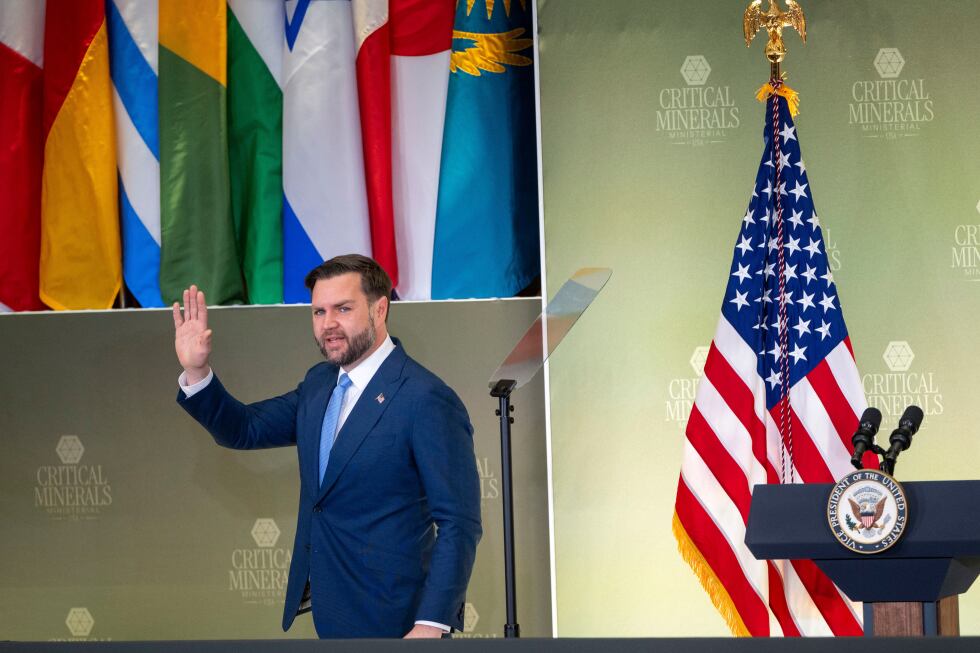
Vice President JD Vance, speaking at a Washington gathering of officials from dozens of European, Asian, and African nations hosted by Secretary of State Marco Rubio, emphasized the urgent need for collective action following revelations during the U.S.-China trade war about Western dependence on Chinese-controlled resources.
“We want members to form a trading bloc among allies and partners, one that guarantees American access to American industrial might while also expanding production across the entire zone,” Vance said.
The administration’s move comes in response to China’s restrictions on critical mineral exports following President Donald Trump’s tariff impositions last year. Although both nations have since scaled back their trade barriers, China’s export limitations remain tighter than before Trump took office, creating ongoing supply concerns.
These minerals are vital components in manufacturing everything from fighter jets and missiles to smartphones and electric vehicles. China currently controls approximately 70% of global rare earths mining and 90% of processing capacity, giving Beijing significant leverage over international supply chains.
Vance described how China has historically undermined competitors by initially flooding markets with cheap materials, preventing new mines from developing elsewhere, then raising prices after establishing market control. The proposed trading bloc would maintain stable pricing over time to break this cycle.
“Our goal within that zone is to create diverse centers of production, stable investment conditions and supply chains that are immune to the kind of external disruptions that we’ve already talked about,” the vice president explained.
The diplomatic gathering signals the administration’s determination to build strategic relationships around national security priorities, despite ongoing tensions with allies over Trump’s territorial ambitions and confrontational rhetoric. While major allies like France and the United Kingdom attended, notably absent were Denmark and Greenland—the mineral-rich Arctic island that previously drew Trump’s interest as a potential acquisition.
Beijing responded cautiously to news of the trading bloc. Foreign Ministry spokesperson Lin Jian stated that China “opposes any country undermining the international economic and trade order through rules set by small cliques.”
Economic experts note the challenge of preventing bloc members from purchasing cheaper Chinese materials outside the agreement. Ian Lange, an economics professor specializing in rare earths at the Colorado School of Mines, pointed out that enforcement might be straightforward for defense contractors but potentially more difficult with commercial manufacturers.
“Let’s just say it’s standard economics or standard behavior. If I can cheat and get away with it, I will,” Lange remarked.
The administration has taken additional measures to secure critical mineral supplies. Trump recently announced Project Vault, a strategic U.S. stockpile of rare earth elements supported by a $10 billion Export-Import Bank loan and nearly $1.67 billion in private capital. The government also made a $1.6 billion investment in USA Rare Earth, its fourth direct investment in an American critical minerals producer, while the Pentagon has committed nearly $5 billion over the past year to stimulate domestic mining.
Several nations have already signaled support for the U.S. initiative. Japan’s minister of state for foreign affairs, Iwao Horii, expressed Tokyo’s full commitment, stating, “Critical minerals and their stable supply is indispensable to the sustainable development of the global economy.” The European Union, Japan, and Mexico announced agreements to develop coordinated trade policies and price floors with the United States.
Heidi Crebo-Rediker from the Council on Foreign Relations characterized the meeting as “the most ambitious multilateral gathering of the Trump administration,” adding, “The rocks are where the rocks are, so when it comes to securing supply chains for both defense and commercial industries, we need trusted partners.”
On the domestic front, the Republican-controlled House approved legislation to accelerate mining on federal land, despite objections from Democrats and conservation groups concerned it would give foreign-owned mining corporations excessive access. The bill, which codifies Trump’s executive orders to boost domestic mining and processing, now heads to the Senate.
The developments occurred on the same day Trump and Chinese President Xi Jinping spoke by phone, although Trump’s social media post about the conversation did not specifically mention critical minerals issues.
Fact Checker
Verify the accuracy of this article using The Disinformation Commission analysis and real-time sources.
