


Listen to the article
The Oakland Athletics have emerged as early adopters of Major League Baseball’s new automated ball-strike challenge system, leading all teams with a 69.2% success rate during the first 10 days of spring training, according to data released by MLB on Monday.
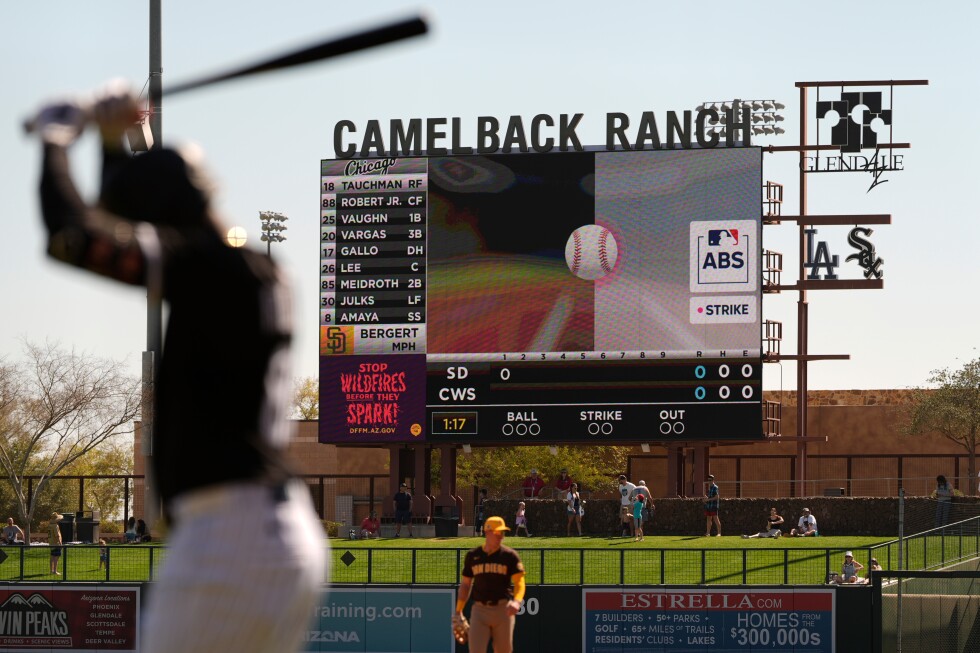
The technology, colloquially known as the “robot umpire” system, will make its regular-season debut on March 25, marking a significant shift in how ball and strike calls can be contested during games. This implementation comes after several years of testing in minor league baseball, which began in 2019.
San Francisco Giants ranked second in challenge success at 66.7%, while Cincinnati Reds, Miami Marlins, and San Diego Padres tied for third at 61.9%. At the opposite end of the spectrum, the World Series champion Los Angeles Dodgers struggled with the new system, winning just 21.4% of their challenges. The Baltimore Orioles (25%), New York Mets (35.3%), and Texas Rangers (38.1%) also posted below-average success rates.
Across all spring training games, teams have averaged 2.3 challenges per game with an overall success rate of 51.3%. The New York Yankees have been the most aggressive in utilizing the new technology, averaging 3.8 challenges per game while winning 52.6% of those appeals. The Minnesota Twins ranked second with 3.6 challenges per game and a 58.3% success rate, followed by the Boston Red Sox at 3.2 challenges per game with 55.2% success.
The Orioles have been the most cautious, averaging just 1.2 challenges per game, while the Dodgers (1.4) and Detroit Tigers (1.5) have also used the system sparingly.
The introduction of the Automated Ball-Strike System represents one of baseball’s most significant technological integrations in recent years. Under the new rules, each team can challenge two ball or strike calls per game. Mirroring the current video review system, teams retain their challenge if successful. For games that extend into extra innings, teams receive one additional challenge for each inning beyond the ninth.
This challenge system builds upon MLB’s gradual embrace of technology in officiating. The league first introduced video reviews for home run calls in August 2008 before substantially expanding reviewable plays for the 2014 season. The current implementation follows a period of testing during last year’s spring training, when teams won 52.2% of their ball/strike challenges (617 of 1,182).
The system aims to address long-standing concerns about consistency in ball and strike calls, which have traditionally been subject to human interpretation and occasional controversy. By providing teams with a technological recourse for disputed calls, MLB hopes to reduce arguments while maintaining the human element of the game through a limited challenge system rather than fully automated calls.
Baseball analysts note that different teams appear to be developing distinct strategies around the new system. Some organizations, like the Yankees, seem to be aggressively testing its boundaries, while others, like the Orioles and Dodgers, have taken a more selective approach.
As opening day approaches, teams will continue refining their strategies for utilizing these challenges during games that count in the standings. The coming regular season will provide the first true test of how this technology influences game strategy, pace of play, and the relationship between managers, players, and umpires.
The league will likely monitor the system’s impact closely throughout the season, gathering data that could inform potential adjustments to the challenge protocol in future seasons.
Fact Checker
Verify the accuracy of this article using The Disinformation Commission analysis and real-time sources.

8 Comments
The early adoption of the robot ump challenge system is an interesting development. I wonder if it will lead to a more data-driven, analytical approach to managing pitchers and hitters. Could be a game-changer if teams can capitalize on the new technology.
Fascinating to see the early adoption of the robot umpire challenge system in spring training. I’m curious to see how the success rates shake out once it’s implemented in the regular season. Seems like the A’s and Giants have really embraced the new technology.
Agreed, it will be interesting to monitor the success rates and see if any teams are able to gain an advantage by mastering the new challenge system.
I have mixed feelings about the robot umpire challenge system. On one hand, it could bring more accuracy and consistency to ball/strike calls. But it also introduces a new layer of complexity and potential gamesmanship. Will be interesting to see how it plays out across the league.
That’s a fair perspective. The new system definitely has pros and cons. It will be a learning process for teams and umpires alike to find the right balance.
Kudos to the A’s and Giants for being early leaders in the robot umpire challenge game. Curious to see if this initial success translates to the regular season or if other teams start to catch up. The technology will certainly add a new strategic element to the game.
It’s smart of the A’s and Giants to get ahead of the curve on the robot ump challenges. Gives them a chance to get familiar with the system before it really matters in the regular season. I wonder if we’ll see a competitive edge emerge between the teams with the highest challenge success rates.
Good point. The teams that can leverage this new technology most effectively could gain a real edge, especially in close games where every challenge call matters.