


Listen to the article
Tens of thousands of travelers find themselves stranded across the Middle East as the conflict between Iran and Israel escalates, with airspace closures and flight cancellations severely disrupting travel throughout the region.
Major airlines have suspended operations to and from affected areas, while Gulf airspace remains largely closed. Many travelers are seeking shelter from airstrikes, while others remain stuck on cruise ships unable to navigate the Strait of Hormuz, a critical maritime passage now deemed unsafe.
In a significant development on Monday, the U.S. State Department issued an urgent advisory for all American citizens to evacuate more than a dozen Middle Eastern countries due to growing safety concerns. The advisory specifically targets Americans in Iran, Iraq, Jordan, Lebanon, and Israel, instructing them to “DEPART NOW” using any available commercial transportation options.
“The rapidly evolving security situation presents unpredictable risks,” U.S. Assistant Secretary of State for Consular Affairs Mora Namdar wrote on social media platform X.
The State Department has also evacuated non-essential personnel and family members from six nations, with the United Arab Emirates being the latest addition to that list on Tuesday. The UAE, which includes the major hubs of Dubai and Abu Dhabi and has long been considered a relatively stable area in the Middle East, has now been drawn into the conflict through interceptions and attacks.
Mike Huckabee, the U.S. ambassador to Israel, has advised Americans there that the safest evacuation route is through Egypt’s Sinai Peninsula, highlighting the limited options available to those seeking to leave the region.
Governments worldwide are coordinating repatriation efforts to bring their citizens home safely. Russia scheduled 24 flights from the UAE and Oman on Tuesday alone, with plans to evacuate approximately 4,500 people. The Russian Transport Ministry confirmed that about 1,000 citizens had already returned on flights that arrived late Monday and early Tuesday.
According to Russia’s Association of Tour Operators, approximately 50,000 Russian tourists remained in the UAE as of Saturday. The Gulf nation has become an increasingly popular destination for Russian travelers in recent years due to direct flight options and visa-free entry allowing stays of up to 90 days.
Italy’s government has arranged special flights to Milan and Rome following criticism directed at Defense Minister Guido Crosetto, who became stranded in Dubai with his family during the initial phase of the U.S.-Israeli military response against Iran. Crosetto returned to Rome on Sunday aboard a military aircraft, but opposition parties have called for his resignation, arguing he should not have traveled to the Middle East during such a volatile period. Italian Premier Giorgia Meloni has defended her minister.
German authorities report approximately 30,000 of their citizens remain on cruise ships, in hotels, or at closed airports throughout the Middle East. The first repatriation flight from Dubai arrived in Frankfurt on Tuesday afternoon. The German government is working to charter additional aircraft at taxpayer expense, prioritizing vulnerable individuals including ill travelers, children, and pregnant women.
France is similarly coordinating evacuation efforts for thousands of its citizens. French Foreign Affairs Minister said Tuesday that an estimated 200,000 French nationals live in the conflict-affected region, with roughly 25,000 French citizens currently visiting the area as tourists.
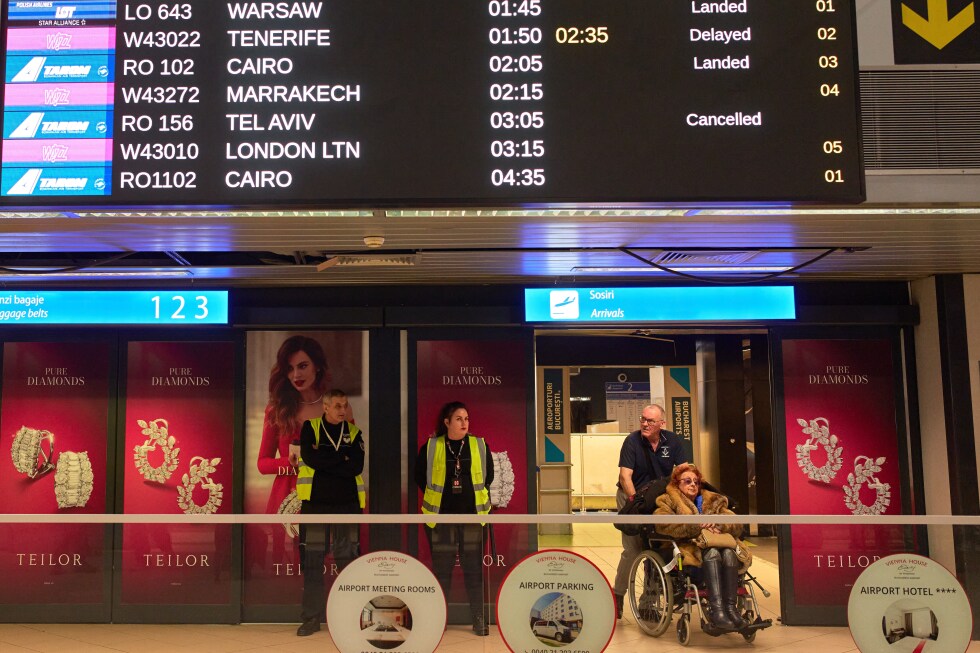
For those who have managed to return home, the relief is palpable. Romanian Orthodox pilgrims who had been visiting Bethlehem arrived in Bucharest Tuesday after traveling from Israel to Cairo. Pilgrim Mariana Muicaru described terrifying moments during her time in Israel.
“We called our children at 3 a.m. to ask forgiveness because we might die and to tell them we love them,” she told The Associated Press, describing nights spent watching rockets cross the sky.
American retiree Louise Herrle from Pennsylvania remains stranded in Dubai with her husband after multiple flight cancellations. “We are now scheduled to go out Thursday at 2:30 in the morning, and, you know, we don’t know if it’s gonna happen or not,” she told the AP from her hotel. Herrle emphasized the importance of registering with the State Department before traveling abroad and maintaining a philosophical outlook: “Just accept the fact that we can’t control the situation… and go from there.”
For German traveler Wassim Mahlas, who landed in Frankfurt Tuesday on a flight from Dubai, the sentiment was simpler. When asked if he was glad to be home, he replied: “Yes, of course. I’m breathing German air again.”
Fact Checker
Verify the accuracy of this article using The Disinformation Commission analysis and real-time sources.

13 Comments
Thousands of people stranded across the Middle East must be incredibly stressful. I hope they can find safe and reliable transportation options to return home as soon as possible.
The evolving security situation presents real risks. Travelers should heed the State Department’s advisory and take all necessary precautions.
The closure of airspace and maritime routes is really complicating travel and logistics in the Middle East. I hope the situation stabilizes soon so people can return home safely.
Cruise ships unable to navigate the Strait of Hormuz is a concerning development. That’s a critical commercial waterway that shouldn’t be compromised.
The State Department’s evacuation advisory underscores the severity of the security risks in the region. Travelers should exercise extreme caution and explore all options to leave the area as soon as possible.
Concerning news about the travel disruption caused by the Iran-Israel conflict. This underscores the unpredictable and volatile nature of geopolitical tensions in the region. My heart goes out to all the stranded travelers seeking safe passage home.
The U.S. State Department’s urgent advisory for Americans to evacuate the area is a prudent move given the rapidly evolving security situation. Safety should be the top priority.
The disruption to airspace and maritime routes is really impacting global travel and trade. Hopefully the relevant authorities can work to reopen critical transportation corridors as soon as it’s safe to do so.
This is a concerning development that highlights the fragility of global mobility. I hope the situation can be stabilized quickly to allow stranded travelers to return home safely.
This conflict is causing major logistical headaches for the travel industry and stranded passengers. Resolving the geopolitical tensions should be the immediate focus to restore safe passage in the region.
This is a challenging situation for the global travel industry. Airlines and cruise operators will face significant disruptions and financial impacts. Governments need to work together to restore safe passage in the region.
The State Department’s evacuation of non-essential personnel from six nations is a wise precautionary measure. De-escalating tensions should be the top priority.
This is a really challenging situation for the travel industry and passengers. I hope the relevant authorities can work to restore safe passage through the region as soon as possible.