


Listen to the article
Privacy advocates are urging California Governor Gavin Newsom to remove a network of hidden license plate readers in Southern California that they believe is connected to a controversial U.S. Border Patrol surveillance program tracking millions of American drivers.
In a letter sent Tuesday, the Electronic Frontier Foundation, Imperial Valley Equity and Justice, and other advocacy groups requested that Newsom’s administration “investigate and release the relevant permits, revoke them, and initiate the removal of these devices.”
The request follows an Associated Press investigation published last November that revealed the Border Patrol has been concealing license plate readers in ordinary traffic safety equipment. This data feeds into a predictive intelligence program that monitors Americans’ driving patterns to identify and detain people whose travel it considers suspicious.
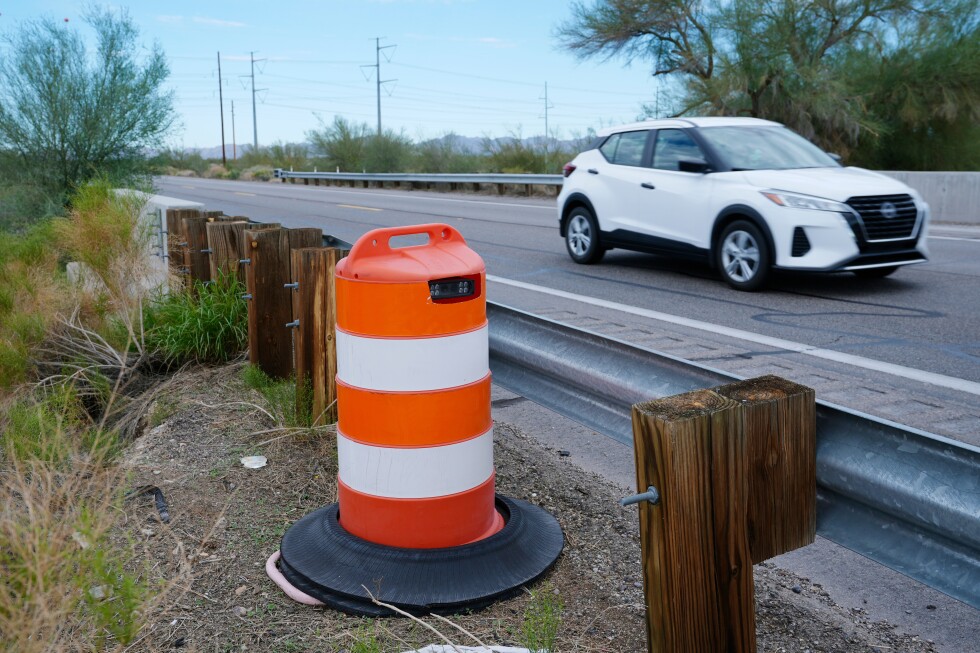
According to the AP report, Border Patrol went to considerable lengths to hide its surveillance equipment in Arizona, disguising it inside orange and yellow construction barrels placed along highways. The advocacy groups claim they’ve identified a similar surveillance network in California, discovering approximately 40 license plate readers in San Diego and Imperial counties, which border Mexico. More than two dozen of these devices were reportedly hidden in construction barrels.
While researchers couldn’t determine the ownership of every device, they obtained some permits from the California Department of Transportation showing that both Border Patrol and the Drug Enforcement Administration had applied for permission to place readers along state highways. Documents indicate the DEA shares its license plate reader data with Border Patrol.
The surveillance system scans and records vehicle license plate information, with an algorithm flagging vehicles based on their origin, destination, and chosen route. Agents appear to focus on vehicles making short trips to border regions, suggesting such travel may indicate drug or human smuggling operations.
When federal agents identify suspicious vehicles, they sometimes refer them to local law enforcement, who initiate traffic stops citing minor infractions like speeding or improper lane changes. Many drivers are unaware they’ve been targeted through a federal predictive intelligence program.
The AP identified at least two cases in California where residents appear to have been caught in the Border Patrol’s surveillance net. In one 2024 incident documented in court records, an agent pulled over a Nissan Altima driver partly because vehicle data showed it took six hours to travel approximately 50 miles between the U.S.-Mexican border and Oceanside, California.
“This type of delay in travel after crossing the International Border from Mexico is a common tactic used by persons involved in illicit smuggling,” the agent noted in court documents.
In another case from 2023, Border Patrol agents detained a woman at an internal checkpoint because she had taken an indirect route between Los Angeles and Phoenix. In both instances, law enforcement accused the drivers of smuggling undocumented immigrants and sought to seize property or file criminal charges.
The intelligence program, which has operated under both Democratic and Republican administrations, has attracted congressional scrutiny since its exposure last year.
While courts have generally upheld license plate reader use on public roads, they have restricted warrantless government access to other tracking data that might reveal sensitive details about people’s movements, such as GPS devices or cellphone location information. Some legal scholars and civil liberties advocates argue that large-scale collection systems like plate readers may violate Fourth Amendment protections against unreasonable searches and seizures.
“Increasingly, courts have recognized that the use of surveillance technologies can violate the Fourth Amendment’s protections,” the organizations wrote. “Although this area of law is still developing, the use of LPRs and predictive algorithms to track and flag individuals’ movements represents the type of sweeping surveillance that should raise constitutional concerns.”
When contacted previously about the program, Customs and Border Protection stated that the agency uses plate readers to identify threats and disrupt criminal networks, and that their use is “governed by a stringent, multi-layered policy framework, as well as federal law and constitutional protections.” The DEA declined specific comment on its investigative techniques.
A spokesperson for the California Department of Transportation noted that state law prioritizes public safety and privacy. Governor Newsom’s office has not yet responded to requests for comment on the advocacy groups’ concerns.
Fact Checker
Verify the accuracy of this article using The Disinformation Commission analysis and real-time sources.

6 Comments
This is a complex issue with valid arguments on both sides. However, I tend to agree that these covert license plate readers cross an ethical line and infringe on personal privacy. The government should focus on more transparent and consensual methods of monitoring.
This is a concerning example of the government expanding its surveillance capabilities without public oversight. I hope Governor Newsom takes these concerns seriously and orders an investigation into the permit process and use of this technology.
I’m glad to see these groups calling for transparency and accountability around this surveillance program. Hiding license plate readers in ordinary traffic equipment feels deceptive and an abuse of public trust. Californians deserve to know the extent of this monitoring.
Interesting to see privacy advocates pushing back against covert license plate readers. This seems like an overreach of government surveillance, even if it’s for border security. I wonder how effective these readers are and if the benefits outweigh the privacy concerns.
While I understand the goal of border security, this covert surveillance program seems to go too far. The government should be upfront about any monitoring technology deployed in public spaces. Removing these hidden license plate readers is the right call.
As a Californian, I’m troubled by the idea of my driving patterns being monitored by federal agencies without my knowledge or consent. These license plate readers seem like a violation of our civil liberties. I hope the state takes action to remove them.