


Listen to the article
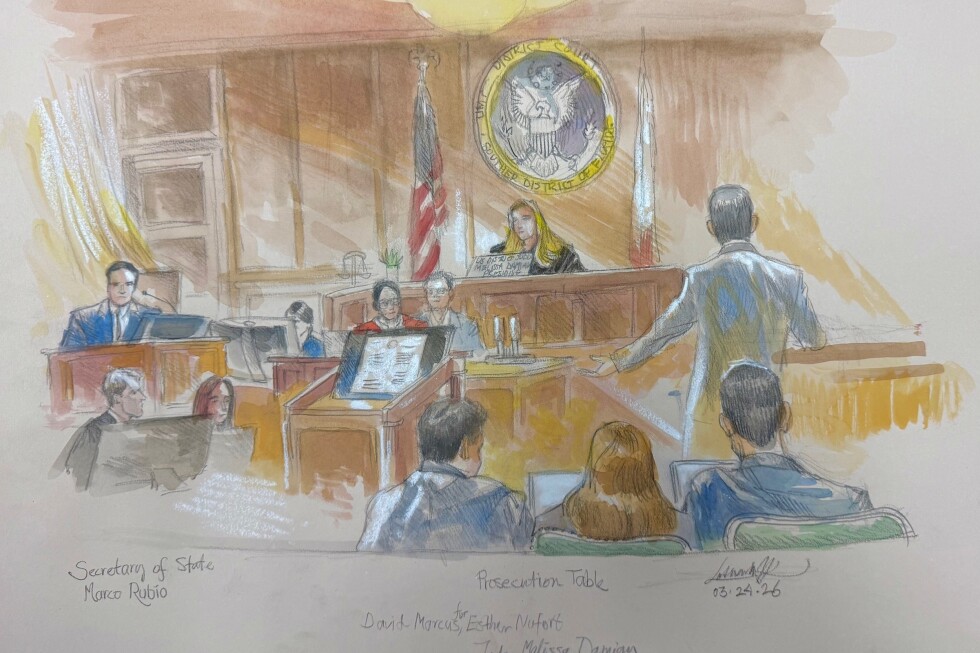
Secretary of State Marco Rubio testified Tuesday that he had no knowledge former Florida congressman David Rivera was lobbying for Venezuela’s government when they met several times to discuss U.S. policy toward the South American nation during the early Trump administration.
“I would’ve been shocked” had I known, Rubio stated during nearly three hours of testimony at Rivera’s federal trial in Miami.
Rivera and an associate were charged in 2022 with money laundering and failing to register as a foreign agent after allegedly receiving a $50 million lobbying contract from Nicolás Maduro’s government. Prosecutors claim the lobbying effort aimed to normalize U.S.-Venezuela relations, while Rivera’s defense argues the three-month contract, which ended before Rivera met with Rubio, focused exclusively on bringing Exxon Mobil back to Venezuela—work typically exempt from foreign agent registration requirements.
The defendants allegedly attempted to arrange meetings for then-Foreign Minister Delcy Rodríguez—now Venezuela’s acting president—with White House officials, members of Congress, and Exxon’s CEO in multiple U.S. cities and Caracas.
Rubio offered deeply personal testimony about his long-standing friendship with Rivera. The two Cuban-American Republicans became “very close” during their time in the Florida legislature, co-owning a Tallahassee house and later both going to Washington—Rubio to the Senate and Rivera to the House. Both were vocal opponents of Venezuela’s socialist government.
In July 2017, Rivera texted Rubio requesting an urgent meeting about Venezuela. They met the following day at a Washington home where Rubio was staying with his family. Rivera informed Rubio he was working with Venezuelan media magnate Raul Gorrín on a plan for Maduro to step aside.
“I was skeptical,” Rubio testified, noting the Maduro government was full of “double dealers” frequently pitching unrealistic transition plans. “But if there was a 1% chance it was real, and I had a role to play alerting the White House, I was open to doing that.”
Rubio maintained he never knew Rivera was allegedly working for Maduro. During the meeting, Rivera showed Rubio millions of dollars in a Chase bank account that Rivera claimed were payments from Gorrín to Venezuela’s opposition.
“It was an impressive amount,” Rubio said. “He didn’t tell me whose account it was. He said it was to support the opposition.”
Two days later, using talking points Rivera provided, Rubio delivered a Senate floor speech signaling the U.S. would not retaliate against Venezuelan insiders who helped remove Maduro from power.
“He provided me with insight into some of the key phrases that regime insiders would’ve wanted to hear to know this was serious,” Rubio testified. “No vengeance, no retribution.”
Rubio also alerted then-President Donald Trump that something might be “brewing” with Venezuela.
The peacemaking effort quickly collapsed. At a second meeting at a Washington hotel, Gorrín failed to produce a promised letter from Maduro to Trump that he wanted Rubio to hand-deliver to the president.
“It was a total waste of my time,” Rubio testified.
Shortly afterward, Trump imposed heavy sanctions on Maduro and his inner circle after what Rubio called a “fake election” that undermined Venezuela’s opposition-controlled legislature. By this time, the senator was closely aligned with the Trump administration’s hard-line approach to Venezuela.
Rubio even recorded a rare 10-minute address to the Venezuelan people in July 2017, broadcast exclusively on Gorrín’s Globovision network, in which he warned Maduro that his current path “will not end well for you.” On the stand, Rubio said had he known Rivera was working with Gorrín on Maduro’s behalf, he would never have agreed to deliver the address on that network.
Rivera claimed Rubio’s testimony supported his defense that as a lifelong opponent of communism, he never worked to strengthen Maduro’s grip on power. “Marco Rubio made it abundantly clear today that everything we worked on together in 2017 was meant to remove Maduro from power in Venezuela,” Rivera said in a statement.
Throughout his testimony, Rubio remained composed and demonstrated detailed knowledge of U.S.-Venezuela policy, despite struggling to recall specifics of his text exchanges with Rivera on Venezuela matters.
His court appearance was highly unusual for a sitting Cabinet member—the first since Labor Secretary Raymond Donovan testified at a Mafia trial in 1983. Highlighting the unique nature of the testimony, Rivera’s attorney asked Rubio to sign a copy of his 2012 autobiography at the conclusion of his testimony. Rivera and his co-defendant, political consultant Esther Nuhfer, are among the limited friends and family Rubio thanks in the acknowledgments section of his memoir.
Fact Checker
Verify the accuracy of this article using The Disinformation Commission analysis and real-time sources.

16 Comments
Rubio’s personal testimony adds an interesting human element to this otherwise complex political and legal case. It will be worth following the trial closely.
Agreed. The personal dynamics between the key figures could provide valuable insights into the motivations and decision-making processes involved.
The potential involvement of Exxon Mobil is an interesting angle to follow. The energy sector’s relationships with foreign governments are always worth scrutiny.
Good point. Any linkages between major corporations and foreign lobbying efforts require close examination.
The allegations of money laundering and failure to register as a foreign agent are quite serious. It will be important to see the full facts emerge through the trial process.
Absolutely. Proper enforcement of foreign lobbying laws is crucial to protect the integrity of the political process.
The alleged attempts to arrange high-level meetings with US officials are concerning. Proper vetting and transparency around such interactions is crucial.
Absolutely. Improper influence peddling can have far-reaching consequences for policy decisions and national interests.
This case highlights the complexities and potential risks involved in navigating US foreign policy, especially in sensitive regions like Venezuela.
Precisely. Maintaining a clear and consistent approach is critical, while also being vigilant against undue influence.
The potential normalization of US-Venezuela relations is an intriguing angle. I wonder how this could impact the global energy and commodities markets.
That’s a good point. Any shifts in the US-Venezuela relationship could have significant implications for oil, minerals, and other key sectors.
Interesting to hear Rubio’s testimony regarding his lack of knowledge about Rivera’s Venezuela lobbying. Raises questions about transparency and accountability in government policy decisions.
Indeed, this case highlights the need for robust disclosure and oversight mechanisms around foreign lobbying efforts.
It will be fascinating to see how the trial unfolds and what new details emerge about the alleged lobbying activities and their potential impact.
Agreed. This case could have significant implications for future foreign lobbying regulations and enforcement efforts.