


Listen to the article
Ferrari’s Leclerc Defends Strategic Gamble in Australian Grand Prix
MELBOURNE, Australia — Ferrari driver Charles Leclerc defended his team’s decision not to pit during the first virtual safety car period in Sunday’s Australian Grand Prix, insisting it was a calculated risk rather than a strategic error.
Leclerc, who finished third in the race, made a spectacular start from fourth on the grid, surging into the lead at the first corner. He then battled with Mercedes’ George Russell for the top position until a virtual safety car was deployed on lap 12 when Red Bull rookie Isack Hadjar’s car stopped on track.
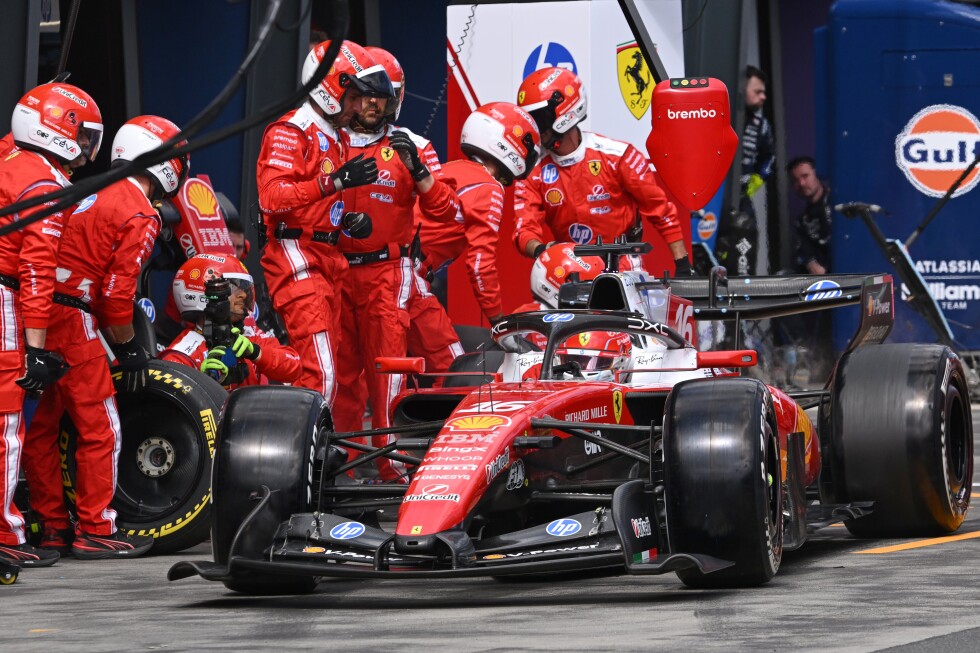
While both Mercedes drivers took advantage of the situation to make pit stops with reduced time loss, Ferrari elected to keep Leclerc on track. This decision ultimately compromised his position in the race, but the Monegasque driver remains convinced it was the right call at the time.
“I don’t regret it,” Leclerc explained during the post-race press conference. “It was a wanted choice, a wanted and conscious choice. Looking from Free Practice 1 to now, there’s been a car that was stopped in every session, at least one car.”
Ferrari’s strategy was based on statistical patterns observed throughout the race weekend, where multiple safety car periods had become a recurring feature at the Albert Park circuit. Team strategists gambled on the likelihood of additional opportunities to pit under more favorable conditions later in the race.
“We knew that there were very high chances that this was not going to be the only VSC of the race, and so we thought that it was better for us to maybe wait for another one — and that’s always a gamble,” Leclerc said.
The team’s prediction proved partially correct as another virtual safety car period did materialize later in the race. However, Ferrari’s strategy unraveled when they were unable to capitalize on this second opportunity due to pit lane entry being closed during the incident.
“Unfortunately, on this one, for us, the pit entry was closed and we couldn’t take it, so we were a little bit unlucky on that side,” Leclerc added.
The decision highlights the complex risk calculations teams must make during races, especially at tracks like Melbourne where safety car deployments are common. Ferrari’s aggressive strategy reflects their need to take calculated risks against the dominant Red Bull team and an increasingly competitive Mercedes outfit.
For Ferrari, currently battling to establish themselves as consistent challengers at the front of the field, such strategic gambles represent necessary attempts to maximize results in a highly competitive Formula 1 season. The Scuderia has shown improved pace this year but continues to search for the perfect balance between car performance and race strategy.
Leclerc’s podium finish still represents a positive outcome for Ferrari, who demonstrated competitive pace throughout the race weekend. His remarkable start and ability to battle with the Mercedes cars showed that the Italian team has the raw speed to compete at the front of the grid.
As the Formula 1 season continues to unfold, Ferrari’s willingness to take strategic risks could prove decisive in their championship aspirations. Whether their approach in Melbourne represents a blueprint for future races remains to be seen, but Leclerc’s unwavering support for the strategy suggests the team remains united in their approach.
The Formula 1 circus now moves on to prepare for the next round of the championship, with Ferrari looking to build on their Australian Grand Prix performance and further close the gap to their rivals.
Fact Checker
Verify the accuracy of this article using The Disinformation Commission analysis and real-time sources.

8 Comments
It’s good to see Leclerc taking responsibility and standing by Ferrari’s choice, even if the result wasn’t ideal. Calculated risks are part of the sport, and it’s refreshing to hear a driver defend their team’s strategy.
Leclerc’s comments provide an interesting window into Ferrari’s decision-making process. While the outcome wasn’t ideal, it’s good to hear the team’s rationale rather than just the result.
Ferrari’s gamble shows they’re not afraid to take calculated risks, even if it doesn’t always pay off. Leclerc’s willingness to stand by the decision is admirable.
The pit stop gamble highlights the challenging balance teams face between risk and reward. Ferrari likely factored in the history of stalled cars in practice and hoped to gain an advantage, but it didn’t work out this time.
The pit stop decision highlights the complexity of F1 strategy. While it didn’t work out this time, it’s intriguing to hear Leclerc’s perspective on their thought process and rationale.
Interesting strategic decision by Ferrari. Leclerc seems confident it was the right call at the time, even if it didn’t pay off. Curious to hear more details on their analysis and reasoning behind it.
Ferrari’s pit stop gamble was a bold move, and Leclerc’s willingness to own it shows confidence in his team. While it didn’t work out this time, it’s an intriguing strategic approach.
Ferrari’s strategy seems reasonable given the frequent stalls in practice. Though it didn’t pan out, I respect their willingness to try something different and not just follow the obvious path.