


Listen to the article
Iranian Protests Enter Third Week as Death Toll Rises and Government Threats Intensify
Nationwide protests challenging Iran’s theocracy have persisted for over two weeks, with demonstrators flooding the streets of Tehran and Mashhad despite growing violence that has claimed at least 116 lives, according to activists.
The U.S.-based Human Rights Activists News Agency reports that in addition to the mounting death toll, approximately 2,600 people have been detained across the country. The situation has become increasingly difficult to monitor as Iranian authorities have implemented an internet blackout and cut phone lines, significantly limiting information flowing in and out of the country.
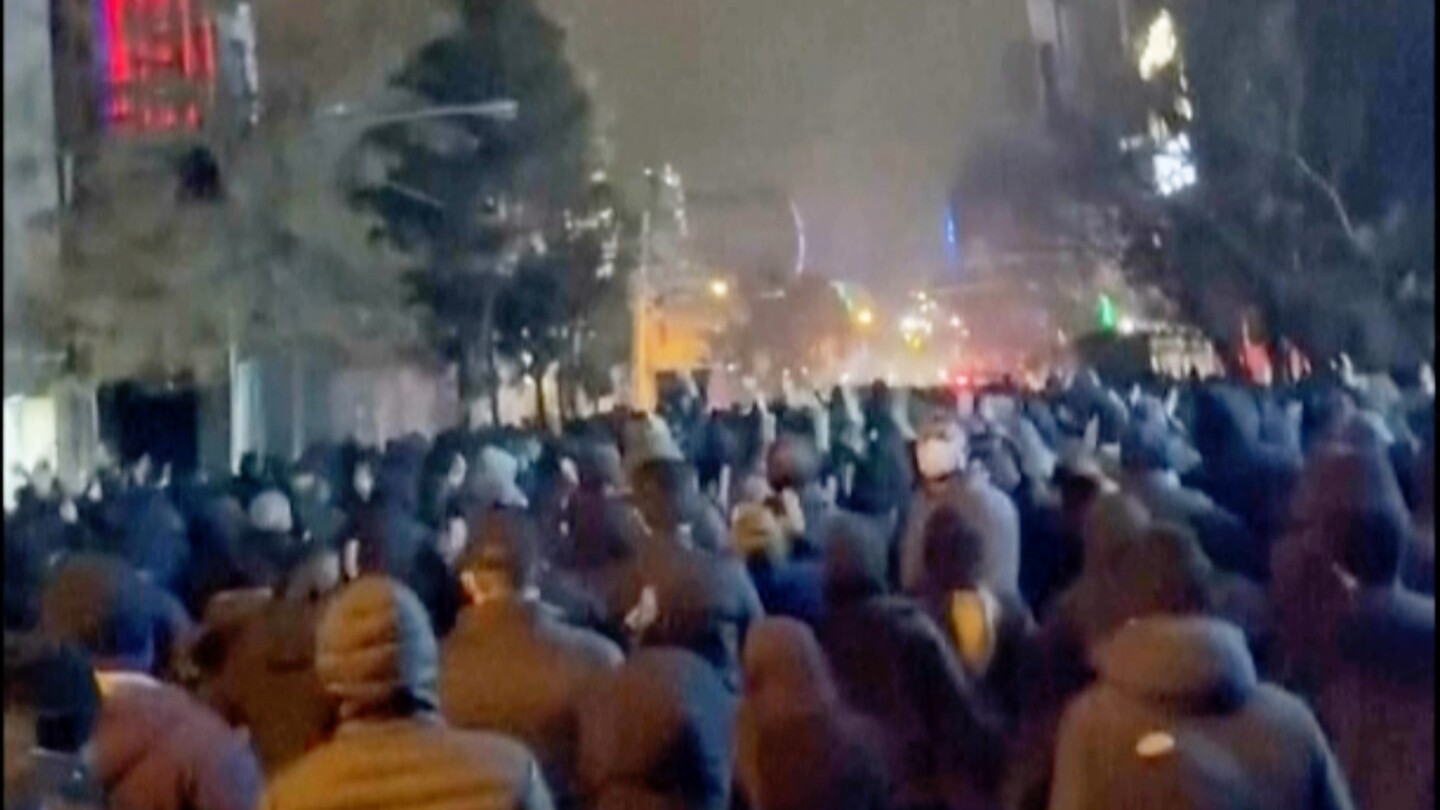
In Tehran, footage smuggled out via satellite connections showed protesters gathering in the northern Punak neighborhood, where authorities had reportedly blocked streets. Demonstrators waved illuminated mobile phones while others banged metal objects and set off fireworks. Similar scenes unfolded in Mashhad, Iran’s second-largest city and home to the revered Imam Reza shrine, where protesters confronted security forces amid burning debris and dumpsters blocking roads.
The protests, which began on December 28, were initially sparked by the collapse of the Iranian rial, which now trades at over 1.4 million to the U.S. dollar. Economic hardship, exacerbated by international sanctions related to Iran’s nuclear program, quickly transformed into broader calls challenging the country’s clerical leadership structure established after the 1979 Islamic Revolution.
Iran’s government has responded with increasingly severe threats. Attorney General Mohammad Movahedi Azad warned on state television that protesters would be considered “enemies of God” – a charge that carries the death penalty. He extended this threat to anyone who “helped rioters.”
Meanwhile, Iran’s parliament speaker issued direct warnings to the United States and Israel during a televised session where lawmakers rushed the dais shouting “Death to America!” The speaker declared that U.S. military facilities and Israel would be “legitimate targets” if the United States were to strike Iran, as threatened by President Donald Trump.
“In the event of an attack on Iran, both the occupied territory and all American military centers, bases and ships in the region will be our legitimate targets,” he stated, adding that Iran would not limit itself to reactive measures but would “act based on any objective signs of a threat.”
Military analysts note that Iran’s threat posture comes despite its air defenses having been severely damaged during a 12-day conflict with Israel in June. Any decision to engage in military action would ultimately rest with 86-year-old Supreme Leader Ayatollah Ali Khamenei, who has signaled a coming crackdown despite warnings from Washington.
The U.S. State Department issued a stark message to Tehran: “Do not play games with President Trump. When he says he’ll do something, he means it.” Trump has expressed support for the protesters on social media, writing that “Iran is looking at FREEDOM, perhaps like never before. The USA stands ready to help!!!”
According to reports in The New York Times and Wall Street Journal, citing anonymous U.S. officials, Trump has been presented with military options for a strike on Iran but hasn’t made a final decision. The U.S. military has stated it maintains forces in the Middle East “that span the full range of combat capability to defend our forces, our partners and allies and U.S. interests.”
Iran’s exiled Crown Prince Reza Pahlavi, son of the last Shah, has encouraged the demonstrations and called for protesters to carry Iran’s old lion-and-sun flag and other pre-revolutionary national symbols to “claim public spaces as your own.” While some demonstrators have shouted support for the Shah era, analysts note that this may represent a yearning for pre-revolution stability rather than explicit support for Pahlavi’s restoration.
Human rights organizations and international observers fear the information blackout will embolden hardliners within Iran’s security services to launch a bloody crackdown on protesters. With only state-controlled media and Qatar’s Al Jazeera appearing to maintain reporting access inside Iran, the true scale of both the protests and the government response remains difficult to verify.
Fact Checker
Verify the accuracy of this article using The Disinformation Commission analysis and real-time sources.

9 Comments
Concerning developments in Iran. The escalating violence and internet blackout make it challenging to get a clear picture of the situation on the ground. I hope all sides can find a peaceful resolution to this crisis soon.
Agreed, the safety of civilians should be the top priority. Maintaining open communication channels will be crucial for de-escalating tensions and finding a path forward.
This is a complex and rapidly evolving situation. While the government’s crackdown is concerning, the protesters’ demands for greater freedoms and rights also warrant consideration. I hope cooler heads can prevail to find a peaceful solution.
Well said. Upholding human rights while maintaining stability is a delicate balance. Constructive diplomacy will be essential to find a path forward that addresses the legitimate grievances of the Iranian people.
The threat of retaliation against US troops and Israel is troubling. All parties involved should exercise restraint and focus on addressing the root causes of the protests through dialogue and reforms, not further violence.
The threat of retaliation against US troops and Israel is a worrying escalation. All sides should focus on de-escalating tensions through diplomatic channels rather than further inflaming the situation with threats of violence.
The rising death toll is deeply troubling. Regardless of one’s political views, the loss of life is always tragic. I hope all parties can show restraint and prioritize de-escalation over further confrontation.
The internet blackout is a concerning tactic to limit the flow of information and dissent. Transparent and unfettered communication will be crucial for understanding the situation and finding a peaceful resolution.
Absolutely. Cutting off communication channels often signals a government’s unwillingness to engage constructively with its citizens. Restoring internet access could be an important confidence-building measure.