


Listen to the article
Oil Price Surge Past $110 Impacts Global Economy as Iran War Disrupts Energy Markets
The price of crude oil surged past $110 a barrel on Monday, reaching levels not seen since 2022, as consumers worldwide begin to feel the economic ripple effects of the Iran conflict and its disruption to global energy production.
While the most immediate impact is being felt at gas pumps across America, the implications extend far beyond drivers. The interconnected nature of the global economy means that nearly all goods—including food—must be transported from production facilities to consumers, with those transportation costs now climbing alongside gasoline, diesel, and jet fuel prices.
Economic experts warn that sustained high oil prices will likely become a significant factor driving U.S. inflation upward. “The longer this lasts, the more significant the shock would be,” cautioned Gregory Daco, chief economist at consulting firm EY-Parthenon.
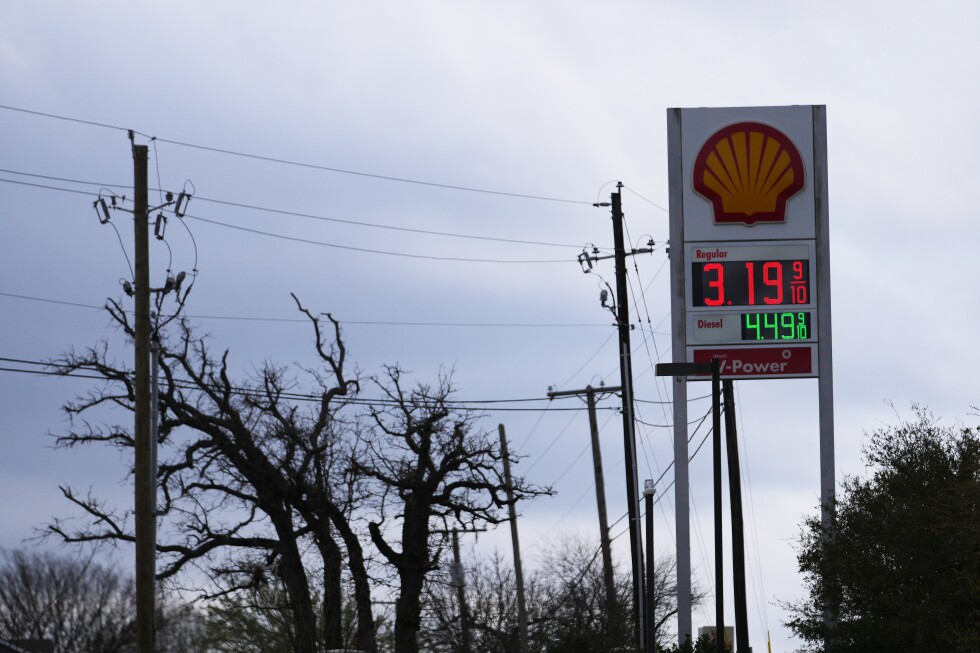
At gas stations nationwide, Americans are paying an average of $3.48 per gallon of regular gasoline, up from $2.98 before the conflict began—a 17% increase since U.S. and Israeli forces engaged with Iran. Regional price variations remain substantial, with California drivers facing $5.20 per gallon (up 12% in just a week), while Louisiana drivers pay just $3.04 on average, benefiting from the state’s oil production and refining capacity.
The impact could be even more pronounced in Asia and Europe, regions more dependent on Middle Eastern oil and gas than the United States. The effective closure of the Strait of Hormuz—a critical waterway carrying one-fifth of the world’s crude oil and liquefied natural gas—has already created significant challenges for global shipping.
Diesel fuel, the lifeblood of commercial transportation, jumped to $4.65 per gallon in the U.S., representing a staggering 23% increase since the conflict began. Patrick De Haan, a petroleum analyst at GasBuddy, emphasized the severity, noting on social media: “Can’t underscore what a massive jolt this is to the logistics, trucking, (agriculture) sectors.”
According to Patrick Penfield, professor of supply chain practice at Syracuse University, fuel costs represent 50-60% of shipping companies’ total operating expenses. “When fuel prices start to go up, everything starts to slow down,” Penfield explained. “Your ships slow down, your trucks slow down. People are less apt to ship things via air. It really causes a drag on the economy.”
Home energy costs are also expected to rise, with Europe’s benchmark natural gas price already up 75% since the war began. This increase affects not only heating and cooking but also the production of goods made from natural gas, including plastics, rubber, and nitrogen fertilizer.
While grocery prices may not immediately reflect the oil surge, David Ortega, professor of food economics at Michigan State University, warns that sustained high oil prices for a month or more could change that calculus. Higher oil prices impact agriculture both by increasing farm input costs (fuel, fertilizer) and by driving up demand for alternative vegetable oils that can substitute for petroleum-based fuels.
“Food gets to the grocery store on diesel, whether it’s on a truck or on a boat,” Ortega noted, explaining that fresh, perishable foods requiring rapid transport could see price increases sooner than packaged goods with longer shelf lives.
The broader inflation impact could be substantial. With U.S. oil prices up roughly 42% from pre-war levels (from approximately $67 to $95 per barrel), economists at JPMorgan estimate this could push U.S. inflation from January’s 2.4% to 3% or higher in coming months. Daco predicts monthly inflation could reach as high as 1% in March—the highest monthly increase in four years.
Consumer spending patterns are likely to shift as households absorb higher energy costs. Mark Mathews, chief economist at the National Retail Federation, notes that U.S. households spend an average of $2,500 annually on gasoline. With an additional $10 weekly expense, discretionary spending on entertainment and dining may decrease, particularly among lower-income consumers.
Some analysts remain cautiously optimistic that temporary price increases won’t immediately translate to higher consumer costs across all sectors. Ed Anderson from the University of Texas suggests that “if the conflict is only in the short run, companies will eat it,” absorbing higher shipping costs rather than passing them immediately to customers.
Italian Finance Minister Giancarlo Giorgetti echoed this sentiment during a G7 meeting in Brussels, urging businesses to avoid passing along energy cost increases. “We must act immediately to stop energy prices from spreading to all consumer goods, as happened in 2022,” he stated, referencing lessons learned after Russia’s invasion of Ukraine.
Fact Checker
Verify the accuracy of this article using The Disinformation Commission analysis and real-time sources.

9 Comments
This is a concerning situation. High oil prices can really squeeze consumers and the broader economy. I hope diplomatic efforts can help stabilize the global energy market soon.
The Iran conflict is yet another supply chain disruption impacting the global economy. Diversifying energy sources and strengthening domestic production seem more critical than ever.
Agreed. Reducing reliance on volatile regions for vital commodities should be a priority.
The interconnected nature of the global economy is on full display here. Disruptions in one sector can rapidly ripple through to consumers in many ways.
Absolutely. The world is more economically integrated than ever before.
I’m curious to see how policymakers respond to the inflationary pressures from rising energy costs. Delicate balance between protecting consumers and not fueling further price spirals.
As an investor, I’ll be watching energy and commodity stocks closely. This situation could create opportunities, but also heightened risks.
Surging fuel prices will be especially hard on lower-income families who spend a larger share of their budgets on transportation. I hope policymakers can provide some targeted relief.
Good point. Vulnerable populations often bear the brunt of economic shocks like this.