


Listen to the article
Iran War Creates Lasting Environmental Crisis Across Persian Gulf Region
Oil depots spewing black smoke. Debris sinking in the Persian Gulf. Missiles pounding military sites. The Iran war has unleashed a toxic mix of chemicals, heavy metals and other pollutants that threaten everything from agriculture to drinking water to public health — with environmental damage and health risks that could persist for decades.
“All the burning of oil and gas fields in the coastal areas, all the ships that are there, the oil tankers that are being burned or sunk — all of these mean pollution,” said Kaveh Madani, an Iranian scientist and director of the United Nations University Institute for Water, Environment and Health. “For someone like me who has fought for sustainability and protection of the environment in that region, this is like going many years backward.”
Documenting the full extent of the environmental damage has proven challenging amid the ongoing conflict. The Conflict and Environment Observatory, a UK-based nonprofit that monitors environmental harm from armed conflicts, has recorded more than 400 environmentally concerning incidents related to the war. However, the organization’s director Doug Weir notes that much remains unknown due to satellite imagery delays and internet blackouts in Iran.
Attacks on oil and gas infrastructure have created some of the most severe environmental hazards. These strikes not only compromise air quality but also cause soil and water contamination that poses immediate and long-term health threats to local populations. Adding to these concerns are the attacks on military sites, some deeply buried and others near populated areas, creating what Weir describes as “huge uncertainties” around potential environmental impacts.
Air Pollution Threatens Public Health
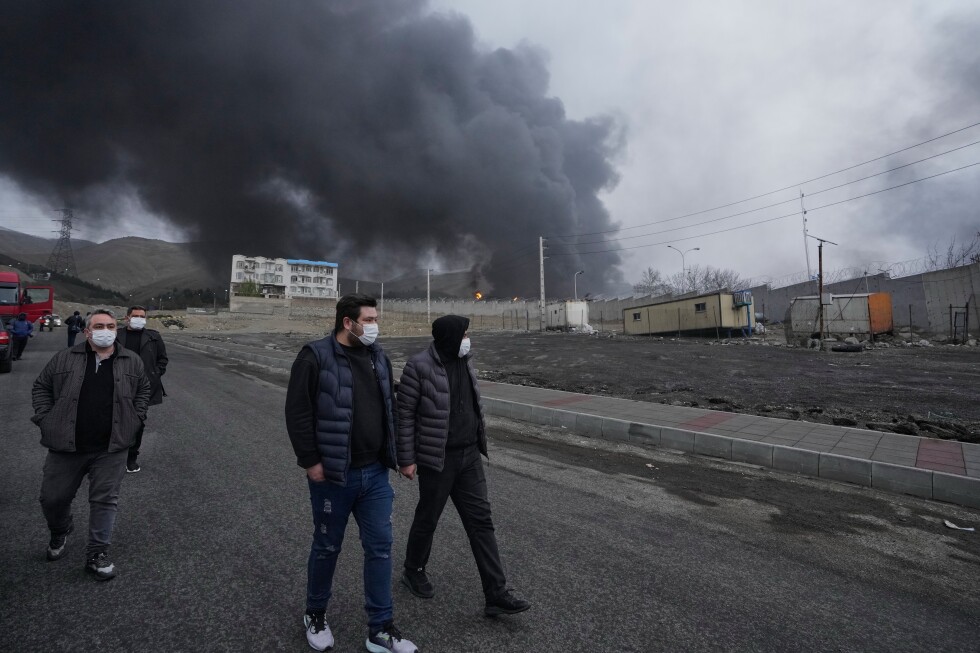
Perhaps the most striking images from the conflict show darkened skies from oil infrastructure set ablaze by airstrikes. Two weeks ago, black rain fell near Tehran after soot, ash, and toxic chemicals from strikes on fuel depots and a refinery combined with atmospheric moisture, prompting officials to warn residents to remain indoors.
Health experts warn that microscopic soot particles increase risks of lung and heart problems, while toxic chemicals released during these strikes pose long-term cancer risks. Heavy metals from falling debris can contaminate soil and water supplies across the region.
Mohammed Mahmoud, head of Middle East Climate and Water Policy with the United Nations University Institute of Water, Environment and Health, points out additional chemical dangers: “If you hit an ammonia-producing plant for fertilizer or for food production… those release chemicals that are absolutely toxic and harmful if they spread.”
The conflict is also accelerating climate change through massive fossil fuel emissions. The carbon accounting platform Greenly estimated that the U.S. military alone released almost 2 billion metric tons of greenhouse gases in just the first six days of the war. When accounting for Israeli and Iranian military emissions and infrastructure damage, the actual figure is certainly much higher—a significant amount considering that global annual greenhouse gas emissions total around 50 billion metric tons.
Global oil shortages resulting from the conflict have also prompted some countries to increase their use of coal, further worsening air pollution and greenhouse gas emissions.
Water Security Under Threat
Countries throughout the arid Persian Gulf region depend heavily on hundreds of desalination plants for drinking water, creating significant health and security vulnerabilities if these facilities are damaged or water sources become contaminated.
Iran has reported damage to one of its desalination plants from a U.S. airstrike, while neighboring Bahrain has accused Iran of targeting one of its facilities. Experts fear more plants could be attacked as the conflict continues.
“People in the region struggle with having access to clean drinking water, even in peace times,” said Madani. “Any damage to water infrastructure can have long-lasting impacts.”
Weir expressed concerns that pollution, particularly oil from sunken ships and other sources, could clog desalination plants or that these facilities could be rendered inoperable by attacks on power infrastructure.
Marine ecosystems are also at risk. While some contaminants will be dispersed and diluted by water movement through the gulf, heavy metals and toxic chemicals may settle in sediment, potentially harming sensitive habitats like coral reefs and seagrass meadows.
“It’s an enclosed basin, quite shallow,” Weir explained. “There are sensitive habitats there, coral reefs, seagrass meadows, sensitive species which could be impacted.”
Nuclear Risks Remain Unclear
The status of Iranian nuclear sites, including facilities targeted in June by the United States and Israel, remains largely unknown. The U.N. nuclear watchdog has not had access to these sites, creating significant uncertainty about their condition.
“Another thing to worry about,” according to Madani, is the possibility of attacks on nuclear facilities throughout the region, which could cause immediate and long-term health and environmental impacts. Radiation exposure can cause skin damage and radiation sickness, while long-term risks include cancer, heart disease, and genetic damage.
U.S. and Israeli officials have stated that one of the war’s objectives is to destroy Iran’s nuclear weapons capability. After Israeli and U.S. forces bombed an Iranian uranium enrichment installation this month, Iran retaliated by firing missiles at two Israeli towns, including one with a nuclear research center. Israel reported that its facility wasn’t damaged.
“We are hearing that there is no major radiation or change in the level of pollutants so that makes us hopeful that nothing has gone wrong,” Madani said. “But the risk is always there.”
Environmental Recovery Could Take Decades
Experts believe environmental remediation will likely be a low priority during post-war reconstruction efforts. Countries typically focus on rebuilding energy and water infrastructure, manufacturing plants, and food production facilities first.
“Some pollution, especially to the gulf or other waterways, I doubt will be addressed soon, and in some cases, not at all,” Mahmoud said.
Weir noted that environmental damage typically receives inadequate attention after most conflicts because remediation is expensive and “humanitarian needs come first,” even when environmental risks are severe.
In densely populated Tehran, numerous strikes have hit not only oil infrastructure but also buildings and residential areas, generating harmful contamination from pulverized building materials. This exposure to dust and chemicals may continue long after the war ends and rebuilding begins, creating a lasting environmental legacy that will affect the region for generations to come.
Fact Checker
Verify the accuracy of this article using The Disinformation Commission analysis and real-time sources.

10 Comments
This is a sobering report on the long-term environmental toll of the Iran conflict. The damage to ecosystems, agriculture, and public health could be devastating and take decades to recover from. Responsible stewardship of natural resources must be a priority during and after armed conflicts.
The long-term consequences of environmental damage from armed conflicts are often overlooked. This report underscores how the fallout from the Iran war could threaten food and water security, public health, and sustainable development in the region for years to come. Addressing these challenges must be a priority.
Monitoring the environmental impact of war is critical but challenging, as this article highlights. I hope the Conflict and Environment Observatory can continue to shed light on the scale of damage and push for measures to mitigate the harm. Lasting ecological restoration will be essential.
As an investor in mining and energy equities, I’m concerned about the potential impact of this environmental crisis on commodity supply chains and production in the Persian Gulf area. Disruptions to regional infrastructure, resources, and workforce could have significant economic implications that need to be considered.
That’s a good point. The environmental damage could certainly disrupt commodity production and trade flows in the region, which would have ripple effects globally. Investors will need to closely monitor the situation and factor in those risks.
It’s tragic to see the Persian Gulf region, which has such rich natural resources and biodiversity, being so badly scarred by conflict. The pollution from oil spills, chemical fires, and other warfare-related incidents will have ripple effects for generations. Protecting the environment should be a key consideration in any peace process.
This is a devastating report on the toll the Iran conflict is taking on the natural environment. The pollution, habitat destruction, and health risks outlined here are truly alarming. I hope the international community can come together to support environmental restoration and public health initiatives in the affected areas.
As someone who has followed the geopolitics of the Middle East, I’m not surprised to see the environmental degradation resulting from this conflict. Sadly, warring factions often have little regard for the land, air, and water that sustain local populations. Protecting the environment should be a core part of any peace negotiations and reconstruction efforts.
I agree. The long-term environmental toll is often an afterthought in the midst of armed conflict, but it needs to be a central consideration. Sustainable, environmentally-responsible rebuilding will be crucial for the region’s future.
This is a sobering reminder that the costs of war go far beyond the immediate human toll. The lasting environmental damage described here will impact the health and livelihoods of countless innocent civilians for decades to come. I hope the international community can mobilize quickly to assess and address this crisis.