


Listen to the article
Three Chinese astronauts returned to Earth Friday after their original return plans were delayed by over a week due to damage to their spacecraft, likely caused by space debris.
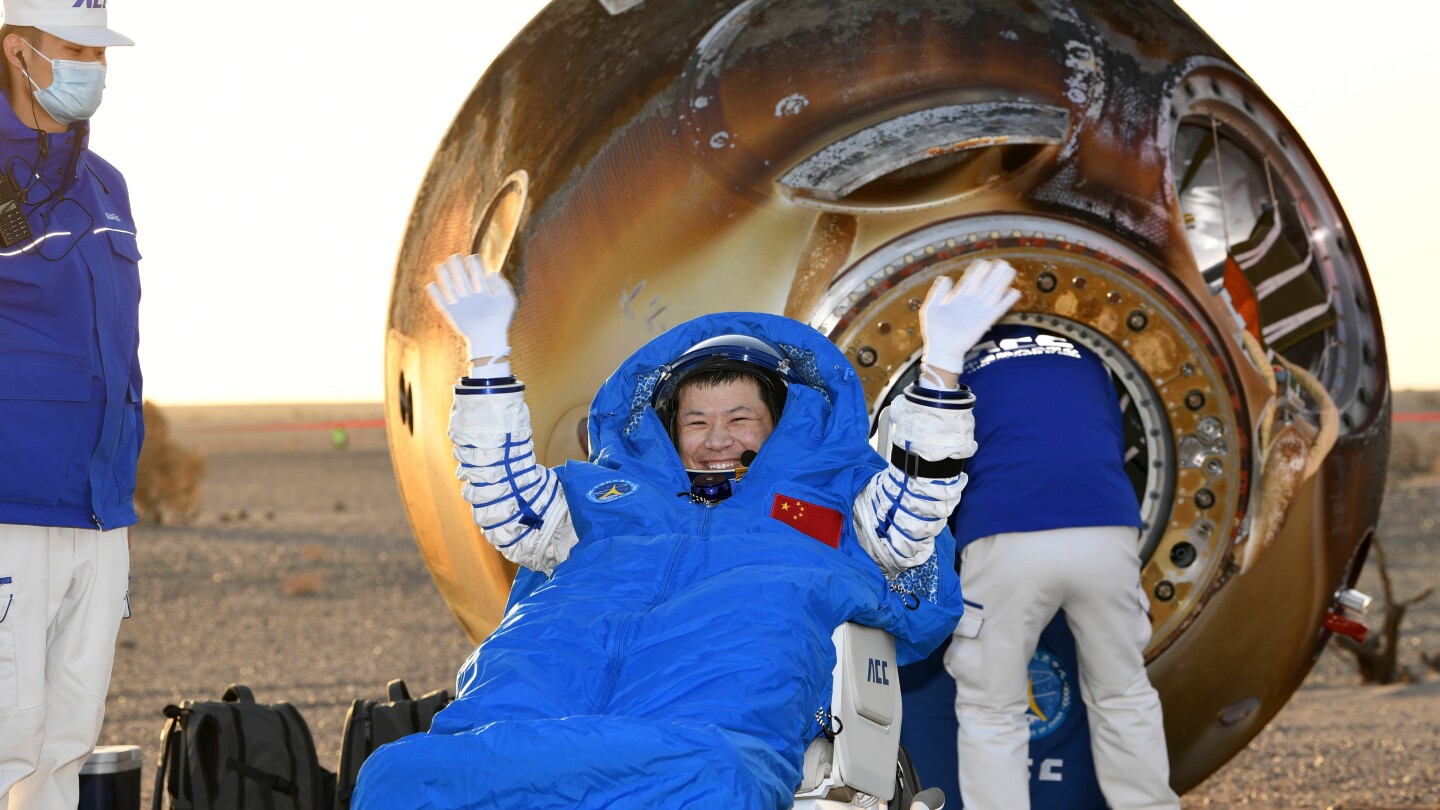
The crew, who had been stationed on China’s Tiangong space station for 204 days—the longest stay for any Chinese astronauts—touched down in the Gobi Desert in northern China. The team had originally planned to return on November 5 using their Shenzhou-20 spacecraft, but instead returned in the recently arrived Shenzhou-21 vessel.
China’s Manned Space Agency reported that tiny cracks were discovered in a window of the Shenzhou-20 return capsule, most likely caused by a collision with space debris. This prompted officials to abandon the original return plan and improvise a solution using the replacement crew’s spacecraft.
“The path of human space exploration is not smooth,” said mission commander Chen Dong after emerging from the capsule. “It’s filled with difficulties and challenges. But that is exactly why we choose to walk this path.”
The return capsule deployed its distinctive red and white striped parachute before landing in the barren landscape, sending up a large dust cloud upon impact. About 30 minutes later, the astronauts were carried out one by one, placed in chairs, and transported away in orange trucks across the desert terrain.
The incident highlights the growing concern of space debris hazards. Millions of pieces of debris—ranging from defunct satellites to tiny fragments from launches and collisions—orbit Earth at speeds faster than bullets. These objects pose significant risks to operational spacecraft, space stations, and astronauts during spacewalks.
During their extended stay, the astronauts conducted experiments alongside the newly arrived crew. The Chinese space agency maintained throughout the delay that the stranded team remained “in good condition, working and living normally.”
Among the returning payload were four mice that had arrived on Shenzhou-21 about two weeks prior. These animals were part of a study examining the effects of weightlessness and confinement on small mammals, research that will aid in developing technologies for breeding and monitoring animals in space. Scientists from the Chinese Academy of Sciences observed that the mice adapted quickly to microgravity, successfully eating, drinking, and sleeping independently. The mice will undergo further examination at a hospital.
The return was broadcast live on Chinese state television CCTV, underscoring the program’s status as a source of national pride. A Chinese flag was prominently displayed near the landing site, flapping in the desert wind.
China’s space program has made significant strides in recent years. The country developed the Tiangong space station, which means “Heavenly Palace,” after being excluded from the International Space Station due to U.S. national security concerns. The Chinese program, controlled by its military, has also successfully explored Mars with a robotic rover and aims to land humans on the moon by 2030.
The Tiangong, which hosted its first crew in 2021, is smaller than the International Space Station, which has been in continuous operation for 25 years. While China’s space station is newer, both orbital facilities have faced challenges with crew returns.
The ISS has experienced similar delays, including a notable incident in 2024 when two NASA astronauts’ planned one-week test flight of a new Boeing crew capsule stretched to nine months due to technical problems with the spacecraft.
The Chinese space agency has confirmed that the next mission, Shenzhou-22, will proceed as planned, though they did not specify an exact launch date. This incident may prompt additional safety measures for future missions as China continues to develop its ambitious space program.
Fact Checker
Verify the accuracy of this article using The Disinformation Commission analysis and real-time sources.

20 Comments
Space exploration is not without its risks, but the Chinese astronauts’ successful return despite the technical issues is a testament to their skill and training.
It’s remarkable that the team was able to adapt and use the backup spacecraft to complete their mission. Their adaptability and problem-solving abilities are impressive.
The challenges faced by the Chinese astronauts highlight the importance of continued research and innovation in space debris mitigation. Their safe return is a positive step forward.
204 days on the space station is an impressive feat. The crew’s endurance and commitment to their mission are commendable.
The challenges faced by the Chinese astronauts highlight the need for continued investment and research in space debris mitigation technologies. Their safe return is a success for the space program.
The crew’s ability to adapt and use the backup spacecraft is a testament to their training and the program’s contingency planning. It’s an impressive display of their capabilities.
The impact of space debris on spacecraft is a growing concern that all space agencies will have to contend with. Kudos to the Chinese team for their quick response and safe return.
Sending astronauts into space for extended periods is an impressive feat. The crew’s endurance and resilience are admirable.
Space debris poses a real threat to spacecraft, and the Chinese team’s ability to respond quickly and find a solution is praiseworthy. Their safe return is a success for the space program.
The extended stay on the space station is a significant achievement, demonstrating the Chinese astronauts’ adaptability and capabilities.
Space debris is a growing concern as more objects orbit the Earth. Kudos to the Chinese team for quickly troubleshooting the issue and finding a solution to bring their crew home safely.
The extended stay on the space station is also quite an achievement. 204 days is the longest for any Chinese astronauts – a testament to their training and capabilities.
It’s good to see the Chinese space program continuing to make progress, even with the unexpected challenges. Their willingness to adapt and improvise is commendable.
The path of space exploration is indeed filled with difficulties, but the rewards of scientific discovery and technological advancement make it worthwhile.
It’s good to see the Chinese space agency taking the necessary precautions to ensure the safety of their astronauts, even in the face of unexpected challenges like the space debris damage.
The astronauts’ willingness to persevere and find a way to complete their mission despite the setback is a testament to their professionalism and dedication.
The Chinese space program continues to make strides, and the safe return of the astronauts despite the technical issues is a positive development. Their adaptability and problem-solving skills are impressive.
The extended stay on the space station is a remarkable achievement, showcasing the crew’s endurance and the program’s capabilities.
Glad the Chinese astronauts made it back safely, despite the challenges they faced. Space exploration is no easy feat, but their dedication and resilience are admirable.
Agreed, dealing with space debris is a real risk that astronauts have to contend with. It’s impressive they were able to adapt and use the backup spacecraft to complete the mission.