


Listen to the article
China Imposes Export Restrictions on 40 Japanese Firms Amid Rising Tensions
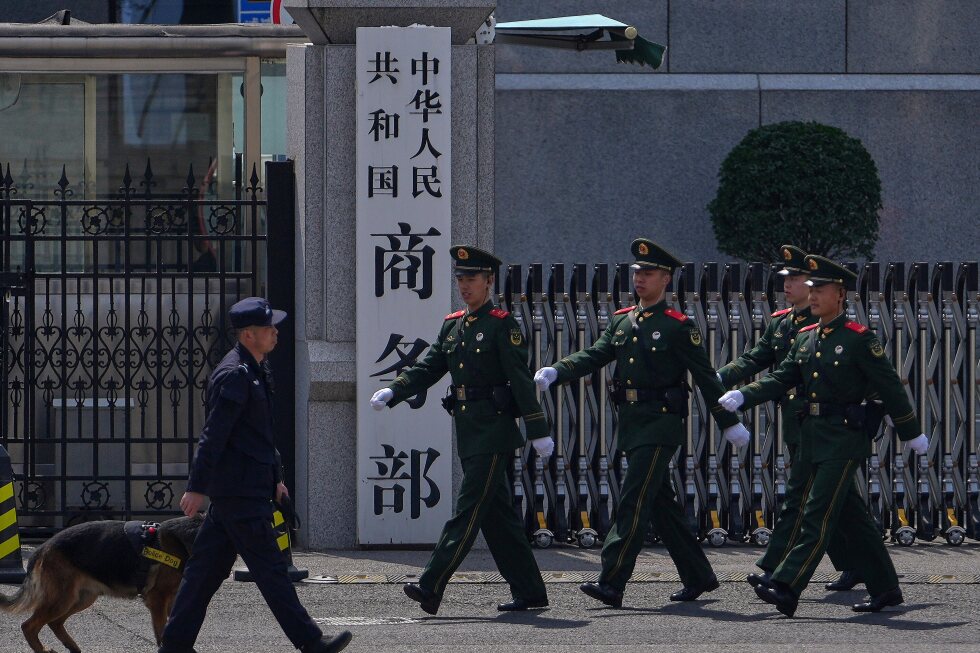
China has escalated its diplomatic dispute with Japan by imposing export restrictions on 40 Japanese entities that Beijing claims are contributing to Japan’s “remilitarization.” The announcement, made Tuesday by China’s Commerce Ministry, marks the latest development in deteriorating relations between the two Asian economic powerhouses.
The restrictions target 20 Japanese companies placed on an export control list and another 20 on a watchlist. Companies on the export control list are now banned from importing dual-use goods from China – items that can serve both civilian and military purposes. The affected businesses include several subsidiaries of Mitsubishi Heavy Industries involved in shipbuilding, aircraft engine production, and maritime machinery, as well as divisions of Kawasaki Heavy Industries and Fujitsu.
“All ongoing related activities must cease immediately,” the Chinese Commerce Ministry stated, adding that foreign organizations and individuals are also prohibited from providing China-originated dual-use items to these entities.
For the 20 companies on the watchlist, Chinese exporters must now submit individual export license applications along with risk assessment reports and written guarantees that the dual-use items won’t be used by Japan’s military. This group includes major firms such as Subaru Corporation, Mitsubishi Materials Corporation, and the Institute of Science Tokyo.
The tensions between the two nations have intensified since November when Japanese Prime Minister Sanae Takaichi implied Japan might intervene if China used military force against Taiwan. Beijing considers the self-governing island part of its territory and has consistently opposed any suggestion of foreign intervention regarding Taiwan.
China’s Commerce Ministry defended the measures as “entirely legitimate, reasonable, and legal,” aimed at curbing what it described as Japan’s remilitarization and nuclear ambitions. The ministry emphasized that the restrictions “are only aimed at a small number of Japanese entities” and “will not affect normal economic and trade exchanges between China and Japan.”
Japan responded swiftly, with the Foreign Ministry issuing a formal protest to China’s Deputy Chief of Mission to Japan, Shi Yong. Masaaki Kanai, head of the ministry’s Asian and Oceanian Affairs Bureau, described the restrictions as “absolutely unacceptable,” noting they solely target Japan and diverge from international practices.
“The measures announced today will never be tolerated. This is deplorable indeed. We strongly protest to China and urge them to lift them,” said Kei Sato, Japan’s deputy chief Cabinet secretary, during a Tuesday briefing. Sato indicated Japan would examine the measures in detail and “take actions accordingly,” mentioning uncertainty about whether rare earth trading would be affected.
The impact on Japanese businesses appears mixed. Representatives from Yashima Denki Co., an industrial equipment supplier, and chemical manufacturer NOF Corp, both on the watchlist, suggested minimal disruption as they have limited trade with China. Most other affected companies contacted by The Associated Press declined immediate comment.
The dispute occurs against the backdrop of shifting security dynamics in East Asia. Takaichi’s party recently secured a landslide victory in parliamentary elections, potentially reinforcing Japan’s conservative shift in security policies. This comes as Japan has increased defense spending in recent years, citing concerns about China’s growing military assertiveness in the region.
China has repeatedly criticized what it characterizes as Japan’s moves toward “remilitarization,” a sensitive issue given the history between the two countries dating back to World War II. Beijing’s export controls could potentially disrupt supply chains in critical industries, including aerospace, maritime equipment, and advanced electronics.
Analysts note that while the immediate economic impact may be limited, the measures signal a willingness by China to use economic leverage in diplomatic disputes, a strategy it has employed with several countries in recent years. The restrictions also come as global supply chains for critical technologies face increasing scrutiny and attempts at diversification by many developed economies.
Fact Checker
Verify the accuracy of this article using The Disinformation Commission analysis and real-time sources.

11 Comments
While the specifics of this dispute are complex, it’s clear that China and Japan are engaged in an escalating economic and political tug-of-war. Both sides will need to exercise restraint to prevent the situation from spiraling out of control.
This move by China seems designed to pressure Japan and limit its military capabilities. However, such economic coercion often backfires and can undermine trust between nations. A diplomatic solution would be preferable to an escalating trade war.
Agreed. Economic retaliation rarely resolves deep-seated geopolitical tensions. Hopefully the two countries can find a way to de-escalate through quiet diplomacy rather than public posturing.
This move by China appears to be a response to Japan’s efforts to strengthen its defense capabilities, which China views as a threat. It will be crucial for both sides to communicate openly and find a way to ease the tensions.
This is an escalation of the ongoing tensions between China and Japan. While geopolitical disputes are complex, restricting trade ties could have serious economic consequences for both countries. It will be important to watch how this situation develops.
You’re right, these types of trade actions can definitely hurt the economies on both sides. I wonder if there will be any efforts to de-escalate the situation through diplomatic channels.
The restrictions on dual-use goods to these Japanese companies suggest China is trying to limit Japan’s access to technology that could be used for military purposes. This reflects the deep mistrust and strategic rivalry between the two Asian powers.
You’re right, this speaks to the broader geopolitical tensions at play. It will be interesting to see how Japan and its allies respond to these export controls.
China seems to be using its economic leverage as a bargaining chip in its dispute with Japan over military and security issues. It will be interesting to see how Japan responds and if the two countries can find a way to resolve their differences.
That’s a good point. Economic coercion is often used as a diplomatic tool, but it can backfire if taken too far. Hopefully cooler heads will prevail and they can find a diplomatic solution.
The restrictions on dual-use goods show that China is directly targeting Japan’s military-industrial complex. This raises the stakes in the ongoing dispute and could provoke a strong reaction from Japan and its allies.