


Listen to the article
American Pasta Dispute: Italian Exports Face Potential 107% Tariff Shock
A routine U.S. Commerce Department antidumping review has escalated into a major trade dispute that threatens to more than double the price of Italian pasta for American consumers. The department is considering imposing a 92% duty on Italian pasta imports, which would come atop an existing 15% tariff implemented during the Trump administration.
The proposed tariffs target 13 Italian producers accused of selling pasta in the U.S. market at below-market prices, allegedly undercutting domestic competitors. The news has sent shockwaves through Italy, where pasta exports represent a significant economic sector.
“Pasta is a pretty small sector to pick on. I mean, there’s a lot bigger things to pick on,” said Sal Auriemma, whose Philadelphia shop, Claudio Specialty Food, has operated for over 60 years. “It’s basic food. Something’s got to be sacred.”
The U.S. represents Italy’s second-largest pasta export market after Germany, accounting for approximately 15% of the country’s €4 billion ($4.65 billion) in annual pasta exports, according to data from Italian farmers’ association Coldiretti.
Italian officials have mobilized to challenge the proposed tariffs. Agriculture Minister Francesco Lollobrigida told lawmakers in mid-October that the government is working with the European Commission and pursuing diplomatic efforts while supporting legal actions against the U.S. sanctions. EU Trade Commissioner Maros Sefcovic called the combined 107% levy “unacceptable” and questioned the evidence supporting the U.S. decision.
Industry representatives argue that the claims of dumping are unfounded. “Prices for Italian pasta in the U.S. remain high, and certainly higher than American-made rivals,” said Margherita Mastromauro, president of the pasta makers sector of Unione Italiana Food.
Economic experts warn the tariffs could devastate Italian pasta exports to America. “A duty rate of 107% would definitely kill this flow of export,” said Lucio Miranda, president of consultancy group Export USA. “It’s not going to be something that you can just dump on the consumer and move on, life continues. It will definitely be a deal killer.”
The Commerce Department’s investigation began in 2024 after complaints from Missouri-based 8th Avenue Food & Provisions, owner of pasta brand Ronzoni, and Illinois-based Winland Foods, whose portfolio includes Prince, Mueller’s, and Wacky Mac. The review focused on La Molisana and Garofalo, Italy’s two largest exporters.
According to the Commerce Department, these companies “presented information incorrectly or withheld it, significantly impeding analysis.” Based on these alleged deficiencies, the department proposed the 92% duty estimate and extended it to 11 other Italian companies.
White House spokesperson Kush Desai defended the action, stating, “After they screwed up their initial responses, the Commerce Department explained to them what the problems were and asked them to fix those problems; they didn’t. And then Commerce communicated the requirements again, and they didn’t answer for a third time.”
The sanctions would apply not only to future imports but also retroactively to shipments from the 12 months through June 2024. The Commerce Department’s final decision is scheduled for January 2, with a possible 60-day extension. The department noted that only about 16% of total Italian pasta imports may be affected.
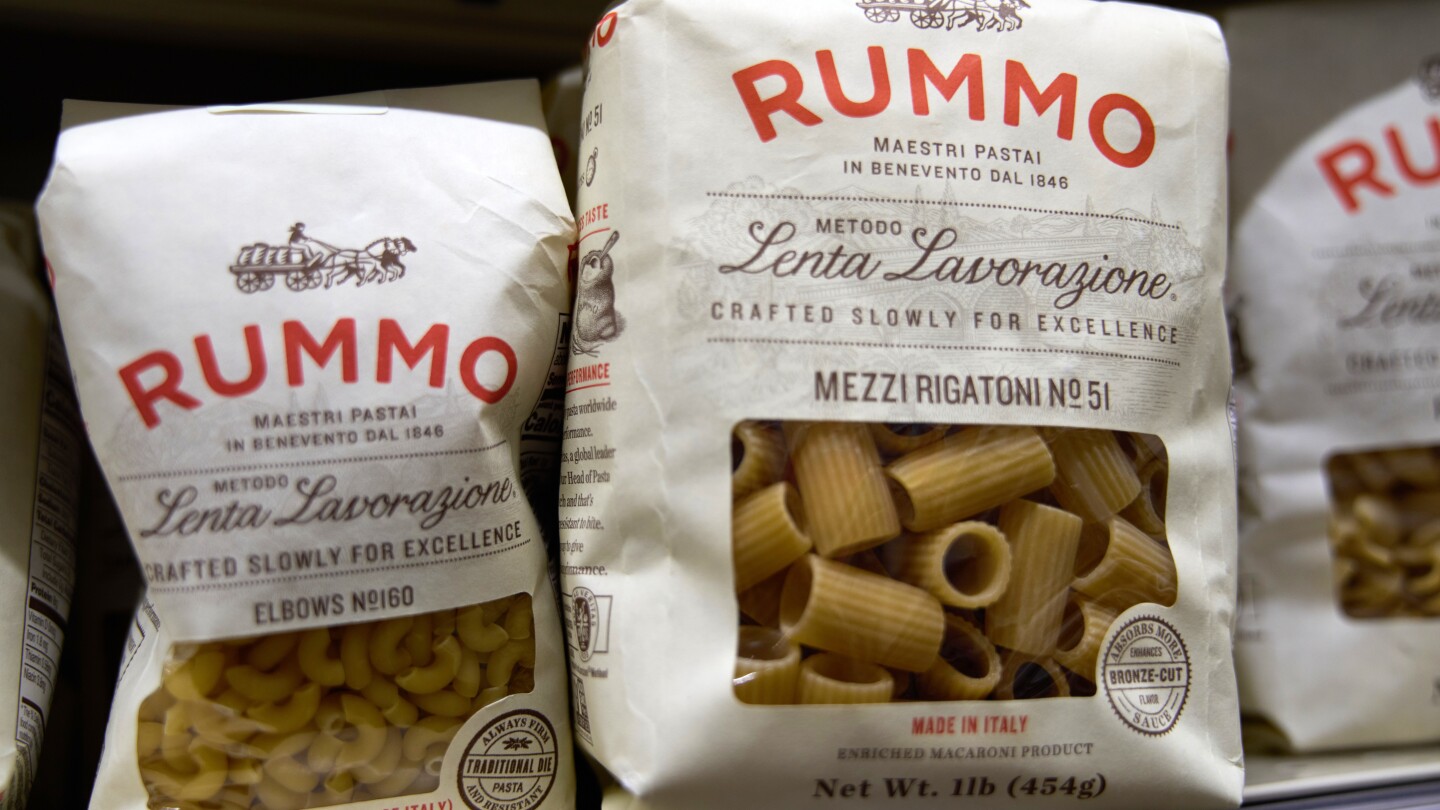
Cosimo Rummo, CEO of Pasta Rummo, a 178-year-old company based in Benevento, Italy, expressed outrage at the threat to his company’s annual €20 million in exports to the U.S.
“These tariffs are completely senseless,” Rummo said. “These are fast-moving consumer goods… Who would ever buy a pack of pasta that costs 10 dollars, the same price as a bottle of wine?”
Unlike some Italian brands like Barilla, which has established production facilities in the U.S. and would thus be spared from the tariffs, Rummo has no intention of relocating production.
For American retailers specializing in Italian imports, the situation has created uncertainty. Robert Tramonte, owner of The Italian Store in Arlington, Virginia, contacted his supplier for assurances and was told there’s enough inventory to maintain current prices until Easter.
Tramonte’s customers rely on him for authentic Italian products, and he expressed relief that they won’t immediately face price increases or have to resort to domestic alternatives. “They’ve tried to make Italian products and use the same ingredients, but the source wasn’t Italy,” he said. “And they just didn’t taste the same.”
Fact Checker
Verify the accuracy of this article using The Disinformation Commission analysis and real-time sources.

11 Comments
While I understand the desire to protect domestic industries, targeting pasta exports seems like an odd choice. Pasta is a cultural staple, not a strategic commodity. This could do more harm than good.
I’m curious to hear the rationale behind these proposed tariffs. Pasta isn’t typically seen as a strategic industry, so I’m surprised the U.S. is taking such a hard stance. Hopefully it doesn’t escalate into a broader trade war with Italy.
Interesting to see the Italian government mobilizing on this issue. Pasta exports must be a significant part of their economy. This could get messy if not handled carefully on both sides.
Making pasta great again? Sounds like the Trump administration is trying to appeal to Italian-American voters. But this could backfire and hurt regular consumers who just want affordable, quality pasta.
Exactly, pasta is a basic food that shouldn’t be politicized. I hope this dispute can be resolved through diplomacy rather than escalating trade barriers.
Tariffs on Italian pasta exports? That seems like an odd move that could hurt American consumers and businesses. I wonder if there’s more to the story than meets the eye.
Agreed, pasta is a staple food that shouldn’t be caught up in trade disputes. Hopefully cooler heads can prevail and find a compromise.
A 92% tariff on top of the existing 15% would be absolutely brutal for Italian pasta exporters. That kind of protectionism seems out of touch with modern global trade.
Agreed, those tariff levels are incredibly high. Hopefully the U.S. reconsiders and finds a more balanced approach that doesn’t overly burden Italian producers or American consumers.
Undercutting domestic competitors is a common rationale for antidumping duties, but a 92% tariff seems extreme, even for Trump’s trade policies. I hope common sense prevails on this one.
Fascinating to see the Italian government getting involved to defend their pasta exports. That suggests this issue is a major economic concern for them. I wonder what the endgame is for the U.S. here.