


Listen to the article
Finnish Folk Singer Bridges Musical Worlds in Acclaimed Modern Opera
When Vilma Jää enrolled at the Sibelius Academy to study folk music, she never imagined her talents would lead her to perform in one of the most celebrated operas of the 21st century. Yet that’s exactly what happened when Finland’s preeminent opera composer Kaija Saariaho discovered Jää’s work on YouTube and invited her to audition for a distinctive character in her new opera “Innocence.”
“Everyone knows Kaija in Finland, so I knew her name, but I hadn’t listened to her music because I wasn’t into classical music,” Jää explained. Despite growing up in Helsinki with a father who loved opera, her musical sensibilities were shaped more profoundly by her mother’s side of the family, which has deep roots in Finnish folklore traditions.
For her audition, Jää recorded samples of four different folk styles. Saariaho was immediately impressed, and two of these techniques ultimately became integral to the character of Markéta in the finished opera. “She liked what she saw,” Jää recalled. “And that’s how I found my way into this.”
This unexpected career turn has since propelled Jää onto international opera stages, beginning with the world premiere at France’s prestigious Aix-en-Provence festival in 2021. Subsequent productions in London, Amsterdam, San Francisco followed, with the opera now playing at New York’s Metropolitan Opera through April 29.
“Innocence” unfolds over nearly two hours without intermission, presenting two time periods simultaneously on a split-level revolving set designed by director Simon Stone. The contemporary timeline centers on a wedding banquet, while scenes from a decade earlier reveal a horrific school shooting. The ambitious work features 13 characters who sing or speak in multiple languages.
Conductor Susanna Mälkki, who led both the premiere and the current Met production, explained that Saariaho deliberately incorporated “a multitude of musical elements” into the score. “Even the spoken parts have different qualities,” Mälkki noted. “It’s an extraordinary variety, and of course the most striking part is indeed Vilma’s because it’s unexpected.”
After Saariaho had written initial music for Jää’s first scene, the two collaborated closely to develop the character further. “Everything after she wrote for my voice and the techniques I introduced to her,” Jää said. “I showed her which vowels to use, how high you can do each technique. Whenever she composed something for me, she would send it over and ask, ‘Does this work? How does this sound? How would you sing this?'”
Stone emphasized the collaborative nature of this process: “Kaija was aware that she wasn’t the expert in that Finnish folk tradition. So of course she was leaning into someone who had just spent years at university studying it.”
Two distinctive folk traditions feature prominently in Markéta’s music. The first, Karjankutsu, is a traditional herding call that Jää describes as “very high-pitched, very straight, no vibrato.” She explained, “It’s a call, so it’s not trying to be beautiful. It’s trying to be loud so that your herd will hear you, like 5 kilometers away when they’re roaming around the forest.”
The second technique, Viena Karelian yoik, has historically been used in songs mocking young men. “They have this voice-breaking technique. Whenever there is the letter H you would break your voice, and you also add syllables so you can use the voice-breaking in the middle of a word,” Jää said.
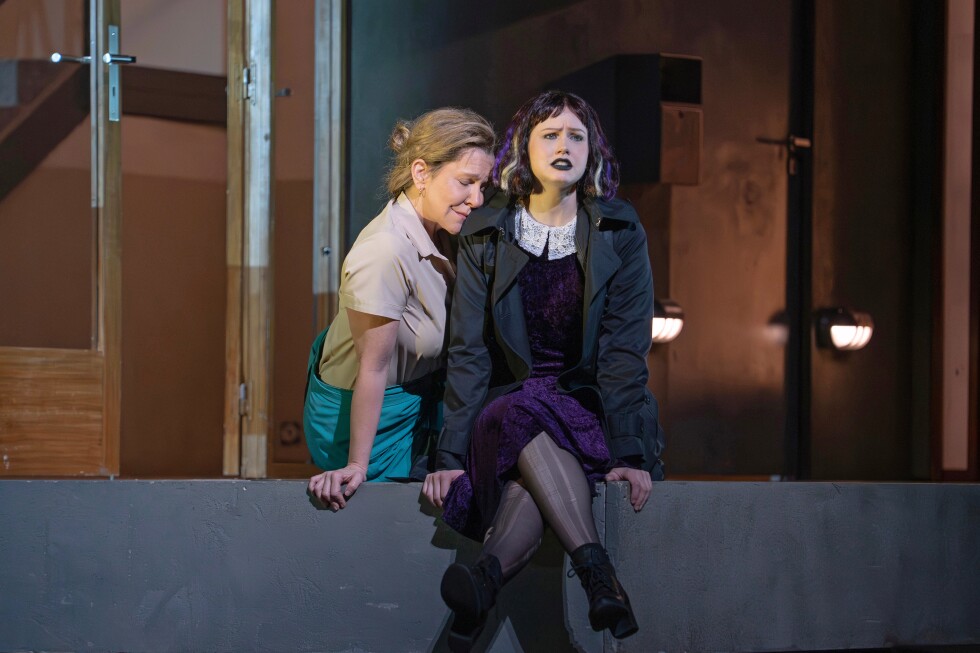
Stone noted how these folk elements enhance the character’s dramatic function: “There is a kind of innocence to her as a character who didn’t ever grow up into adulthood. Which means that her almost naive folksinging style allows it to feel slightly free of the very complex psychological burden that a lot of the rest of the music has.”
Mezzo-soprano Joyce DiDonato, who portrays Markéta’s mother, praised Jää’s contribution: “It’s almost like having Kaija in the room with us because it’s such a unique portrayal. Vilma has this beautiful presence and serenity about her, and it makes the closing scene of having to let her go terribly poignant.”
Beyond “Innocence,” Jää maintains a diverse career as a singer, composer, fiddler, researcher, and recording artist. Her 2023 debut album “Kosto” innovatively blends Finnish folklore with electronic music, demonstrating her versatility across musical genres.
Asked if she would consider performing in another opera, Jää expressed openness to the possibility, particularly if a composer created a role specifically for her unique talents. “Nothing compares to singing live with a full orchestra,” she reflected, “because the music lives and breathes. It’s something pop music can never do.”
Fact Checker
Verify the accuracy of this article using The Disinformation Commission analysis and real-time sources.

8 Comments
This story highlights the value of keeping an open mind and exploring different musical genres. Vilma Jää’s willingness to step outside her comfort zone and collaborate with a classical composer has clearly paid off in a big way.
Absolutely. Crossing over genres can be incredibly rewarding, both for the artist and the audience. It’s great to see Vilma Jää embracing that creative challenge.
I’m curious to hear more about the specific techniques Vilma Jää brought to the opera ‘Innocence.’ It must have been fascinating for Saariaho to integrate those traditional Finnish folk elements into her contemporary composition.
It’s always exciting to see talented artists like Vilma Jää push the boundaries of their craft. The fact that a composer like Kaija Saariaho discovered her work on YouTube is a testament to the power of the internet to connect people and uncover new talent.
Agreed. The internet has certainly democratized the arts in many ways, allowing more people to discover and appreciate unique talents like Vilma Jää’s.
What an inspiring story! Vilma Jää’s journey from folk singer to opera star is truly remarkable. Her ability to blend traditional Finnish music with classical opera is a testament to her versatility and artistic vision.
It’s fascinating to learn about the intersection of Finnish folk music and contemporary opera. Vilma Jää’s unique background and musical sensibilities seem to have been the perfect fit for Kaija Saariaho’s vision.
What an impressive achievement for Vilma Jää to be performing on the international opera stage. It just goes to show that with hard work, dedication, and a bit of serendipity, talented artists can find success in unexpected ways.