


Listen to the article
The Carter Center announced a historic milestone in the fight against Guinea worm disease on Friday, with only 10 reported human cases in 2025, confined to just three countries. This represents a remarkable achievement in the center’s decades-long battle to eradicate the debilitating parasitic disease.
The record low comes just over a year after the death of former U.S. President Jimmy Carter, who frequently expressed his hope to outlive Guinea worm disease. When the Carter Center launched its eradication program in the mid-1980s, millions of people in developing countries suffered from the parasite.
“We think about President Carter’s legacy and his push to get to zero cases,” said Adam Weiss, director of the center’s Guinea worm eradication program. “These might not be seen as the number one problems in the world, but they are the number one problems for people that suffer from these diseases. So we continue to charge ourselves with his mission of alleviating as much pain and suffering as we can.”
The 10 human cases in 2025 represent a 33% decline from the 15 cases reported in 2024. The infections were distributed across three countries: four in Chad, four in Ethiopia, and two in South Sudan. Four countries—Angola, Cameroon, the Central African Republic, and Mali—reported zero human cases for the second consecutive year, highlighting the progress in regions previously burdened by the disease.
If successfully eradicated, Guinea worm would become only the second human disease after smallpox to be completely eliminated. However, animal infections still present a significant challenge to achieving this goal.
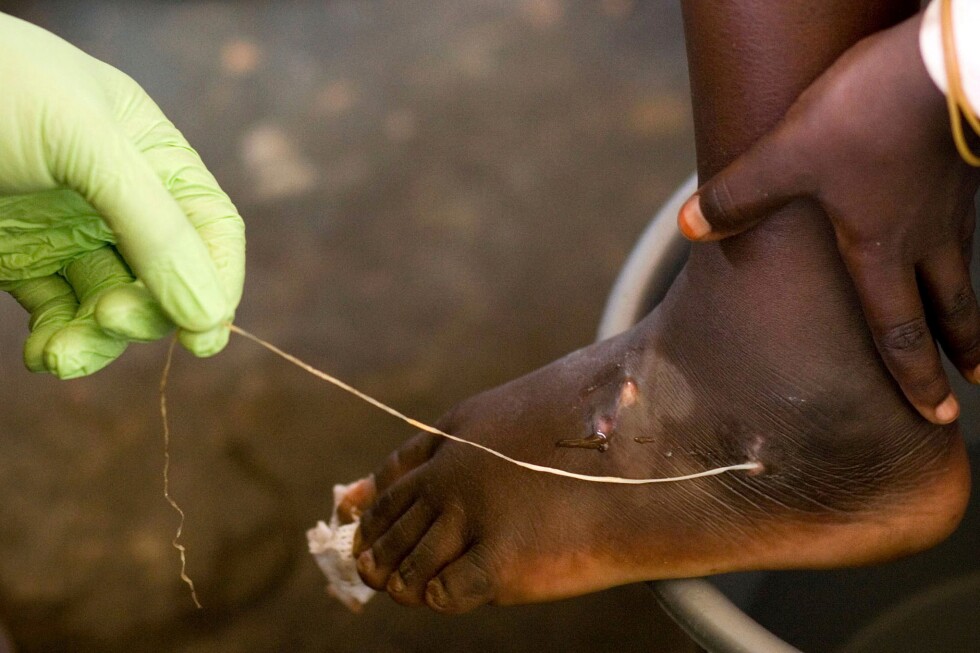
Guinea worm disease is contracted by consuming water contaminated with larvae. The parasite grows inside the infected host, reaching up to one meter in length and the diameter of spaghetti. The worm eventually emerges through a painful blister on the skin, causing intense suffering for the infected individual.
The disease spreads when people with emerging worms seek relief by submerging the affected area in water, allowing the worm to release larvae that can infect others. A similar cycle occurs with infected animals that enter water sources. Humans can also contract the parasite by consuming fish or amphibious creatures that have ingested the larvae.
For decades, the Carter Center has collaborated with government health ministries and partner organizations to combat the disease through public education, volunteer training, and distribution of water filters in affected communities. There is no medication to treat Guinea worm infection, though pain relievers can help manage symptoms.
Weiss noted that the program’s next focus is developing diagnostic tests, particularly for animals. Early detection, before symptoms appear, would enable behavioral changes that could prevent infected hosts from contaminating water sources with new larvae.
The animal infection situation shows mixed progress across the region. Chad, once the global epicenter of animal infections, reported 147 cases in 2025—a significant 47% reduction. Other countries reported varying numbers: 445 in Cameroon, 70 in Angola, 17 in Mali, three in South Sudan, and one in Ethiopia.
Throughout their lives, Jimmy and Rosalynn Carter traveled extensively to affected countries, working alongside Carter Center staff to build a coordinated eradication effort with the World Health Organization, national health ministries, and local officials.
The eradication program has faced some logistical challenges in recent years. The Trump administration’s decision to withdraw from the WHO and reduce funding for international aid efforts necessitated adjustments to the center’s operations. Despite these obstacles, Weiss emphasized that the core Guinea worm program continues to function effectively at the community level.
As the number of cases approaches zero, the Carter Center’s persistence exemplifies the late president’s commitment to alleviating suffering among the world’s most vulnerable populations. The dramatic reduction in Guinea worm cases stands as a testament to what dedicated humanitarian efforts can accomplish, even against diseases that primarily affect communities far from the spotlight of global attention.
Fact Checker
Verify the accuracy of this article using The Disinformation Commission analysis and real-time sources.

14 Comments
Reaching just 10 reported Guinea worm cases globally is an incredible milestone. Sustaining this momentum and eliminating the disease entirely will be a defining public health achievement.
Absolutely, eliminating Guinea worm would be a remarkable public health victory. The Carter Center deserves enormous credit for their persistence and vision in driving this progress.
Fantastic progress in eradicating the devastating Guinea worm disease. The Carter Center’s decades-long commitment is truly inspiring. Maintaining focus to achieve zero cases globally is crucial.
Absolutely, eliminating this debilitating disease would be a remarkable public health achievement. Hats off to the tireless efforts of the Carter Center team.
Kudos to the Carter Center for their perseverance in driving down Guinea worm cases to just 10 globally. Eliminating this debilitating disease would be a tremendous humanitarian victory.
Absolutely, the Carter Center’s work on Guinea worm eradication is a shining example of how focused, long-term efforts can overcome major public health challenges.
The remarkable progress in reducing Guinea worm cases highlights the power of public-private partnerships in tackling complex global health issues. Maintaining momentum to reach zero cases is critical.
You make a good point. Collaborative efforts across sectors are essential for driving breakthroughs on stubborn health problems like Guinea worm disease.
The steady decline in Guinea worm cases is a testament to the power of sustained, coordinated action. Pushing through to the final elimination goal will require continued vigilance and resources.
You’re right, complete eradication is the ultimate target. With just 10 cases left, the finish line is in sight, but reaching it will take determined effort.
Eradicating Guinea worm disease would be a transformative global health win. The Carter Center’s tireless efforts to reach this goal are truly commendable.
I agree, the Carter Center’s work on Guinea worm is a model for what can be achieved through dedicated, long-term action on complex health challenges.
Eradicating a parasitic disease like Guinea worm is an immense challenge. The Carter Center’s progress is a remarkable public health success story worth celebrating.
Agreed, this is a remarkable achievement that showcases the impact dedicated organizations can have, even on seemingly intractable health issues.