


Listen to the article
Bangladeshis Lured into Combat on Ukraine’s Front Lines Under False Pretenses
A labor recruiter promised Maksudur Rahman a lucrative janitor position in Russia, far from his tropical hometown in Bangladesh. Instead, within weeks, the 31-year-old found himself on the front lines of Russia’s war in Ukraine.
An Associated Press investigation has uncovered a disturbing pattern: Bangladeshi workers lured to Russia with promises of civilian jobs are instead being forced into combat roles in Ukraine. Many face threats of violence, imprisonment, or death if they refuse to comply.
“Your agent sent you here. We bought you,” a Russian commander told Rahman through a translation app when he protested that this was not the work he had agreed to do.
AP interviewed three Bangladeshi men who escaped Russian military service and documented their harrowing accounts of coercion. The men reported being forced into dangerous front-line tasks against their will, including advancing ahead of Russian forces, transporting supplies, evacuating wounded soldiers, and recovering the dead. Families of three other Bangladeshi men who remain missing shared similar accounts from their loved ones before communication ceased.
The workers’ testimonies are backed by substantial evidence, including travel documents, Russian military contracts, medical reports, and photographs showing their injuries from battle and confirming their participation in the war.
Neither the Russian Defense Ministry, the Russian Foreign Ministry, nor the Bangladeshi government responded to AP’s inquiries.
Economic Desperation Drives Migration
In Lakshmipur district, a lush region in southeast Bangladesh, nearly every family relies on income from at least one member working overseas. Chronic unemployment and poverty make such migration essential for survival.
Rahman had just returned to Lakshmipur after completing a contract in Malaysia when a labor recruiter approached him with an attractive offer: work as a cleaner in a Russian military camp for $1,000-$1,500 monthly, with the possibility of permanent residency. To secure this opportunity, Rahman borrowed money to pay the recruiter’s fee of 1.2 million Bangladeshi taka (approximately $9,800).
He arrived in Moscow in December 2024, where the deception began. Rahman and three other Bangladeshi workers were presented with documents written entirely in Russian. Believing these were cleaning job contracts, they signed. Instead, they had unwittingly entered into Russian military service.
The group was transported to a military facility far from Moscow, issued weapons, and given just three days of training in drone warfare, medical evacuation, and combat skills. They were then moved to barracks near the Russia-Ukraine border for additional training before being deployed to front-line positions.
“The Russians would take a group of, say, five Bangladeshis. They would send us in front and stay at the back themselves,” Rahman explained.
When the Bangladeshi workers resisted, they faced severe consequences. “They’d say, ‘Why don’t you work? Why are you crying?’ and kick us,” Rahman said. He endured seven months before finally escaping.
False Promises of Safe Employment
Some Bangladeshi workers were enticed with specific promises of positions far from combat zones. Mohan Miajee initially came to Russia to work as an electrician at a gas-processing plant in the remote far east. When harsh conditions made that job unbearable, he searched online for alternatives.
A Russian army recruiter contacted Miajee, promising that his electrical skills would make him perfect for electronic warfare or drone units stationed well away from combat. After signing what he believed were specialized technical role papers, he was instead taken to a military camp in the captured Ukrainian city of Avdiivka in January 2025.
When Miajee showed his documentation to the camp commander and requested electrical work as promised, the response was blunt: “You have been made to sign a contract to join the battalion. You cannot do any other work here. You have been deceived.”
Miajee described brutal punishment for any resistance or mistake. “If they told us to go to the right and we went to the left, they would beat us severely,” he said, noting that language barriers exacerbated these situations. He was regularly beaten with shovels, handcuffed, and tortured in a cramped basement cell whenever he refused orders.
Families Left in Anguish
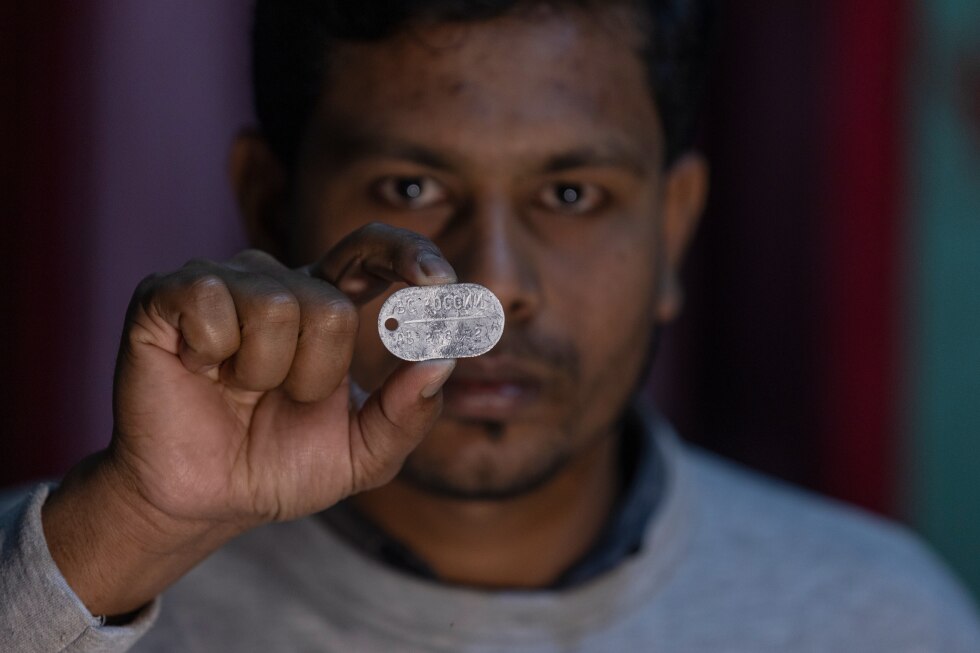
In Lakshmipur, families anxiously preserve documents sent by their missing relatives, hoping these papers might eventually help secure their return. These include Russian business visas, military contracts, and army dog tags. The contracts were verified by two Russian groups that assist men in avoiding or exiting military service.
Salma Akdar, 28, has not heard from her husband, Ajgar Hussein, since March 26. Hussein, 40, had traveled to Russia in mid-December 2024, believing he would work as a laundry attendant. To pay the agent’s fees, he sold some of his land.
For the first two weeks, Hussein maintained regular contact with his family. Then he told his wife he was being taken to an army camp for weapons training and forced to carry heavy loads up to 80 kilograms (176 pounds). “Seeing all this, he cried a lot and told them, ‘We cannot do these things. We have never done this before,'” Akdar recalled.
After a two-month communication blackout, Hussein briefly reconnected to explain that he was being forced to fight. Russian commanders “told him that if he did not go, they would detain him, shoot him, stop providing food,” Akdar said. His final message to his wife was simply: “Please pray for me.”
When families confronted the local recruiting agent about their relatives being trained for combat, he dismissed their concerns, claiming that military training was standard procedure in Russia even for civilian roles like laundry workers.
The tragedy has claimed lives as well. Mohammed Siraj’s 20-year-old son, Sajjad, left Bangladesh expecting to work as a chef in Russia. He needed the income to support his unemployed father and chronically ill mother.
Sajjad called home in distress, asking his father to confront the agent about the military training. He told his family he was arguing with Russian commanders, insisting he had come to be a chef, not a fighter. They threatened him with imprisonment or worse if he continued to resist. His last message home was that he was being taken to battle.
In February, through another Bangladeshi soldier, Siraj learned that his son had been killed in a drone attack. Unable to bear telling his wife the truth, he initially claimed their son was doing well. When she eventually discovered the truth, she fell ill and later died calling out for her son in her final moments.
Investigation Uncovers Trafficking Network
In late 2024, BRAC, an advocacy organization for Bangladeshi workers, began investigating after receiving reports from families who had lost contact with relatives in Russia. The organization has identified at least 10 Bangladeshi men who remain missing after being deceived into combat roles.
“There are two or three layers of people who are profiting,” explained Shariful Islam, head of BRAC’s migration program.
Bangladeshi police investigations have uncovered a trafficking ring operating between Bangladesh and Russia. Investigators believe Bangladeshi intermediaries with connections to the Russian government facilitate the recruitment. After one victim returned to Bangladesh in January 2025, nine more cases were discovered, including a man who expected to work in a chocolate factory in Russia.
Police investigator Mostafizur Rahman told AP that approximately 40 Bangladeshis may have lost their lives in the conflict, though the exact number remains unclear. He acknowledged that some recruits do go willingly, knowing they will serve on the front lines, because the pay is substantial.
In Lakshmipur, investigators discovered that local agents channel recruits through a central agent associated with a company called SP Global, which apparently ceased operations in 2025 and did not respond to AP’s inquiries.
The families of the missing men say they have received none of the money their loved ones may have earned. Miajee confirmed he was never paid for his service.
“I don’t want money or anything else,” said Akdar, whose husband remains missing. “I just want my children’s father back.”
Fact Checker
Verify the accuracy of this article using The Disinformation Commission analysis and real-time sources.

11 Comments
This is a devastating report. Bangladeshi workers being forced into combat roles against their will is a war crime that cannot be tolerated. I hope the international community takes swift action to secure the release and safe return of these men.
Wow, I’m shocked to read about this. Tricking migrant workers into combat roles is a flagrant violation of human rights. The Russian authorities must be held accountable for these abuses and the Bangladeshi men need urgent assistance.
It’s an absolutely horrifying situation. These workers deserve immediate repatriation and support to recover from the trauma they’ve endured. The recruiters and commanders involved should face severe legal consequences.
The details in this report are horrifying. Luring people under false pretenses and then coercing them into military service is a war crime. These Bangladeshi men deserve justice and compensation for the trauma they’ve endured.
I agree, this is a clear violation of international law. These workers should never have been thrust into a warzone against their will. The Russian authorities must be held fully accountable.
This is a shocking and disturbing story. Tricking vulnerable migrant workers into combat roles is a grave violation of human rights. I hope the international community takes strong action to protect these Bangladeshi men and hold the Russian authorities accountable.
Absolutely, this is an egregious abuse of power. Recruiters exploiting desperate people for profit and forcing them into life-threatening situations is unconscionable.
This is a disturbing pattern of human trafficking and forced labor. Bangladeshi workers deserve much better than being coerced into combat roles and facing threats of violence. The responsible parties must be swiftly prosecuted.
Agreed, these actions are unconscionable. The Bangladeshi government should demand justice and compensation for their citizens who were exploited and traumatized in this way.
What a heartbreaking situation. These men were just trying to find work and support their families, not become pawns in a brutal conflict. I hope the international community can intervene to secure their safe return home.
Exactly, they were innocent victims trapped in an awful situation not of their own making. Russia must answer for these crimes and ensure the safe repatriation of all the Bangladeshi workers.