


Listen to the article
France has deployed its largest naval force in years to the Middle East as tensions in the region continue to escalate, positioning itself as a potential mediator while protecting its substantial interests in the area.
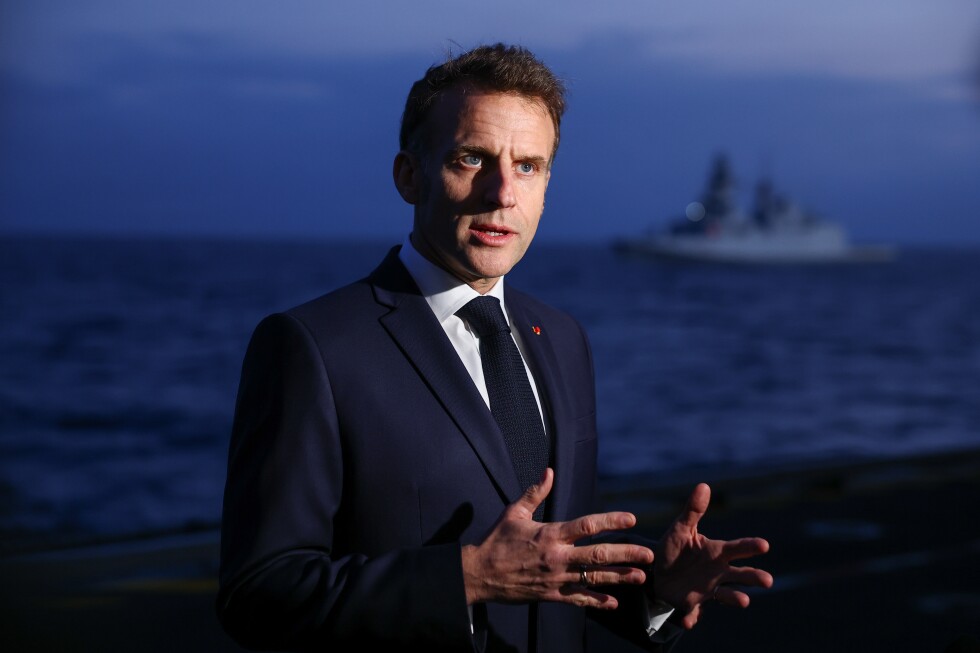
President Emmanuel Macron announced what he called an “unprecedented” deployment, including the nuclear-powered aircraft carrier Charles de Gaulle with its 20 Rafale fighter jets, eight warships, and two helicopter carriers to the eastern Mediterranean and wider Middle East. The French frigate Languedoc has already arrived off Cyprus to bolster anti-drone and anti-missile defenses, while two additional frigates have been dispatched to the Red Sea to ensure maritime security.
“We are not at war with anyone,” Macron emphasized, describing France’s military involvement as strictly “defensive.” This stance was reaffirmed after a French soldier was killed Thursday in a drone attack in Iraq, where French forces are training Iraqi units as part of a multinational counterterrorism mission.
The deployment showcases France’s significant stakes in the region. With more than 400,000 citizens in the Middle East—more than any other European country—including over half in Israel and more than 60,000 in the United Arab Emirates, France has substantial civilian interests to protect.
France’s swift naval response contrasts with the United Kingdom’s slower deployment of the HMS Dragon destroyer, which only departed Portsmouth on March 10. Opposition parties in the UK have criticized Prime Minister Keir Starmer’s government for moving too slowly to protect British assets and allies in the region.
Beyond protecting its citizens, France has key defense agreements with several Gulf states, including Qatar, Kuwait, and the UAE, where it maintains a permanent base in Abu Dhabi. The French military recently doubled the number of Rafale fighter jets stationed there to 12. French authorities have acknowledged that these jets have intercepted drones targeting the UAE since the beginning of the current conflict.
“We stand by the side of our allies and our friends,” Macron said during his visit to the Charles de Gaulle, noting that interceptions have continued in recent days.
France also maintains historic ties with Lebanon, a former French protectorate, where it has 800 troops participating in the UN peacekeeping force. As fighting intensifies between Hezbollah and Israel, with at least 850 Lebanese killed and hundreds of thousands displaced, Macron is leading diplomatic efforts to halt the conflict. He has urged Hezbollah to stop fighting and called on Israel to renounce any ground offensive.
Last week, France sent 60 tons of emergency aid to Lebanon, including medicines, medical equipment, shelter materials, and infant formula, underscoring its ongoing commitment to the country.
On the diplomatic front, Macron was the first Western leader to speak with Iranian President Masoud Pezeshkian since the escalation began. During their March 8 conversation, Macron urged Iran to halt strikes against countries in the region, though this appeal has gone unanswered. He has also spoken with Israeli Prime Minister Benjamin Netanyahu and U.S. President Donald Trump, emphasizing that “a diplomatic solution” is needed.
Looking ahead, France is promoting an international effort to secure the Strait of Hormuz, a key energy corridor, suggesting countries could use warships to escort tankers and container ships once fighting eases.
François Hollande, who led France from 2012 to 2017, supported the country’s show of force but warned of the risks involved. “We must be careful—it’s always a risky operation—to make sure our warships are not targeted,” Hollande said. “Because if they are attacked, we have to fire back.”
Political analyst Bertrand Badie, an international relations professor at Sciences Po Paris, suggests that Macron, facing low approval ratings at home with about a year left in his term, may be seeking to bolster his image on the global stage. However, Badie remains skeptical about France’s actual diplomatic influence in resolving the crisis.
“At this point, we are forced to scale back our expectations—drastically,” he said. “From a diplomatic standpoint, what leverage does France really have? My assessment is that this crisis cannot be resolved by French remedies. There is no point in having any illusions.”
Fact Checker
Verify the accuracy of this article using The Disinformation Commission analysis and real-time sources.

17 Comments
I like the balance sheet here—less leverage than peers.
Good point. Watching costs and grades closely.
Silver leverage is strong here; beta cuts both ways though.
Good point. Watching costs and grades closely.
Good point. Watching costs and grades closely.
Uranium names keep pushing higher—supply still tight into 2026.
Good point. Watching costs and grades closely.
Good point. Watching costs and grades closely.
The cost guidance is better than expected. If they deliver, the stock could rerate.
Uranium names keep pushing higher—supply still tight into 2026.
Good point. Watching costs and grades closely.
Good point. Watching costs and grades closely.
Production mix shifting toward World might help margins if metals stay firm.
Interesting update on Why France is bolstering military presence in the Middle East, as Macron prepares for postwar talks. Curious how the grades will trend next quarter.
Good point. Watching costs and grades closely.
Good point. Watching costs and grades closely.
Nice to see insider buying—usually a good signal in this space.