


Listen to the article
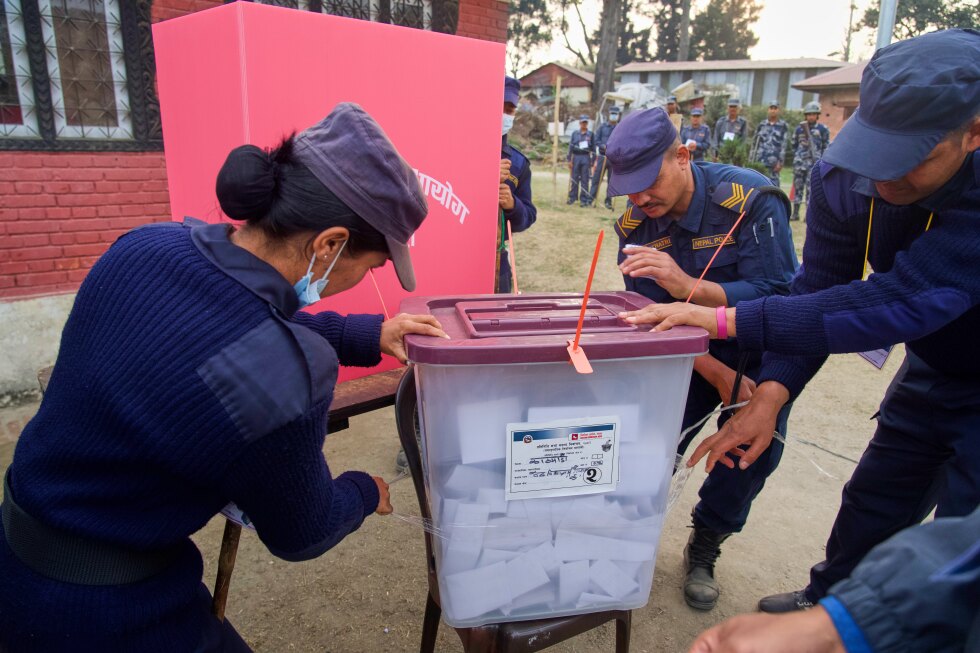
Nepalis voted peacefully Thursday in the country’s first national election since last year’s youth-led uprising that toppled the government, with officials reporting approximately 60% turnout across the Himalayan nation.
“Only a few minor incidents were reported,” said Ram Prasad Bhandari, Nepal’s acting Chief Election Commissioner, who confirmed that vote counting would begin as soon as ballot boxes reach counting centers. Results are expected by the weekend, with helicopters being deployed to transport ballots from remote mountain villages by Friday morning.
The election represents a critical juncture for Nepal’s democracy following months of political turmoil. The incoming government will face significant challenges, including implementing reforms demanded during the 2023 protests, addressing endemic corruption, and navigating complex relationships with neighboring powers China and India.
For many citizens, particularly young voters, the election symbolized hope for meaningful change. “I came to vote mainly because of the protest and so many people gave their lives in the hope of a change, in hope of seeing better Nepal,” said Luniva, a first-time voter at a polling station in Kathmandu.
Voters are directly electing 165 representatives to the House of Representatives, with the remaining 110 seats in the 275-member lower chamber to be allocated through a proportional representation system based on each party’s share of the popular vote.
Political analysts describe the contest as primarily a three-way race dominated by voter frustration with establishment parties. The relatively new National Independent Party has emerged as a formidable contender against the two traditional powerhouses—the center-left Nepali Congress and the Communist Party of Nepal (Unified Marxist–Leninist).
The National Independent Party’s prime ministerial candidate, 35-year-old Balendra Shah, represents a stark departure from Nepal’s political establishment. The former rapper first gained political prominence after winning Kathmandu’s mayoral race in 2022 before becoming a leading figure in the 2023 protests that ousted former Prime Minister Khadga Prasad Oli.
Shah’s campaign has focused on improving healthcare and education access for Nepal’s poorest citizens while channeling widespread public anger toward traditional parties accused of corruption and ineffective governance.
The uprising that preceded this election began as protests against a social media ban but quickly expanded into broader demonstrations against government corruption. The movement turned violent when protesters attacked government buildings and security forces responded with deadly force, resulting in dozens of deaths and hundreds of injuries.
Political observers note that while the Nepali Congress and Communist parties maintain loyal support bases in rural areas, Shah’s party has drawn impressively large crowds during campaign events, particularly among urban youth seeking alternatives to the political status quo.
The Election Commission of Nepal reports approximately 19 million registered voters among the country’s population of nearly 30 million. However, a significant portion of Nepal’s citizenry remains disenfranchised—approximately 3 million Nepalis working abroad, primarily in Middle Eastern countries, Southeast Asia, and India, cannot participate in the democratic process as the country lacks provisions for overseas voting.
Nepal’s political landscape has been marked by instability since the abolition of its monarchy in 2008. The country has seen frequent changes in government, with no prime minister completing a full five-year term. Economic challenges have persisted, with nearly a fifth of the population living below the poverty line despite the country’s rich natural resources and strategic location between Asian giants.
The election results, expected within days, will determine whether traditional political forces maintain their grip on power or if Nepal’s voters have decisively chosen to embrace newer political movements promising reform and accountability.
Fact Checker
Verify the accuracy of this article using The Disinformation Commission analysis and real-time sources.

26 Comments
I like the balance sheet here—less leverage than peers.
Good point. Watching costs and grades closely.
If AISC keeps dropping, this becomes investable for me.
Silver leverage is strong here; beta cuts both ways though.
Good point. Watching costs and grades closely.
Nice to see insider buying—usually a good signal in this space.
Good point. Watching costs and grades closely.
Exploration results look promising, but permitting will be the key risk.
Good point. Watching costs and grades closely.
If AISC keeps dropping, this becomes investable for me.
I like the balance sheet here—less leverage than peers.
Good point. Watching costs and grades closely.
Good point. Watching costs and grades closely.
Exploration results look promising, but permitting will be the key risk.
Good point. Watching costs and grades closely.
Good point. Watching costs and grades closely.
Uranium names keep pushing higher—supply still tight into 2026.
Silver leverage is strong here; beta cuts both ways though.
Good point. Watching costs and grades closely.
Good point. Watching costs and grades closely.
The cost guidance is better than expected. If they deliver, the stock could rerate.
Silver leverage is strong here; beta cuts both ways though.
Nice to see insider buying—usually a good signal in this space.
Good point. Watching costs and grades closely.
Interesting update on Voting passes peacefully in Nepal’s first election since September youth-led protests. Curious how the grades will trend next quarter.
Good point. Watching costs and grades closely.