


Listen to the article
Argentine Teens Find Identity in “Therian” Movement, Embracing Animal Personas
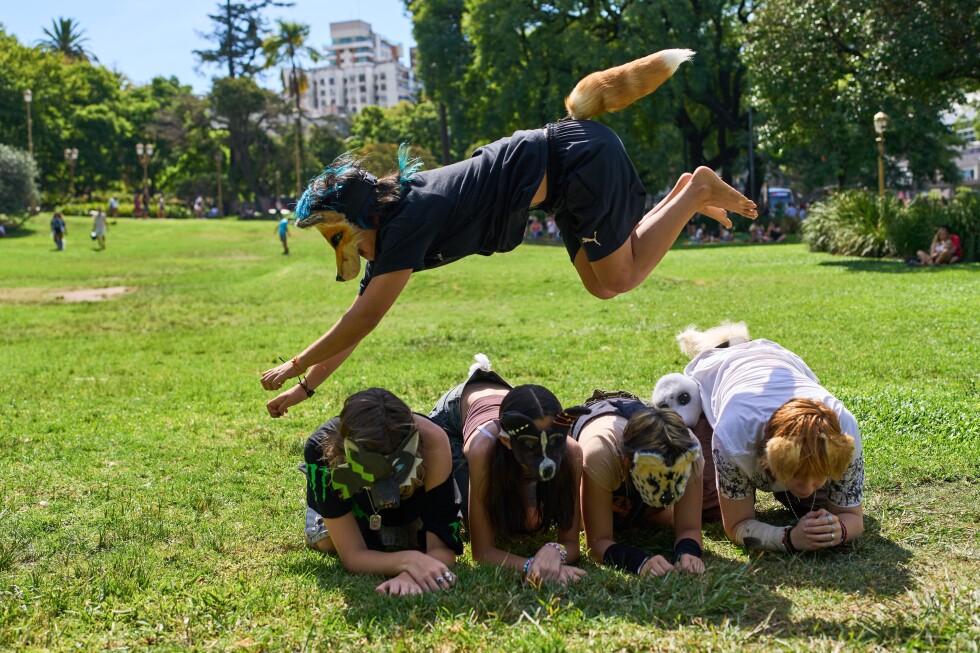
On a recent Sunday in Buenos Aires, an unusual scene unfolded in a city plaza. Sofía, wearing a lifelike beagle mask, ran across the grass on all fours. Nearby, 15-year-old Aguara leapt through the air, clearing an obstacle course while mimicking the precise movements of a Belgian Malinois dog. Others dressed as cats and foxes perched in tree branches, keeping their distance from curious onlookers.
These teenagers are part of a growing movement of “therians” – individuals who identify mentally, spiritually or psychologically with non-human animals. The phenomenon has rapidly gained traction across Argentine social media in recent months, particularly on TikTok, where the hashtag #therian has accumulated over 2 million posts, with Argentina leading engagement among Latin American countries.
“I wake up like a normal person and live my life like a normal person,” explains Aguara, who counts her age as the equivalent of two years and two months in dog years. “I simply have moments when I like being a dog.”
As the self-proclaimed leader of her “pack,” Aguara has built an impressive following of more than 125,000 on TikTok, where she coordinates regular meetups throughout the Argentine capital. Her influence within the community has positioned her as a central figure in the movement’s expansion.
The trend has caught the attention of major influencers and media outlets across the country, generating reactions ranging from amusement and bewilderment to outright anger. The visibility has prompted psychologists to analyze the phenomenon and its implications for adolescent development and social identity.
For many participants, the therian community offers a sense of belonging and acceptance that may be absent elsewhere in their lives. Aru, a 16-year-old who attended the park gathering wearing a seal mask, represents what she calls the “otherpaw” branch of therians – individuals who wear masks and tails or move on all fours primarily for enjoyment rather than identity reasons.
“It’s not necessarily about identifying as an animal,” Aru explains. She believes the trend has flourished in Argentina because of the country’s “fairly free” social environment that allows for such expression.
The movement raises questions for parents and mental health professionals about whether such behavior represents typical adolescent exploration or something more concerning. Débora Pedace, a psychologist and director of the Integral Therapeutic Center in Buenos Aires, acknowledges the complex reactions the phenomenon generates but offers a measured assessment.
“From a psychological standpoint, this is a symbolic identification with an animal,” Pedace explains. “It becomes pathological or alarming only when it turns into a deeply rooted belief and the person fully assumes the role of an animal, potentially leading to self-harm or hurting others.”
Most therians maintain that their animal identification is just one aspect of otherwise typical teenage lives. They attend school, participate in family activities, and maintain regular friendships. The animal persona emerges in specific contexts or emotional states, serving as a form of self-expression rather than a complete identity replacement.
Social media has played a crucial role in the movement’s rapid growth. TikTok’s algorithm has helped connect Argentine therians with like-minded individuals both locally and internationally, creating a global community that shares experiences, tips for crafting personas, and emotional support.
The therian phenomenon represents the latest example of how digital platforms allow niche communities to form and expand rapidly. While previous generations might have explored alternative identities in isolation or small local groups, today’s teenagers can instantly connect with thousands of others who share their interests or experiences.
For now, Buenos Aires parks continue to serve as gathering spots for these animal-identifying teens, who find in their shared experiences a sense of community and validation. Whether the trend represents a lasting identity movement or a passing phase of adolescent exploration remains to be seen, but its emergence highlights the complex interplay between digital culture, identity formation, and community-building in contemporary youth culture.
Fact Checker
Verify the accuracy of this article using The Disinformation Commission analysis and real-time sources.

12 Comments
This ‘therian’ phenomenon highlights the diverse and complex ways in which people are navigating identity and self-expression, particularly among younger generations. It will be interesting to see how this trend evolves and what it might reveal about broader societal and cultural shifts.
Absolutely. The rise of the ‘therian’ movement in Argentina is a compelling example of how new forms of identity exploration and expression are emerging, driven by the unique experiences and perspectives of young people.
The idea of young people identifying as animals and embracing animal-like behaviors is certainly thought-provoking. I wonder if this trend speaks to a broader societal desire to reconnect with nature and explore more primal aspects of the human experience.
That’s an insightful observation. The ‘therian’ movement may reflect a yearning for a more visceral, embodied connection to the natural world that is often lacking in modern, urbanized life.
This is a fascinating cultural phenomenon. While unusual, it’s interesting to see young people exploring identity and connection with the natural world in this way. I wonder what the broader social and psychological implications might be.
I agree, it’s an intriguing expression of identity. It would be insightful to understand the motivations and experiences of these ‘therians’ in more depth.
This ‘therian’ movement seems to be gaining quite a bit of traction, especially on social media platforms like TikTok. It raises some interesting questions about how young people are navigating identity and self-expression in the digital age.
The rapid growth of this trend across Argentina is certainly noteworthy. I’m curious to learn more about the cultural and societal factors that may be contributing to its popularity.
While this ‘therian’ phenomenon may seem unusual to some, it’s important to approach it with an open and understanding mindset. Self-identity is a complex and deeply personal experience, and we should respect the ways in which people choose to express it.
Agreed. Rather than passing judgment, it would be valuable to try to understand the perspectives and experiences of these young ‘therians’ and how this movement is shaping their sense of identity and connection to the natural world.
While the ‘therian’ movement may seem unconventional, it’s important to approach it with empathy and an open mind. These young people are engaging in a deeply personal process of self-discovery and identity formation, which can take many different forms.
Agreed. Rather than dismissing or judging this phenomenon, it would be valuable to try to understand the underlying motivations and experiences of the ‘therians’ themselves, and how this movement is shaping their sense of identity and connection to the natural world.