


Listen to the article
Violent Clashes Erupt as Albanian Opposition Demands Government Resignation
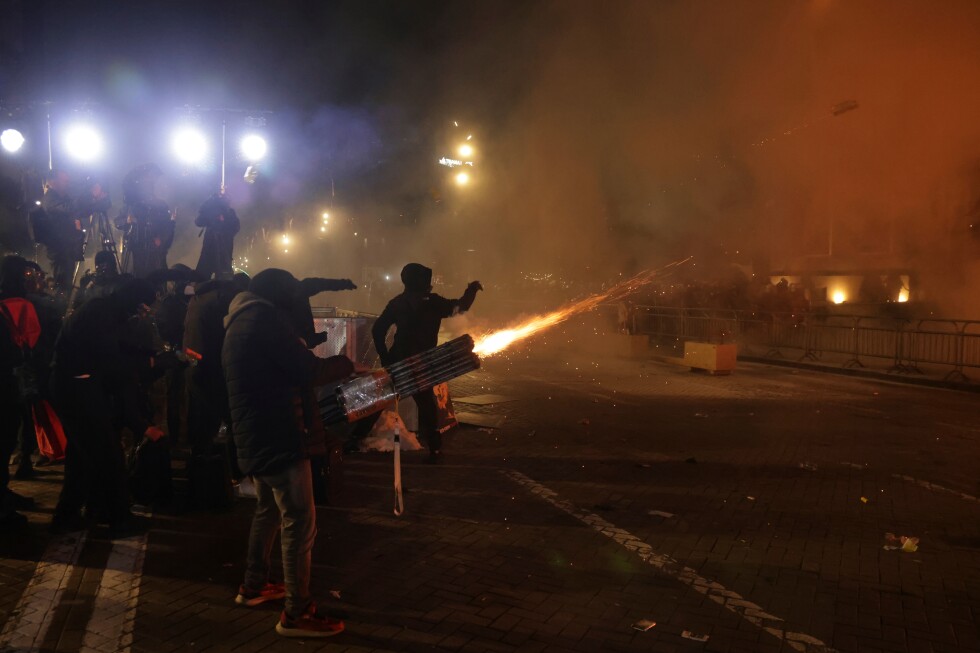
Riot police deployed tear gas and water cannon against protesters in Tirana Tuesday night as thousands of opposition supporters rallied in the Albanian capital demanding the resignation of Prime Minister Edi Rama’s government. Demonstrators responded by hurling Molotov cocktails and flares in the latest escalation of political tensions gripping the Balkan nation.
Hospital officials reported that sixteen protesters required medical treatment for burns and other injuries following the confrontation. Police authorities confirmed thirteen arrests during the demonstration, which marked the third major anti-government protest in recent months.
The unrest stems from corruption allegations involving Deputy Prime Minister Belinda Balluku, who also serves as minister for energy and infrastructure. Anti-corruption prosecutors have accused Balluku of improperly influencing public procurement processes for construction projects to favor certain companies. The opposition is demanding that lawmakers lift Balluku’s immunity from prosecution, which requires a parliamentary vote.
Prime Minister Rama has thus far resisted mounting pressure to dismiss his deputy, further inflaming tensions with opposition forces. The government deployed more than 1,300 police officers to maintain security during Tuesday’s demonstration, reflecting concerns about potential violence after previous protests also turned confrontational.
Opposition Democratic Party leader Sali Berisha, addressing the crowd, characterized the demonstration as a “peaceful uprising” at a critical moment for Albania’s future. Berisha, himself a former prime minister who has faced corruption allegations, accused Rama of “declaring war on the justice system” by refusing to allow Balluku to face prosecution.
The political crisis unfolds against a backdrop of Albania’s ambitions to join the European Union. The country is currently under close monitoring by EU officials as part of its accession process, with hopes of completing membership requirements by 2027. However, international watchdog organizations consistently highlight Albania’s struggles with widespread corruption, which threatens to undermine its EU aspirations.
Political analyst Mentor Kikia offered a sobering assessment of the protests’ potential impact, suggesting significant political change remains unlikely. “Citizens are distrustful, having consistently voted for the lesser evil to remove the greater evil from power,” Kikia noted. “The current perception is that if Rama leaves, Berisha will return. One left power because of corruption, the other must also leave power because of corruption.”
This cynicism reflects Albania’s complex political landscape, where corruption allegations have plagued both major political factions. The Democratic Party, now leading opposition protests, previously held power under Berisha’s leadership before losing to Rama’s Socialist Party amid its own corruption scandals.
Albania’s political instability poses challenges beyond its borders. As a NATO member and EU candidate country, its domestic turmoil raises concerns about regional stability in the Western Balkans, an area where the European Union and United States have invested significant diplomatic capital.
For ordinary Albanians, the political deadlock and corruption allegations from both sides of the political spectrum have deepened disillusionment with the country’s democratic institutions. Many citizens view the current crisis not as an ideological battle but as a power struggle between political elites accused of similar misconduct.
As tensions continue to simmer, the international community is closely monitoring developments in Tirana, concerned that prolonged political instability could derail Albania’s reform agenda and European integration process. EU officials have repeatedly stressed that combating corruption remains a fundamental requirement for Albania’s EU membership bid.
With neither side showing signs of compromise, further demonstrations and potential clashes appear likely in the coming weeks, testing the resilience of Albania’s democratic institutions and its path toward European integration.
Fact Checker
Verify the accuracy of this article using The Disinformation Commission analysis and real-time sources.

14 Comments
The use of violence by both protesters and police is concerning. While the grievances of the opposition seem legitimate, resorting to Molotov cocktails and flares is not the right way to pursue political change.
I agree, the escalation of violence is counterproductive. The government should exercise restraint and focus on investigating the corruption allegations through proper legal channels.
While the protesters have legitimate grievances, the use of violence is never justified. I hope the authorities and opposition can find a peaceful way to resolve this crisis and address the underlying corruption issues.
Agreed. Resorting to Molotov cocktails and flares will only escalate the situation and undermine the opposition’s moral authority. A commitment to nonviolent protest is essential for democratic change.
It’s disappointing to see these clashes in Albania, a country that has generally been seen as a regional success story in its democratic transition. I hope the political parties can find a way to address the underlying issues through constructive dialogue.
Absolutely. Albania has made significant progress, but this situation shows how fragile democratic institutions can be when faced with entrenched corruption. Transparent and accountable governance should be the priority.
This situation underscores the challenges facing many developing nations in tackling corruption and maintaining political stability. I hope the Albanian authorities can find a constructive resolution through dialogue and the rule of law.
Corruption is a major issue that undermines public trust in institutions. Addressing it will require a comprehensive anti-corruption strategy and commitment from all political stakeholders.
Interesting to see the continued unrest in Albania over corruption allegations. It will be important for the government to address the concerns of the protesters in a transparent and peaceful manner.
Agreed, the allegations of improper influence in public procurement processes are quite serious. Lifting the immunity of the deputy prime minister could be an important step towards addressing the protesters’ demands.
These protests highlight the importance of having strong, independent anti-corruption institutions that can investigate allegations without political interference. The government should cooperate fully with any investigations to restore public trust.
You’re right, the independence of anti-corruption bodies is crucial. Lifting the immunity of the deputy prime minister would be an important step, but the process must be fair and impartial.
This is a complex situation with valid concerns on both sides. The government must be held accountable for corruption, but the protesters also have a responsibility to demonstrate peacefully. I hope cooler heads can prevail and a constructive dialogue can emerge.
Well said. Finding a balanced approach that addresses the corruption allegations while maintaining public order will be crucial for Albania’s long-term political and economic stability.