


Listen to the article
Vietnam’s Communist Party Chief Takes Presidency, Consolidating Power
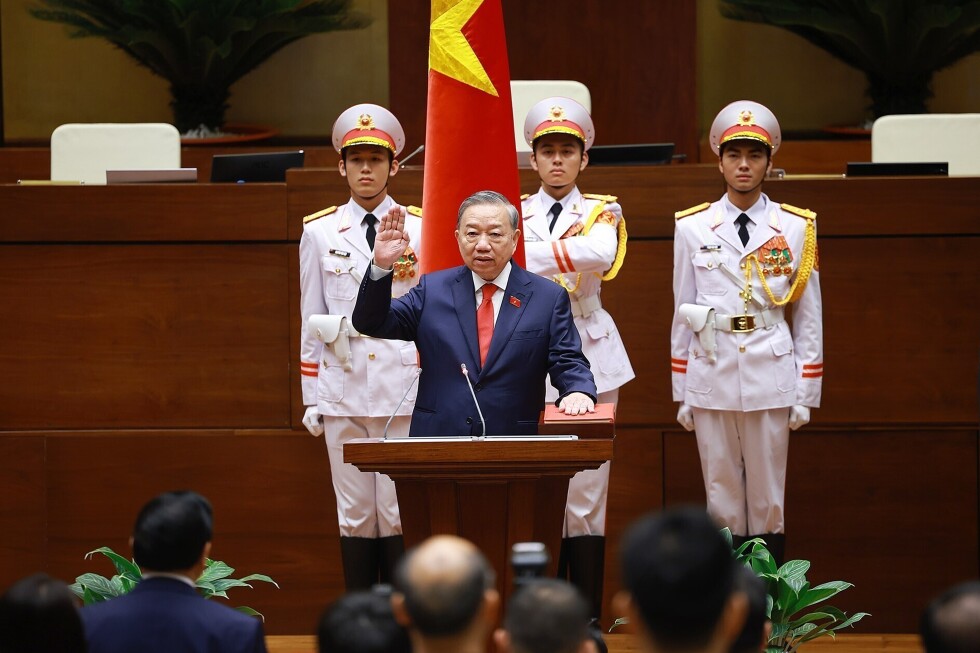
Vietnam’s Communist Party General Secretary To Lam was unanimously elected as the country’s president for a five-year term on Thursday, marking a significant consolidation of power in one of Southeast Asia’s fastest-growing economies.
The National Assembly’s decision places both the party leadership and presidency in Lam’s hands, departing from Vietnam’s traditional power-sharing arrangement where different individuals typically hold the top positions. This consolidation mirrors governance structures seen in neighboring China under Xi Jinping and in Laos.
In a complementary move, lawmakers also elected former central bank governor Le Minh Hung as Vietnam’s prime minister for the next five years, completing a leadership reshuffle at the highest levels of government.
After taking the oath of office, the 69-year-old Lam addressed the National Assembly, emphasizing that his primary focus would be maintaining peace and stability. “We aim to improve people’s livelihoods so all can share the benefits of development,” he stated, highlighting these factors as foundations for sustainable economic growth.
This dual-role arrangement isn’t entirely unprecedented for Lam, who briefly held both positions earlier in 2024 following the death of his predecessor, Nguyen Phu Trong. However, the formalization of this arrangement for a full term represents a significant shift in Vietnam’s political landscape.
Political analysts view this concentration of power as transformative for Vietnamese governance. Nguyen Khac Giang of Singapore’s ISEAS–Yusof Ishak Institute noted that Lam now possesses “a stronger mandate and far more political room to push through his agenda than any leaders” since Vietnam’s economic reforms began in the 1980s.
“The opportunity is obvious. Faster decision-making, greater policy coherence, and a better chance of pushing difficult reforms at a pivotal moment,” Giang explained. “But the risk is that concentration of power can move faster than institutional reform.”
Lam’s ascent to Vietnam’s dual top positions caps a remarkable career trajectory. Beginning in the security services, he rose through the ranks as a career policeman before reaching the political summit. His rise was accelerated by the sweeping anti-corruption campaign initiated by his predecessor, which Lam oversaw as head of the Ministry of Public Security.
Since becoming party chief, Lam has implemented Vietnam’s most extensive bureaucratic overhaul in decades. His administration has cut government jobs, merged ministries, redrawn provincial boundaries, and accelerated major infrastructure projects across the country.
Economic performance and private-sector growth have been central to Lam’s agenda. His government aims to move Vietnam beyond its traditional labor- and export-driven economic model, which has successfully lifted millions from poverty and created a manufacturing-based middle class. The ambitious target is to achieve 10% or higher annual economic growth over the next five years.
Prime Minister Hung reinforced this vision in his inaugural address, stating that the 10% growth target is aligned with Vietnam’s strategic goals. He identified “strengthening science, technology, innovation and digital transformation as top priorities” for his administration.
However, significant challenges loom on the horizon. Vietnam’s immediate task is implementing this ambitious economic vision amid global economic disruptions, including energy market volatility stemming from conflicts in the Middle East. While Vietnam’s economy expanded at an annualized rate of 7.8% in the first quarter of this year—up from 7.1% last year—it remains below the 9.1% target and slower than late 2025 growth rates.
On the international front, Vietnam faces the delicate task of balancing relations between major powers. The country is experiencing pressure from the United States over its trade surplus while simultaneously managing ties with China, its largest trading partner and rival claimant in the disputed South China Sea.
“Vietnam has benefited from a careful balancing strategy in foreign policy, but maintaining that position will become harder in a more turbulent world,” Giang observed, highlighting one of the key challenges facing the new leadership.
As Lam begins his term with unprecedented authority, Vietnam’s political direction and economic trajectory will be closely watched by investors, neighboring countries, and global powers with strategic interests in Southeast Asia.
Fact Checker
Verify the accuracy of this article using The Disinformation Commission analysis and real-time sources.

12 Comments
It’s noteworthy that Vietnam is following a similar governance model to China with this leadership transition. Will be important to see if it enhances economic dynamism or stifles political freedoms.
Agreed, the move toward a more centralized leadership structure bears watching. Curious to hear perspectives on how this may shape Vietnam’s future trajectory.
The election of To Lam as both party chief and president reflects Vietnam’s desire for stability and continuity in its leadership. I’m interested to see how this impacts the country’s policy priorities and international engagement.
Agreed, the leadership transition in Vietnam bears close watching. The country’s trajectory will have ripple effects across the region.
Vietnam’s move to centralize power under To Lam is noteworthy. It will be important to understand how this affects the country’s economic reforms, foreign investment, and regional dynamics.
This consolidation of power in Vietnam is an interesting development that could have broader implications. I’m curious to see how it shapes the country’s future course.
The election of To Lam as both party chief and president signals a shift in Vietnam’s political structure. I’m eager to learn more about how this may impact the country’s economic and diplomatic priorities.
Agreed, the leadership changes in Vietnam are worth following closely. They could have significant ramifications for the country’s trajectory and regional dynamics.
Interesting move by Vietnam to consolidate power under one leader. Curious to see how this impacts the country’s economic growth and foreign relations going forward.
Consolidation of power is a common trend in Southeast Asia. Will be important to monitor if it leads to greater stability or increased authoritarianism.
Vietnam’s decision to combine the party leadership and presidency is a significant shift. I’m curious to learn more about the potential implications for the country’s economic and political development.
This consolidation of power will be an important factor to monitor as Vietnam navigates its economic and geopolitical challenges in the years ahead.