


Listen to the article
Venezuelan Opposition Leader’s Brief Freedom Ends in Swift Rearrest
Venezuelan authorities have sought the arrest of opposition figure Juan Pablo Guanipa just hours after his release, highlighting the ongoing political tensions in the country following the U.S. military’s dramatic seizure of former President Nicolás Maduro last month.
Attorney General Tarek William Saab announced Monday that his office had requested the revocation of Guanipa’s release measures, claiming the opposition leader had violated unspecified conditions imposed by the court. Authorities are now seeking to place Guanipa under house arrest instead.
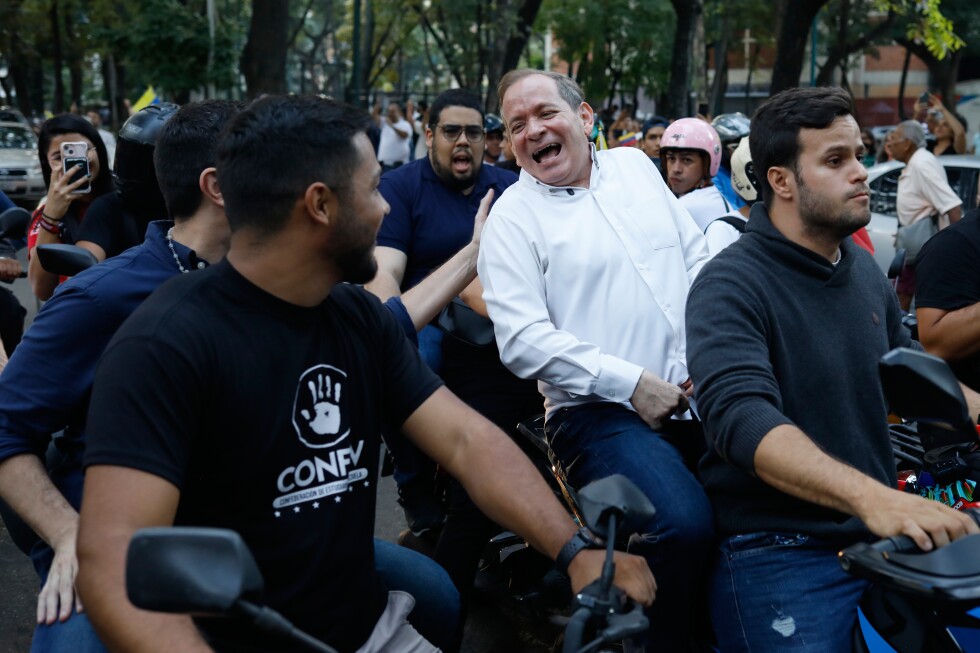
The development came less than 12 hours after Guanipa was among several prominent opposition members freed from detention as part of what appeared to be a goodwill gesture by Venezuela’s acting government led by Delcy Rodríguez.
“My father cannot be a criminal simply for making statements,” said Ramón Guanipa, the opposition leader’s son, who told reporters that armed men in civilian clothes intercepted his father around 11:45 p.m. Sunday in Caracas. “How much longer will speaking out be a crime in this country?”
According to Ramón Guanipa, the men who detained his father were wearing bulletproof vests and carrying long guns. He also disputed the attorney general’s claims, showing reporters court documents that listed only two conditions for his father’s release: monthly court check-ins and no travel outside Venezuela. He insisted his father had not violated either condition during his brief hours of freedom.
Political Prisoners Released
The prisoner releases began following Rodríguez’s ascension to acting president after Maduro’s capture by U.S. forces on January 3. The former president and his wife, Cilia Flores, were taken from a military base in Caracas to New York to face federal drug trafficking charges.
Venezuelan-based prisoner rights group Foro Penal confirmed at least 30 people were released on Sunday alone. Among those freed were several members of opposition leader María Corina Machado’s political organization, including attorney Perkins Rocha, who was released to house arrest, and local organizer María Oropeza, who had livestreamed her own arrest in 2024 as military intelligence officers broke into her home with a crowbar.
During his brief freedom, Guanipa had expressed optimism about Venezuela’s future. “I am convinced that our country has completely changed,” he told reporters. “I am convinced that it is now up to all of us to focus on building a free and democratic country.”
Some freed detainees joined families waiting outside detention facilities, chanting “We are not afraid!” and marching a short distance in celebration of their release.
Context of Political Detention
Guanipa, a former governor representing the opposition, was detained in late May 2025 and accused by Interior Minister Diosdado Cabello of participating in an alleged “terrorist group” plotting to boycott legislative elections. His brother Tomás had rejected these accusations, maintaining the arrest was intended to suppress dissent.
The acting government announced on January 8 that it would release a significant number of political detainees—a key demand from the country’s opposition, human rights organizations, and the United States. However, families and rights watchdogs have criticized the slow pace of these releases.
Speaking from Washington on Monday, opposition leader María Corina Machado condemned Guanipa’s rearrest: “They are terrified that Venezuelan society will mobilize and express its voice civically. But let me tell you something, there’s no going back… What will Juan Pablo become now? What will Perkins become as a prisoner in his own home? A reference in this fight.”
Path Forward
The ruling party-controlled National Assembly has begun debating an amnesty bill that could potentially lead to the release of hundreds more political prisoners. The opposition and non-governmental organizations have reacted with cautious optimism while requesting more information about the proposal.
Jorge Rodríguez, National Assembly President and brother of the acting president, posted a video on Instagram Friday showing him outside a detention center in Caracas, promising that “everyone” would be released no later than next week once the amnesty bill is approved.
The United Nations has also engaged with the situation. UN High Commissioner for Human Rights Volker Türk spoke with Acting President Rodríguez in late January and dispatched a team to Venezuela, offering support to help the country “work on a road map for dialogue and reconciliation” centered around human rights.
As Venezuela navigates this period of significant political transition, the rapid reversal of Guanipa’s freedom underscores the fragility of the current reconciliation efforts and the challenges that remain in the country’s path toward democratic stability.
Fact Checker
Verify the accuracy of this article using The Disinformation Commission analysis and real-time sources.

7 Comments
This news is a concerning setback in Venezuela’s efforts to address its longstanding political and economic crises. Achieving a lasting resolution will require good-faith dialogue and compromise from all stakeholders, both domestic and international.
I hope the international community continues to closely monitor the situation in Venezuela and press for the restoration of democratic norms and the rule of law. Sustained pressure may be necessary to ensure the fair treatment of all citizens, regardless of their political affiliations.
This development is likely to further strain relations between Venezuela’s government and the opposition. Resolving these political tensions through lawful and inclusive means, rather than confrontation, would be in the best interest of all Venezuelans.
The ability of citizens to freely express dissenting views without fear of persecution or arbitrary detention is a fundamental right. This case seems to undermine that principle and further polarize the political landscape in Venezuela.
The mining and energy sectors in Venezuela have faced significant disruptions and uncertainty due to the ongoing political turmoil. Stabilizing the country’s institutions and economic environment is crucial for attracting much-needed investment in these vital industries.
I’m curious to learn more about the specific conditions that led to Guanipa’s initial release and the alleged violations that prompted the rearrest order. Transparent and impartial application of the law is crucial for restoring stability and trust in Venezuela’s institutions.
This is a concerning development, highlighting the ongoing political tensions and fragility of the rule of law in Venezuela. The swift re-arrest of an opposition figure after a brief release raises questions about the motivations and transparency of the judicial process.