


Listen to the article
U.S. Ambassador’s Comments on Israel’s Territorial Rights Spark International Backlash
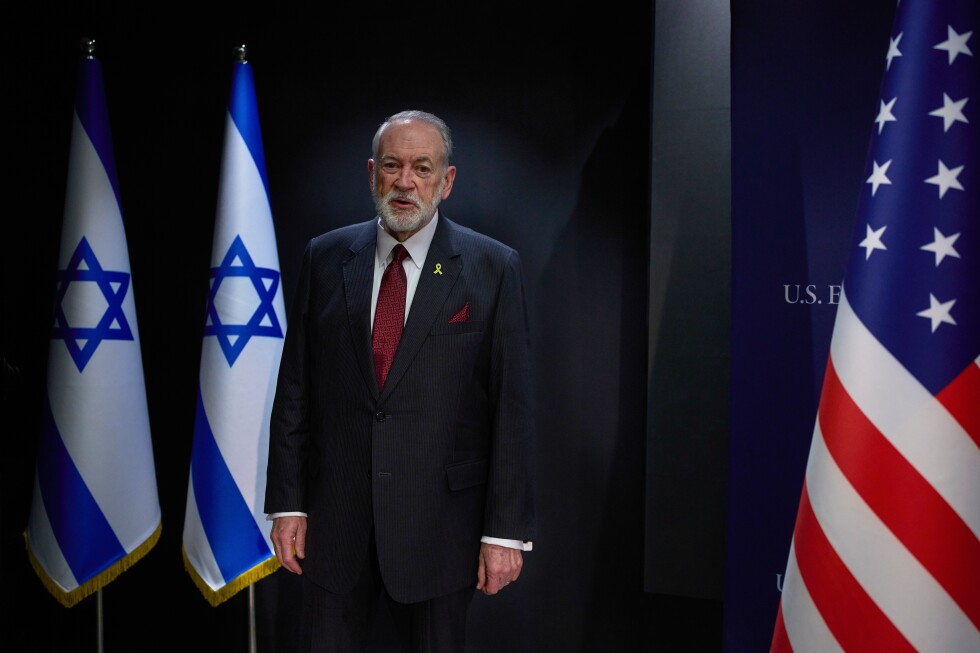
Controversy erupted across the Middle East on Sunday following remarks by U.S. Ambassador to Israel Mike Huckabee suggesting Israel has legitimate claims to much of the region. The comments, made during an interview with conservative commentator Tucker Carlson, have drawn sharp criticism from Arab nations while U.S. officials scramble to clarify the ambassador’s position.
During the interview aired Friday, Carlson referenced biblical passages from Genesis Chapter 15 describing land promised to Abraham’s descendants, which would encompass significant portions of modern-day Jordan, Syria, Iraq, and Lebanon. When asked if Israel had a right to those territories, Huckabee responded: “It would be fine if they took it all.”
The U.S. Embassy in Israel quickly attempted to contain the diplomatic fallout, stating Sunday that Huckabee’s comments were taken out of context and do not represent a change in U.S. policy toward the region.
In the same interview, Huckabee did clarify that Israel is not seeking territorial expansion beyond its current borders, saying: “They’re not asking to go back and take all of that, but they are asking to at least take the land that they now occupy, they now live in, they now own legitimately, and it is a safe haven for them.” He added that Israel’s primary concern is protecting its citizens, not annexing neighboring countries.
Nevertheless, the ambassador’s comments prompted a swift and coordinated response from fifteen Arab and Muslim nations. Egypt, Saudi Arabia, Jordan, Bahrain, the United Arab Emirates, Qatar, Indonesia, Pakistan, Turkey, Syria, Kuwait, Lebanon, Oman, the Palestinian Authority, and several Arab governing bodies issued a joint statement condemning Huckabee’s remarks as “dangerous and inflammatory” that threaten regional stability.
“These statements directly contradict the vision put forward by U.S. President Donald J. Trump… based on containing escalation and creating a political horizon for a comprehensive settlement that ensures the Palestinian people have their own independent state,” the joint statement read.
Huckabee, a former Arkansas governor and presidential candidate, is known for his evangelical Christian beliefs and has long been a vocal supporter of Israel and the West Bank settlement movement. Throughout his career, he has consistently opposed the internationally supported two-state solution for Israelis and Palestinians.
The controversy comes at a particularly sensitive time, as Israel braces for potential attacks from Iran. Iranian officials have previously threatened to strike both Israel and U.S. military installations in the Middle East if the United States launches an offensive against Iran.
Adding to the regional tension, President Trump warned on Friday that limited strikes against Iran remain a possibility, even as diplomatic efforts continue. The U.S. has reinforced its military presence in the region, positioning the USS Gerald R. Ford aircraft carrier near the Mediterranean Sea, signaling its readiness to act if necessary.
Israeli Prime Minister Benjamin Netanyahu has taken a hard line against Iranian threats, warning last week that any attack on Israel would trigger a response “that they cannot even imagine.” This tough rhetoric follows a series of escalations between the two countries, including an Israeli strike against Iran last year that sparked a 12-day conflict, during which the United States targeted Iranian nuclear facilities.
The current situation highlights the complex web of alliances, historical claims, and religious considerations that continue to define Middle Eastern politics. While U.S. officials attempt to manage the diplomatic fallout from Huckabee’s comments, the episode underscores the volatility of a region where casual remarks by diplomatic representatives can quickly inflame tensions between nations with deep historical grievances.
As both military preparations and diplomatic efforts continue, observers note that the ambassador’s comments—regardless of intent—have added another layer of complexity to already fragile U.S. relationships across the Middle East.
Fact Checker
Verify the accuracy of this article using The Disinformation Commission analysis and real-time sources.

6 Comments
This is a complex geopolitical issue with deep historical roots. While Israel has legitimate security concerns, unilateral claims to expand borders would likely destabilize the region further. Diplomacy and compromise are needed.
The ambassador’s comments seem to have been misinterpreted or taken out of context. The U.S. has long maintained a balanced approach to the Israeli-Palestinian conflict, and I don’t expect that policy to change dramatically.
The Middle East is a powder keg, and any perceived shift in U.S. policy could have serious ramifications. I’m glad the administration is working to clarify the ambassador’s remarks and reassure its regional partners.
Territorial disputes in the Middle East are highly contentious. While Israel has legitimate security concerns, unilateral claims to expand borders would likely inflame regional tensions. Diplomacy and compromise are needed to achieve lasting peace.
As an observer, I’m curious to see how this plays out diplomatically. The U.S. has a delicate balancing act in maintaining relationships with Israel and its Arab neighbors. Clear communication of its position will be crucial.
This is a sensitive and complex issue. I’m glad the U.S. is clarifying the ambassador’s remarks, which appear to be inconsistent with official policy. Nuance is important when discussing the Middle East.