


Listen to the article
The United States has proposed a 15-point ceasefire plan to Iran while simultaneously bolstering military presence in the Middle East, sending paratroopers to support Marines already heading to the region, according to an official familiar with the situation.
Iran’s military has dismissed the diplomatic overture, continuing its attacks on Israel and Gulf states, including an assault that ignited a fire at Kuwait International Airport. The Iranian military issued a defiant statement: “Our first and last word has been the same from day one, and it will stay that way: Someone like us will never come to terms with someone like you.”
Washington submitted the plan via intermediaries from Pakistan, who have offered to host renewed negotiations, according to a source briefed on the proposal who spoke anonymously due to the sensitive nature of the discussions. Israeli officials, who have advocated for continued U.S. military action against Iran, were reportedly surprised by the submission of a ceasefire plan.
The conflict, approaching its one-month mark, has significantly disrupted global energy markets. Iran’s attacks on regional energy infrastructure and its chokehold on the Strait of Hormuz—through which approximately 20% of the world’s oil typically passes—has sent oil prices soaring and created fears of a potential global energy crisis.
Despite the ongoing diplomatic efforts, military movements continue to escalate. At least 1,000 troops from the U.S. Army’s 82nd Airborne Division will deploy to the Middle East in coming days, according to three sources with knowledge of the plans. The Pentagon is also deploying two Marine units that will add approximately 5,000 Marines and thousands of sailors to the region.
President Donald Trump has confirmed that American officials are engaged in negotiations with Iran but hasn’t specified who they’re communicating with. Meanwhile, Iran’s Khatam Al-Anbiya Central Headquarters, which commands both the regular military and the Revolutionary Guard, suggested there are no talks underway, asking rhetorically: “Have your internal conflicts reached the point where you are negotiating with yourselves?”
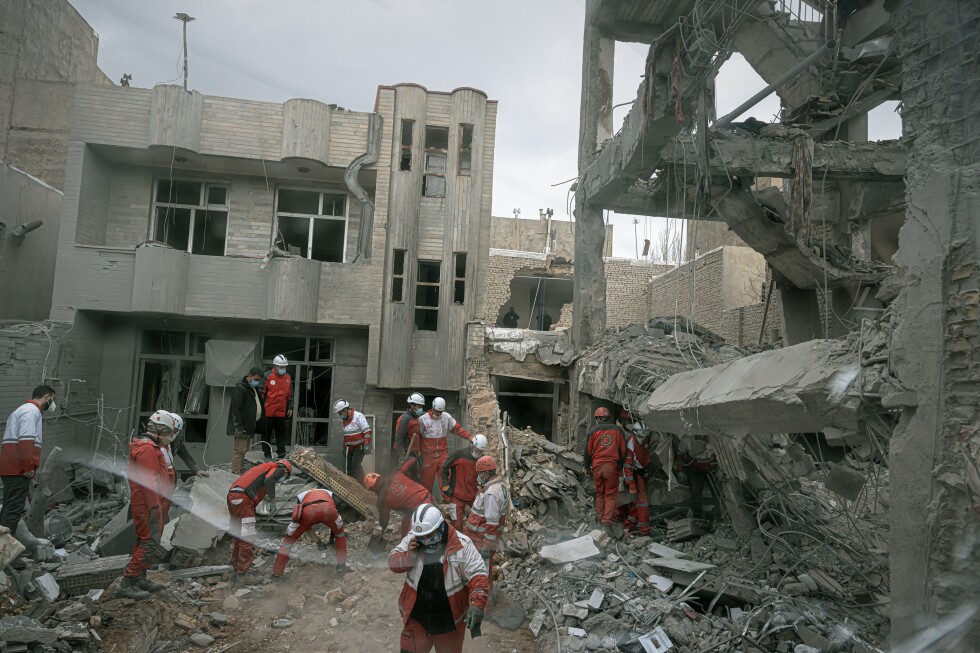
On the ground, military operations continue unabated. The Israeli military announced early Wednesday that it had begun new wide-scale attacks targeting Iranian government infrastructure, with witnesses reporting airstrikes in the northwestern city of Qazvin. Missile alert sirens sounded in Israel as Iran launched its own attacks, which have occurred daily since Israel and the U.S. first struck Iran on February 28.
Iran has also maintained pressure on Gulf Arab nations. Saudi Arabia’s Defense Ministry reported destroying at least eight drones in the kingdom’s oil-rich Eastern Province, while missile alert sirens sounded in Bahrain. Kuwait confirmed it shot down multiple drones, though one struck a fuel tank at Kuwait International Airport, causing a fire that emergency services worked to contain.
The prospect of a ceasefire has had a moderating effect on oil prices. Brent crude, the international benchmark, had approached $120 per barrel during the height of the conflict but traded just below $100 in morning trading as ceasefire discussions helped calm markets. This still represents a nearly 40% increase since the war began.
Any negotiations between the U.S. and Iran face formidable obstacles. Washington’s objectives regarding Iran’s ballistic missile and nuclear programs remain difficult to achieve, and it’s unclear which Iranian officials have the authority to negotiate—or would be willing to, especially as Israel has vowed to continue targeting the country’s leadership.
Iran maintains deep suspicion toward the United States, which twice under the Trump administration has launched attacks during high-level diplomatic talks, including the strikes that initiated the current conflict.
Speaking at the White House, President Trump said negotiations include special envoy Steve Witkoff, his son-in-law Jared Kushner, Secretary of State Marco Rubio, and Vice President JD Vance. “We have a number of people doing it,” Trump stated. “And the other side, I can tell you, they’d like to make a deal.”
However, Mohammad Bagher Qalibaf, speaker of Iran’s parliament, has denied Trump’s claim of direct talks, though Iranian Foreign Minister Abbas Araghchi’s office confirmed he has discussed the war with several counterparts this week.
Fact Checker
Verify the accuracy of this article using The Disinformation Commission analysis and real-time sources.

7 Comments
This US-Iran standoff highlights the volatility and uncertainty in global energy and commodity markets. A prolonged conflict could have severe economic consequences. Hopefully, cooler heads can prevail and a ceasefire agreement can be reached.
Interesting development in the Iran-US conflict. Seems like both sides are still posturing and unwilling to compromise. De-escalation would be ideal to stabilize energy markets, but Iran appears to be in no mood for diplomacy.
The US-Iran conflict is a complex geopolitical issue with major implications for energy and commodity markets. I’m curious to see if either side shows more flexibility to find a diplomatic off-ramp and de-escalate the situation.
Iran’s dismissal of the US ceasefire proposal is concerning. Both sides seem dug in, raising the risk of further escalation and disruption to critical energy infrastructure and supplies. A negotiated settlement would be best for all.
The US offer of a ceasefire plan is a diplomatic olive branch, but Iran’s defiant response suggests the conflict is far from over. This prolonged tension is concerning for global energy security and commodity markets.
The US ceasefire proposal seems like a reasonable attempt at de-escalation, but Iran’s dismissive response suggests the two sides remain far apart. This is a concerning situation for energy and commodity investors.
It’s unfortunate to see Iran reject the US ceasefire plan. A negotiated settlement would be the best path forward to stabilize the region and global energy markets. Ongoing hostilities risk further disruptions to critical supplies.