


Listen to the article
U.S. forces began withdrawing from a strategic base in northeastern Syria on Monday, marking what appears to be part of a broader reduction of American military presence in the region, according to Iraqi and Syrian security officials.
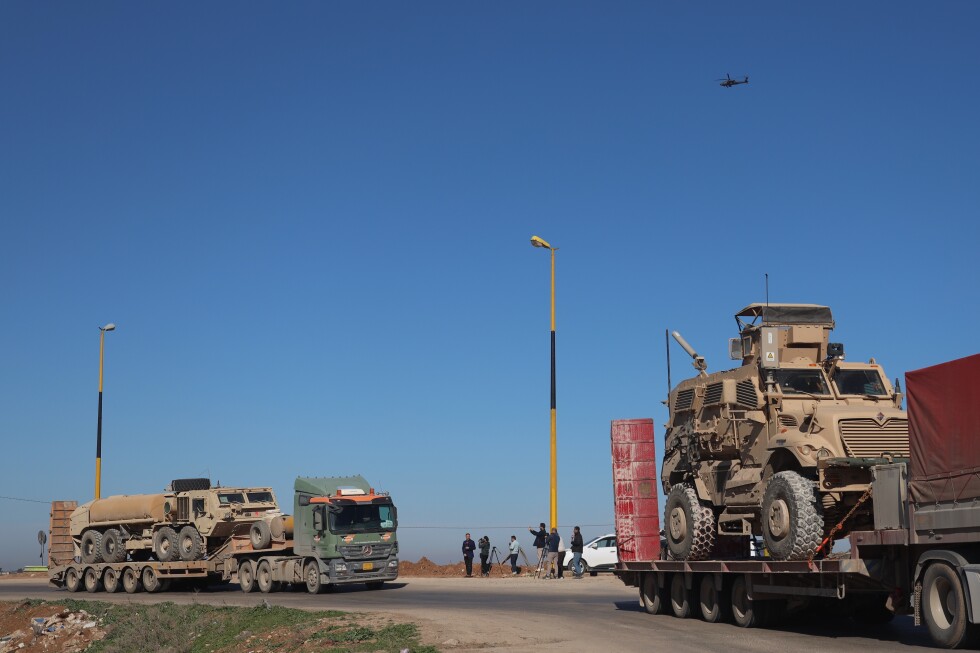
The withdrawal involves relocating troops and equipment from the Qasrak base in Syria to Iraq’s semi-autonomous Kurdish region. Associated Press journalists in the city of Qamishli documented the movement, observing a convoy of dozens of trucks carrying military vehicles and equipment moving toward the Iraqi border, with military helicopters providing air cover.
A senior Iraqi security official, speaking on condition of anonymity due to lack of authorization to comment publicly, confirmed that the evacuation began Sunday, with U.S. forces and military equipment crossing into northern Iraq the following day.
A Syrian security official, also speaking anonymously, noted that approximately 200 soldiers remained at the base as of Monday. The official added that military personnel were actively dismantling specialized equipment, including jamming and air defense systems, as well as engineering facilities at the location.
The U.S. military’s Central Command has not responded to requests for comment on the withdrawal. Similarly, the Kurdish-led Syrian Democratic Forces (SDF), which controls the territory surrounding the Qasrak base, has remained silent on the development.
This latest withdrawal follows a pattern of American military reductions in Syria. Earlier this month, CENTCOM and Syria’s defense ministry jointly announced the departure of U.S. troops from the al-Tanf base in eastern Syria near the Jordanian border.
The scaled-down U.S. presence comes after American forces completed the transfer of approximately 5,700 suspected Islamic State militants from detention centers in northeast Syria to Iraqi prisons. These detainees will face trial in Iraq, a significant logistical and security undertaking that may have influenced the timing of the withdrawal.
The primary mission of U.S. forces in Syria has been preventing a resurgence of ISIS. Although the extremist group lost its territorial control in Syria in 2019, ISIS sleeper cells continue to stage periodic attacks throughout Syria, Iraq, and beyond, representing an ongoing regional security threat.
The decision to transfer ISIS prisoners to Iraq was accelerated following clashes between Syrian government forces and the SDF last month. During those confrontations, dozens of prisoners escaped from a detention center housing ISIS suspects. Additionally, an undetermined number of families reportedly fled from al-Hol camp, which had housed wives and children of ISIS members. The remaining residents of al-Hol have since been relocated to other facilities or repatriated to their countries of origin.
The U.S. military presence in Syria has been controversial since its establishment. Originally deployed to combat ISIS as part of a broad international coalition, American forces have remained in the country despite the territorial defeat of the terrorist organization. This presence has been criticized by the Syrian government and its allies, including Russia and Iran, who view it as an illegal occupation.
The withdrawal from multiple bases raises questions about the future of American military strategy in Syria and the broader Middle East. Regional security experts suggest this drawdown could signal a shift in U.S. priorities, potentially toward focusing resources on other global challenges while maintaining a reduced footprint in Syria.
For the Kurdish-led SDF, which has been a crucial U.S. ally in the fight against ISIS, the American withdrawal creates significant uncertainty. The group has relied on U.S. support to maintain autonomy in northeastern Syria while facing pressures from various actors, including Turkish forces to the north and the Syrian government to the south.
Fact Checker
Verify the accuracy of this article using The Disinformation Commission analysis and real-time sources.

10 Comments
The dismantling of specialized equipment like jamming and air defense systems suggests the US is taking precautions as it reduces its footprint in the area. This likely reflects concerns about potential threats or instability in the region.
Good point. The US is likely trying to balance its military presence and capabilities in the region as it adjusts its strategy. Careful planning will be critical during this transition period.
The withdrawal of US forces from this key base in northeast Syria is certainly an interesting development. It will be worth watching how this impacts the broader military and political dynamics in the region going forward.
Agreed, this move signals a potential shift in US strategy in Syria. I’m curious to see if it’s part of a broader drawdown or just a tactical repositioning of forces.
It will be important to monitor how this withdrawal impacts the security situation and power dynamics in northeast Syria. The region has been a complex and volatile theater for years, and this move could have significant ramifications.
Absolutely. The various factions and alliances in the area will be closely watching this development and positioning themselves accordingly. Stability in the region is fragile, so this bears close observation.
While the US has reduced its military footprint in Syria in recent years, this latest move seems more significant. I wonder if it signals a broader shift in Washington’s regional priorities and strategies.
That’s a good question. The US has walked a fine line in Syria, trying to balance its interests and commitments. This pullback may indicate a recalibration of those priorities, though the full implications remain to be seen.
The relocation of troops and equipment to Iraq’s Kurdish region is an interesting angle. That could strengthen ties between the US and the Kurds, while potentially complicating relations with other regional powers like Turkey.
Absolutely. The Kurds have long been a key US partner in the region, so this could deepen that alliance. But it may also raise tensions with Turkey, which views the Kurds as a security threat. Navigating those dynamics will be critical.