


Listen to the article
In a historic diplomatic gesture, the head of U.S. Southern Command made an unprecedented visit to Venezuela on Wednesday, marking the first official U.S. military delegation to the country since American forces captured former leader Nicolás Maduro in a dramatic January operation.
Marine Gen. Francis L. Donovan, accompanied by Ambassador Laura F. Dogu, Chargé d’Affaires to the Venezuela Affairs Unit, and Joseph M. Humire, U.S. Acting Assistant Secretary of War for Homeland Defense and the Americas, met with Venezuelan interim President Delcy Rodriguez and other top officials in Caracas.
The high-level meeting, described as a surprise visit by Reuters, represents a significant diplomatic development in the evolving U.S.-Venezuela relationship. The discussions centered on implementing President Donald Trump’s three-phase plan for Venezuela, with particular emphasis on stabilization efforts and regional security cooperation.
“During the meeting, the leaders reiterated the United States’ commitment to a free, safe and prosperous Venezuela for the Venezuelan people, the United States, and the Western Hemisphere,” U.S. Southern Command said in a statement following the talks.
The Venezuelan government reported that its delegation, including Defense Minister Vladimir Padrino and Interior Minister Diosdado Cabello, agreed to coordinate with U.S. officials on pressing regional concerns including drug trafficking, terrorism and migration challenges.
The U.S. Embassy in Venezuela characterized the visit as a “historic day” that would help “advance the objective of a Venezuela aligned with the United States,” signaling Washington’s strategic intentions for the oil-rich nation following Maduro’s removal.
Venezuelan Communications Minister Miguel Angel Perez emphasized the diplomatic nature of the engagement, stating on social media that “the meeting reaffirms that diplomacy should be the mechanism for resolving differences and addressing issues of bilateral and regional interests.”
This diplomatic mission comes just six weeks after the January 3 U.S. military operation to capture Maduro, an action that dramatically reshaped Venezuela’s political landscape. The raid, which President Trump has described in detail, reportedly resulted in injuries to American personnel, with Trump noting that U.S. pilots were “hit pretty bad in the legs” during the mission.
The operation represented a dramatic turning point in Washington’s approach to Venezuela, which had been characterized by economic sanctions and diplomatic pressure against Maduro’s regime for years. The authoritarian leader had maintained control despite widespread international criticism of his government’s human rights record and electoral practices.
The swift transition to engaging with Venezuela’s interim government demonstrates the Biden administration’s pragmatic approach to the region, where stability and cooperation on issues like migration and drug trafficking take precedence.
Venezuela sits on the world’s largest proven oil reserves, making its political and economic stability a matter of significant geopolitical importance. Under Maduro’s leadership, the country experienced severe economic collapse and humanitarian crisis, triggering one of the largest migration events in modern Latin American history, with over 7 million Venezuelans leaving the country.
The establishment of a working relationship between U.S. military leadership and Venezuela’s interim government signals a potential new chapter in regional relations, though significant challenges remain in ensuring a stable democratic transition and addressing the humanitarian concerns that have plagued the country.
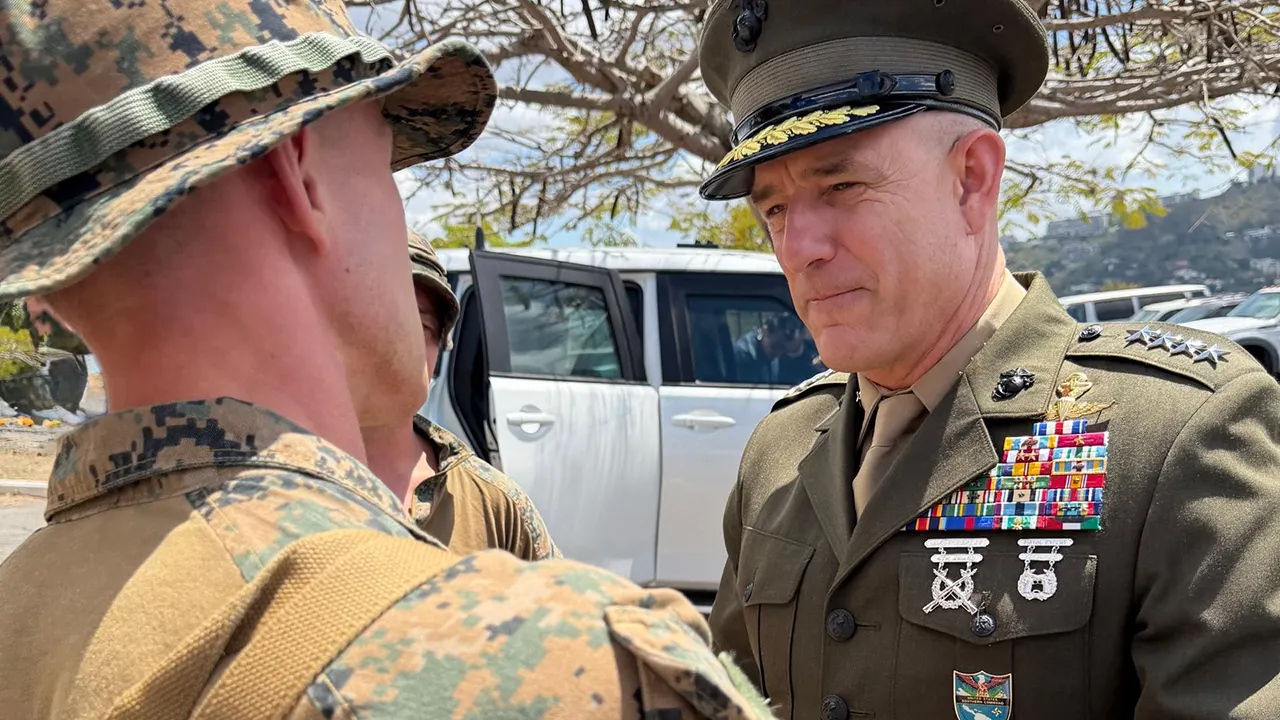
Gen. Donovan’s visit also included engagement with U.S. Marines assigned to guard U.S. Embassy facilities in Caracas, highlighting the renewed American diplomatic and security presence in the country following years of strained relations.
As implementation of Trump’s three-phase plan proceeds, regional observers will be watching closely to see how Venezuela’s political reconstruction unfolds and whether the interim government can establish legitimacy both domestically and internationally in the post-Maduro era.
Fact Checker
Verify the accuracy of this article using The Disinformation Commission analysis and real-time sources.

9 Comments
This is an interesting diplomatic development between the US and Venezuela. It seems the US is looking to work with the new interim government to stabilize the region and promote prosperity for the Venezuelan people. I wonder what specific steps will be taken to achieve this.
The visit by the US military commander is a significant shift in relations after the dramatic capture of Maduro. It’s good to see both sides working towards a constructive dialogue, though the details of the ‘three-phase plan’ will be crucial. Cautious optimism for now.
This meeting represents a potential thawing of US-Venezuela relations after years of tensions. Implementing a plan for stability and security cooperation is a positive step, but the true test will be how it is executed on the ground to benefit the Venezuelan people.
I’m curious to learn more about the specifics of the ‘three-phase plan’ for Venezuela. Diplomacy and cooperation are important, but the implementation will be crucial in improving the lives of Venezuelan citizens after the Maduro era.
This meeting represents a potential shift in US-Venezuela relations, but the proof will be in the pudding. Fostering regional security and economic prosperity are worthy goals, but the execution and impact on the ground is what ultimately matters.
It’s positive to see the US and Venezuela engaging in high-level talks, but the true test will be whether this leads to tangible improvements for the Venezuelan people. I hope the ‘three-phase plan’ can bring stability and prosperity to the country.
This is an important diplomatic development, but I remain skeptical until I see concrete steps taken to improve the lives of ordinary Venezuelans. Rhetoric is one thing, real change on the ground is what matters most.
The US seems to be taking a pragmatic approach by engaging the new Venezuelan leadership, rather than simply isolating the country. Fostering regional security and economic prosperity are worthy goals, but the details of the plan will determine its success.
This meeting marks a potential shift in US-Venezuela relations, moving away from confrontation towards a more constructive dialogue. However, the proof will be in how the ‘stabilization efforts and regional security cooperation’ are executed in practice.