


Listen to the article
The United States is positioned to launch a “highly kinetic” military campaign against Iran following one of its largest recent military buildups in the Middle East, according to a former senior Pentagon official.
Dana Stroul, now research director at The Washington Institute for Near East Policy, made this assessment as Washington and Tehran prepare for a second round of indirect nuclear talks in Oman. The talks, scheduled for February 26, come amid escalating tensions between the two nations.
“The US military is ready for a sustained, highly kinetic campaign should President Trump order it, and also prepared to defend allies and partners in the Middle East from Iran’s missiles,” Stroul told Fox News Digital. She emphasized America’s unique military capabilities, noting that “no ally or enemy is capable of what we have seen from the US in this current buildup.”
The current military posture represents a significant expansion compared to the June 2025 strikes on Iranian nuclear targets. While those operations were limited but highly targeted against key facilities, the current force deployment is broader and more sustained, designed for potentially longer-term operations.
“Two US aircraft carriers and their accompanying vessels and air wings were stationed in the Middle East last summer during the 12-day war and the US operation Midnight Hammer,” Stroul explained. “The addition of the Ford is really important, it expands US offensive capabilities if we go to war with Iran.”
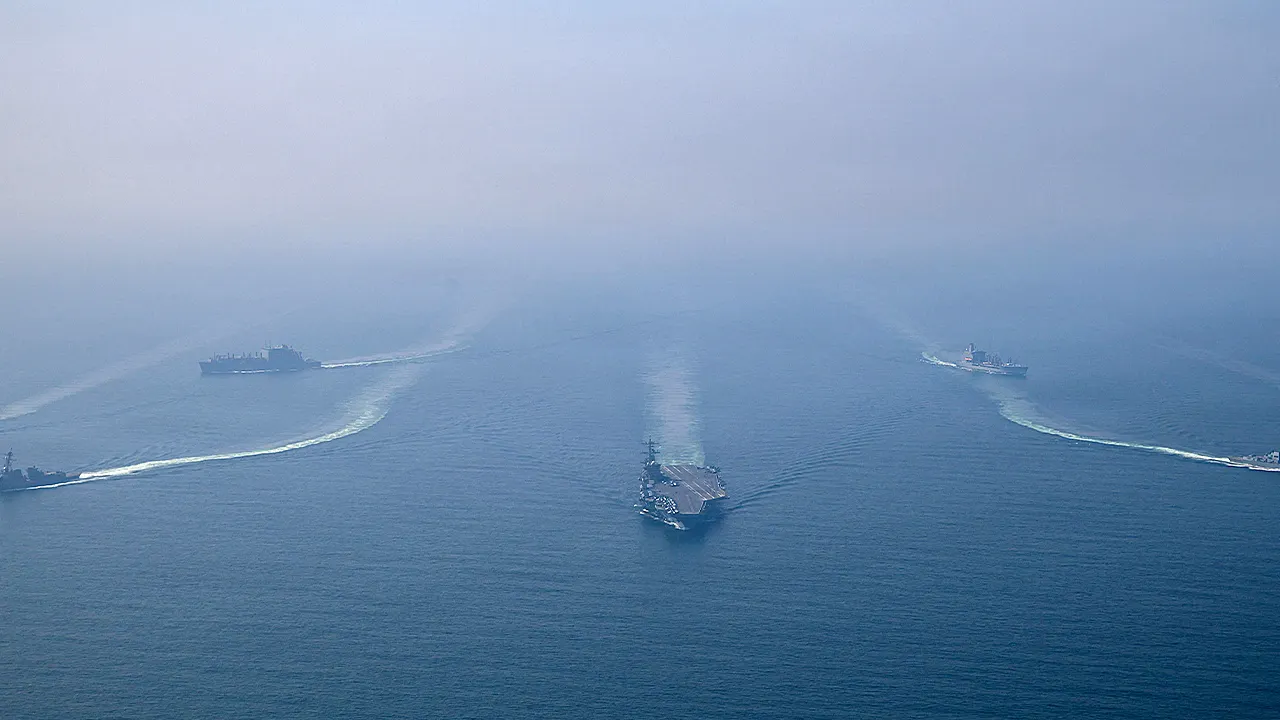
The USS Gerald R. Ford, the world’s largest warship, was recently tracked transiting the Strait of Gibraltar eastward after being redirected from its homeward journey. Meanwhile, the USS Abraham Lincoln is operating in the Arabian Sea. Both carriers will be positioned within the US Central Command theater, though their exact locations remain classified for security reasons.
“They will both be in the Middle East CENTCOM theater,” Stroul noted, adding that there could be “one in the eastern Mediterranean and the other in the Arabian Gulf.” This strategic positioning allows for maximum operational flexibility and force projection capabilities.
Beyond the aircraft carriers, the United States has “increased the number of guided-missile destroyers, fighter aircraft, refuelers, and air defense systems” in the region, creating a comprehensive military posture that could support sustained operations if ordered.
The military buildup coincides with ongoing diplomatic efforts. Oman is once again serving as mediator between Washington and Tehran, hosting indirect talks as both sides navigate the increasingly tense situation. President Trump has reportedly given Iran a 15-day window to reach a deal or face what he described as an “unfortunate outcome.”
Stroul characterized Iran’s approach as attempting to balance brinkmanship with negotiation, saying, “Iran’s leaders are playing a weak hand by combining saber-rattling about their own capabilities, staging preparations and exercises to signal readiness.” She added that Tehran is “attempting to slow this down by pursuing negotiations.”
The former Pentagon official emphasized the vast military disparity between the two nations. “No one should be under any illusions about the reality of US dominance — Iran is completely outmatched in conventional terms,” she said. “Israel dominated Iranian airspace in one day last year, targeted many of Iran’s security leaders, took out half of its missile arsenal, and the US significantly set back its nuclear program.”
Iran’s regional influence has also diminished in recent years. “Iran’s long-cultivated network of proxies across the region is degraded after more than two years of Israeli operations, and they declined to enter the war and support Iran’s defense last summer,” Stroul explained. “No matter what Iran’s leaders say, Iran is not able to rebuild a decades-long project in a few months.”
The current tensions come as concerns mount about Iran’s nuclear program. Steve Witkoff, President Trump’s Special Representative for the Middle East, has warned that Iran is reportedly “a week away” from acquiring “bomb-making material.”
Despite the clear military readiness, Stroul emphasized that any action would ultimately be a political decision rather than a question of military capability. “The US military is in a position to execute whatever orders President Trump gives,” she concluded. “It is not a question of military readiness, but a political decision.”
Fact Checker
Verify the accuracy of this article using The Disinformation Commission analysis and real-time sources.

14 Comments
The US military’s posturing in the Middle East is understandable given the ongoing regional tensions, but I hope diplomacy can ultimately prevail to avoid further conflict and suffering.
Absolutely. While military preparedness is necessary, the preferred path forward should be through peaceful negotiations and compromise. The people of the region deserve stability and security.
The US military’s readiness in the Middle East is a concerning development, but not entirely unexpected given the history of tensions in the region. I’ll be closely following the upcoming nuclear talks in Oman.
You make a fair point. The nuclear talks will be a crucial test of both sides’ willingness to find a diplomatic solution. I’m hopeful that reason and compromise will prevail over confrontation.
The US military’s positioning in the Middle East is certainly concerning, but not entirely surprising given the history of tensions in the region. I’m curious to see how the upcoming nuclear talks in Oman will progress.
The nuclear talks will be crucial in determining the trajectory of US-Iran relations. Careful diplomacy and compromise from both sides will be essential to avoid further conflict.
Interesting to see the US military continue to posture for potential conflict in the Middle East. While tensions remain high, I hope diplomacy can prevail to avoid further escalation and bloodshed.
Agreed, de-escalation through diplomatic channels would be the preferred path forward. However, the US military’s readiness is understandable given the delicate regional dynamics.
The US military’s readiness in the Middle East is a complex issue with significant geopolitical implications. I’ll be closely following the developments around the upcoming nuclear talks in Oman.
Agreed, the nuclear talks will be a crucial test of both sides’ willingness to compromise and find a diplomatic solution. The stakes are high, but I’m hopeful that reason will prevail.
While the US military’s positioning in the Middle East is understandable, I hope that diplomatic efforts can ultimately prevail in de-escalating tensions and avoiding further conflict. The region has suffered enough.
I share your sentiment. Diplomacy and compromise should be the preferred path forward, even if military readiness is necessary as a deterrent. The people of the region deserve stability and peace.
While the US military’s posturing is concerning, I’m hopeful that cooler heads will prevail and a diplomatic resolution can be found. The people of the Middle East have suffered enough from prolonged conflict.
You raise a fair point. Ultimately, the well-being of regional civilians should be the top priority, regardless of geopolitical tensions. Diplomacy must take precedence over military action.