


Listen to the article
US Envoys Press Netanyahu to Advance Gaza Ceasefire Deal
Top U.S. envoys met with Israeli Prime Minister Benjamin Netanyahu on Saturday, urging his government to move forward with the second phase of the Trump-brokered ceasefire in Gaza amid continuing complications over the remains of the last Israeli hostage.
Netanyahu held discussions with President Donald Trump’s envoy Steve Witkoff and Jared Kushner, Trump’s son-in-law and Middle East adviser. According to a U.S. official who spoke on condition of anonymity, the envoys have been working closely with Netanyahu on recovering the remains of the last hostage in Gaza and on subsequent steps for demilitarizing the territory.
The U.S. administration is eager to maintain momentum on the ceasefire agreement, which took effect on October 10. However, Netanyahu faces domestic pressure to delay further implementation until Hamas returns the remains of Ran Gvili, the last Israeli hostage.
A pivotal development in the second phase would be reopening the Rafah border crossing between Gaza and Egypt. Ali Shaath, head of the future technocratic government expected to administer Gaza’s day-to-day affairs, announced Thursday that the crossing would open in both directions this coming week. Israel, which currently controls the Gaza side of the crossing, has not confirmed this timeline but indicated it would consider the matter in cabinet discussions scheduled for Sunday.
The Gvili family issued a statement Saturday urging increased pressure on Hamas. “President Trump himself stated this week in Davos that Hamas knows exactly where our son is being held,” the family said. “Hamas is deceiving the international community and refusing to return our son, the last remaining hostage, in what constitutes a clear violation of the agreement it signed.”
Hamas countered on Wednesday that it has already provided “all information” it possesses about Gvili’s remains to ceasefire mediators and accused Israel of obstructing search efforts in areas under Israeli control.
Egypt Pushes for Rafah Crossing Reopening
Egyptian Foreign Minister Bader Abdelatty held discussions with Bulgarian diplomat Nickolay Mladenov, the high representative for Gaza and director of Trump’s new Board of Peace in Gaza. According to the Egyptian Foreign Ministry, Abdelatty emphasized the importance of implementing the second phase of the ceasefire agreement, including deploying an international monitoring force, opening the Rafah crossing in both directions, and withdrawing Israeli forces from Gaza.
The Egyptian minister characterized the second phase implementation as a “key entry point” to launch Gaza’s reconstruction efforts. The ministry statement did not specify when the crossing would open for travelers or for evacuating sick and wounded Palestinians.
Tragedy Amid Ongoing Tensions
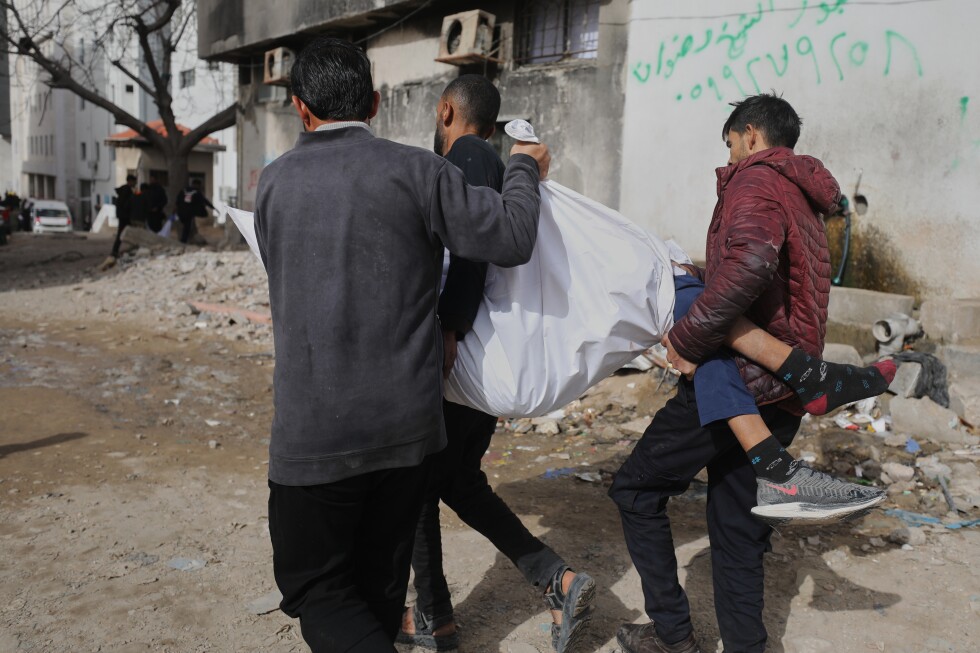
On Saturday, an Israeli strike killed two Palestinian teenagers in Gaza, according to authorities at Shifa Hospital in Gaza City. The victims, identified as cousins Mohammad Zawara, 15, and Sulaiman Zawara, 13, were reportedly searching for firewood when they were killed.
A relative, Arafat al-Zawara, told The Associated Press that the boys were killed in an area Israel’s military had designated as safe for Palestinians, approximately 500 meters from the Yellow Line that separates Israeli-controlled areas in eastern Gaza from the rest of the territory.
“They were targeted directly, not through any fault of their own,” he stated outside the hospital morgue.
Israel’s military disputed this account, claiming it had targeted several militants who crossed the Yellow Line and planted explosives threatening troops. The military denied that children were among those killed.
At the hospital, Yusuf Zawara, Mohammad’s father, was overwhelmed with grief. “No, he is not dead,” he said while embracing his son’s body. “Mohammad, oh Mohammad, come on, get up. They hit you with a missile. You couldn’t escape? Run, people, run! Why didn’t you run away?” he sobbed.
The desperate search for firewood has forced many Palestinians to venture near the Yellow Line as they seek anything that can be burned—including garbage and plastic—for cooking and warmth. Gaza has been without central electricity since the early days of the conflict that began with the Hamas-led attack on Israel on October 7, 2023, and fuel for generators remains scarce.
Hundreds of thousands of Palestinians are living in tent camps and war-damaged buildings as temperatures drop below 10 degrees Celsius at night and winter storms sweep in from the Mediterranean. The Gaza Health Ministry reports that at least nine children have died from severe cold in recent weeks.
Since the ceasefire began, more than 480 Palestinians have been killed by Israeli fire, according to the Gaza Health Ministry, which maintains detailed casualty records generally regarded as reliable by UN agencies and independent experts.
Fact Checker
Verify the accuracy of this article using The Disinformation Commission analysis and real-time sources.

8 Comments
Reopening the Rafah border crossing would be a major step forward, but Hamas’ intransigence on the hostage remains is complicating matters. Delicate diplomacy required to keep the ceasefire on track.
The US is clearly eager to build on the initial ceasefire, but Netanyahu’s domestic political pressures are a wild card. Navigating that will require skillful negotiation.
This is a critical moment for the Gaza ceasefire process. The US envoys are right to push for progress, but the hostage issue casts a long shadow. Resolving that impasse will be essential.
Curious to see how this plays out. The US is pushing hard, but the Gaza hostage issue is a major complicating factor for Netanyahu. Delicate diplomacy required to keep the ceasefire process on track.
The Rafah crossing reopening would be a major boost, but the hostage remains are a major sticking point. Netanyahu is in a tough spot – balancing domestic politics and the broader peace process.
Agreed, the US is trying to maintain momentum but Netanyahu’s position is understandably tricky. Resolving the hostage issue will be key to unlocking the next phase of the ceasefire.
Interesting development on the Gaza ceasefire. Maintaining momentum is crucial, but Netanyahu faces tricky domestic politics around the issue of hostage remains. Careful balancing act for all parties involved.
Agreed, the US envoys have their work cut out for them trying to advance the ceasefire process. Resolving the hostage issue will be key to unlocking the next phase.