


Listen to the article
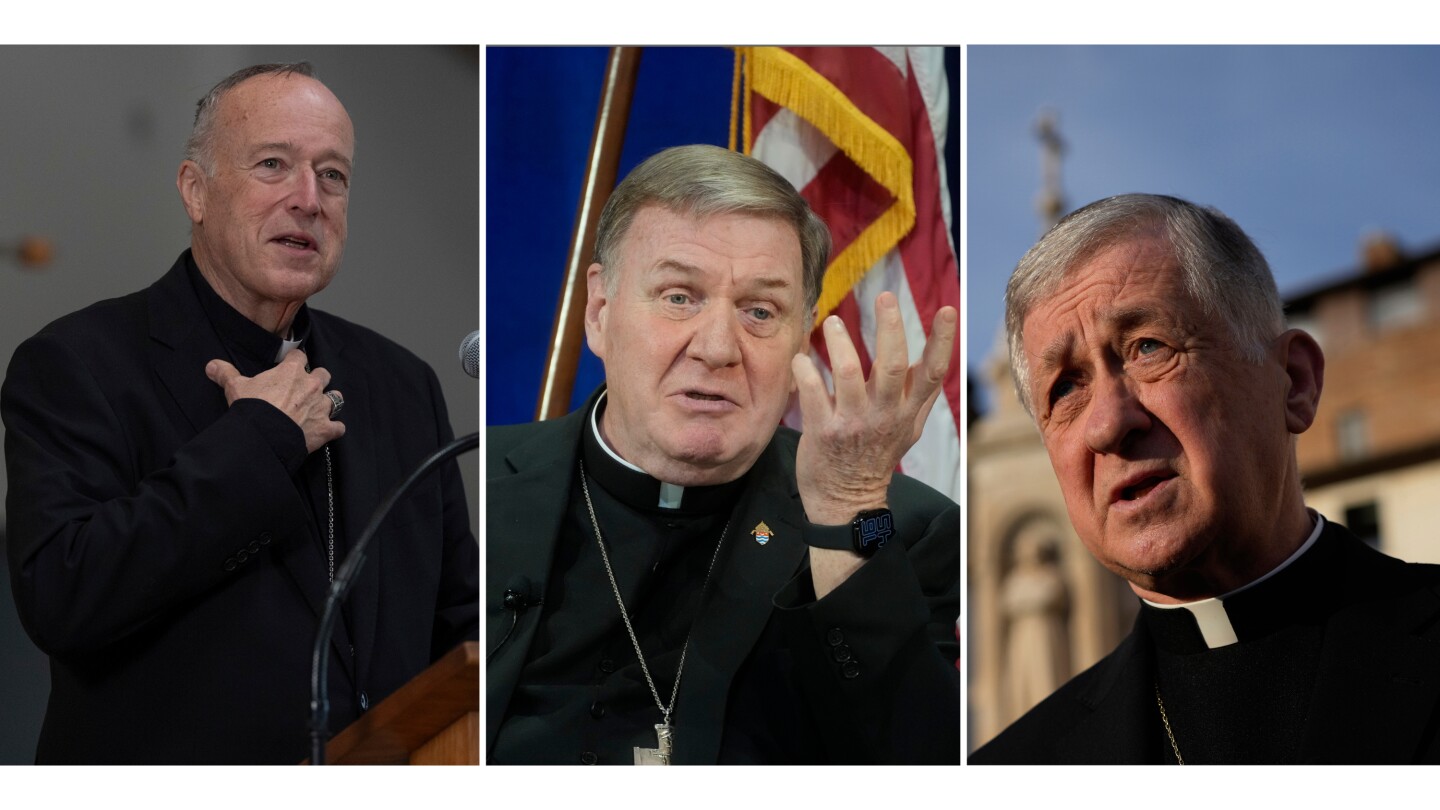
Three prominent U.S. Catholic cardinals have issued a rare joint statement calling on the Trump administration to adopt a more morally guided approach to foreign policy, expressing concern over military actions in Venezuela, territorial ambitions regarding Greenland, and cuts to foreign aid programs.
Cardinals Blase Cupich of Chicago, Robert McElroy of Washington, and Joseph Tobin of Newark warned that current U.S. foreign policy lacks moral vision and is mired in “polarization, partisanship, and narrow economic and social interests.”
“Most of the United States and the world are adrift morally in terms of foreign policy,” Cardinal McElroy told The Associated Press. “I still believe the United States has a tremendous impact upon the world.”
This public stance represents the second time in recent months that American Catholic leadership has voiced criticism of the Trump administration. In November, the U.S. Conference of Catholic Bishops condemned the administration’s mass deportation of migrants and what they described as the “vilification” of immigrants in public discourse.
The cardinals, who are considered leaders among the progressive wing of the U.S. Catholic Church, cited Pope Leo XIV’s January 9 address to diplomatic representatives at the Holy See as their inspiration. In that speech, delivered primarily in English, the pope—the first U.S.-born pontiff in history—criticized nations using force to assert global dominance, which he said “completely undermines” peace and the post-World War II international legal order.
Although the pope did not name specific countries, his remarks came in the context of recent U.S. military operations in Venezuela aimed at removing President Nicolás Maduro, American assertions about acquiring Greenland, and Russia’s ongoing war in Ukraine.
The U.S. Conference of Catholic Bishops was consulted on the cardinals’ statement, and its president, Archbishop Paul Coakley, “supports the emphasis placed by the cardinals on Pope Leo’s teaching in these times,” according to spokesperson Chieko Noguchi. The White House did not immediately respond to requests for comment.
In their statement, the cardinals addressed specific policy concerns, writing: “We renounce war as an instrument for narrow national interests and proclaim that military action must be seen only as a last resort in extreme situations, not a normal instrument of national policy.” They advocated for “a foreign policy that respects and advances the right to human life, religious liberty, and the enhancement of human dignity throughout the world, especially through economic assistance.”
Cardinal Tobin explained their moral vision, telling the AP, “It can’t be that my prosperity is predicated on inhuman treatment of others. The real argument isn’t just my right or individual rights, but what is the common good.”
In interviews, Cardinals Cupich and McElroy revealed that the statement was partly motivated by concerns expressed by fellow cardinals during a January meeting at the Vatican. They acknowledged the complexity of issues like Maduro’s prosecution but questioned the methods employed.
“When we go ahead and do it in such a way that is portrayed as saying, ‘Because we can do it, we’re going to do it, that might makes right’—that’s a troublesome development,” Cardinal Cupich said. “There’s the rule of law that should be followed.”
President Trump has defended the capture of Maduro as legal and has repeatedly argued that U.S. control of resource-rich Greenland is essential for national security, despite it being a semi-autonomous region of Denmark, a NATO ally.
The cardinals also criticized the Trump administration’s significant reduction of the U.S. Agency for International Development’s budget. The administration had justified these cuts by claiming USAID projects advanced a liberal agenda and were financially wasteful. Cardinal Tobin, who has worked in over 70 countries as a Redemptorist priest, lamented these reductions, noting the significant impact U.S. humanitarian assistance has on issues from hunger to healthcare globally.
The cardinals emphasized that their intent was not merely to criticize the administration but to encourage America to regain its moral standing in the world through ethical foreign policy decisions.
“We’re not endorsing a political party or a political movement,” Cardinal Tobin clarified. He added that all people of goodwill have a role to play: “They can make an argument of basic human decency.”
The unusual intervention highlights growing tensions between Catholic leadership and the administration on issues of global engagement, humanitarian policy, and America’s role in promoting peace and human dignity worldwide.
Fact Checker
Verify the accuracy of this article using The Disinformation Commission analysis and real-time sources.

10 Comments
This is an interesting stance from Catholic leaders. While foreign policy debates often get caught up in partisan politics, it’s valuable to have moral and religious perspectives weigh in. I’m curious to hear more about the specific concerns they have raised.
Yes, I agree it’s important for faith leaders to provide a moral framework for foreign policy decisions. The call for a more ‘morally guided approach’ is thought-provoking.
The cardinals make a strong case that US foreign policy has lost its moral compass. Prioritizing narrow interests over universal principles of justice and human dignity is deeply problematic. Their intervention is a welcome challenge to the status quo.
Absolutely. This is an important contribution to the ongoing debate over America’s global role and responsibilities. Reclaiming a moral foundation for foreign policy decisions should be a top priority.
It’s heartening to see religious leaders taking a principled stand on foreign policy matters. The cardinals’ critique of the current ‘polarization, partisanship, and narrow interests’ driving US global engagement is spot on. Hopefully this pushes the administration to reevaluate its approach.
Yes, this kind of moral leadership from influential figures within the Catholic Church could help shift the national discourse in a more constructive direction. Their call for a foreign policy grounded in universal human values is timely and necessary.
The cardinals raise some valid points about the need for greater moral vision in US foreign policy. Policies driven by narrow interests rather than broader principles of justice and human dignity are concerning. It will be interesting to see how the administration responds.
Absolutely. Foreign policy should be rooted in moral and ethical considerations, not just political or economic calculations. These Catholic leaders are providing an important counterpoint to the current approach.
While I don’t always agree with the Catholic Church’s positions, I respect their willingness to speak up on this issue. Moral leadership is crucial, especially when it comes to weighty foreign policy decisions that impact so many lives. Their call for greater vision and principle is warranted.
Agreed. Even if one doesn’t share the cardinals’ religious beliefs, their broader appeal to moral and ethical standards in foreign policy is compelling. It’s a perspective that deserves serious consideration.