


Listen to the article
U.S. Aircraft Carrier Arrives in Middle East as Tensions With Iran Escalate
The USS Abraham Lincoln and three accompanying destroyers have arrived in the Middle East, U.S. Central Command announced Monday, potentially giving President Donald Trump military options regarding Iran amid its ongoing crackdown on protesters.
The carrier strike group is currently deployed “to promote regional security and stability,” according to Central Command’s social media statement. The naval force is positioned in the Indian Ocean rather than the Arabian Sea, which directly borders Iran.
This deployment marks the return of a significant U.S. naval presence to the region after a notable absence. The last American aircraft carrier in the area was the USS Gerald R. Ford, which was redeployed in October to the Caribbean as part of Washington’s pressure campaign against then-Venezuelan President Nicolás Maduro.
The arrival brings thousands of additional U.S. military personnel to a region already on edge. President Trump told reporters last week that the ships were sent “just in case,” adding, “We have a massive fleet heading in that direction, and maybe we won’t have to use it.”
The deployment comes against the backdrop of Iran’s harsh response to protests that erupted in late December. According to activist groups, the crackdown has resulted in at least 5,973 deaths and more than 41,800 detentions. Iranian officials dispute these figures, reporting a much lower death toll of 3,117.
Trump had previously threatened military intervention if Iran executed mass numbers of detained protesters or killed peaceful demonstrators. More recently, he claimed Iran had halted plans to hang 800 protesters—an assertion Iran’s top prosecutor dismissed as “completely false.” The shifting narrative suggests the administration may be calibrating its response based on evolving intelligence or diplomatic considerations.
Despite these apparent inconsistencies, Trump has kept military options on the table. During a conversation aboard Air Force One last Thursday, the president warned that any military action against Iran for executing protesters would make last year’s U.S. strikes on Iranian nuclear facilities “look like peanuts” by comparison.
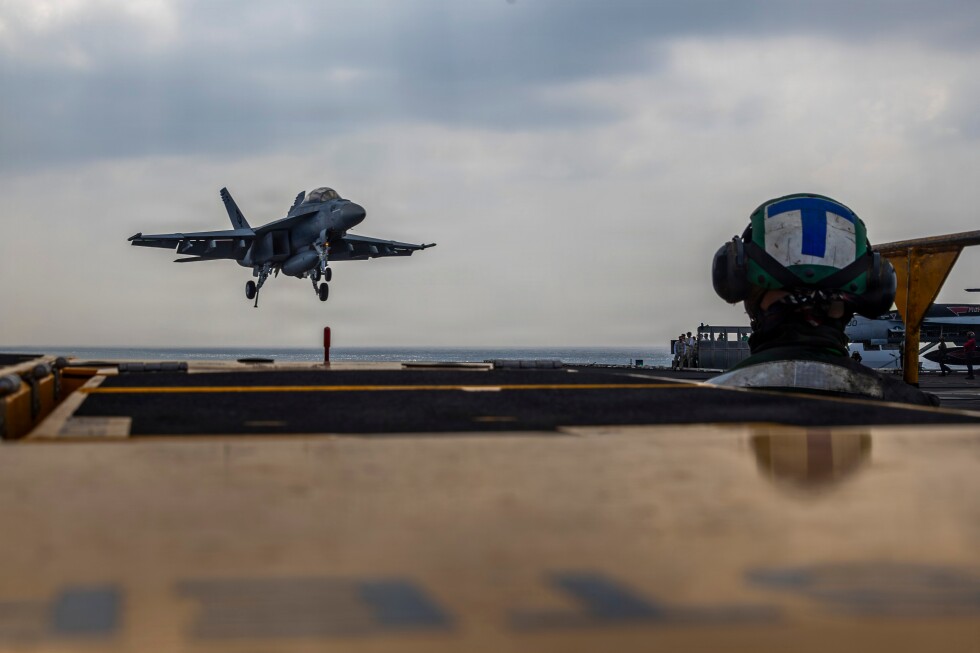
The Lincoln carrier strike group brings substantial firepower to the region. The aircraft carrier itself hosts multiple squadrons of advanced aircraft, including F-35 Lightning II stealth fighters and F/A-18 Super Hornet fighter jets. The three accompanying destroyers carry hundreds of missiles, potentially including dozens of Tomahawk land attack cruise missiles capable of precision strikes deep inside Iran.
Beyond naval assets, Central Command confirmed that U.S. Air Force F-15E Strike Eagle fighter jets are now also operating in the region. Open-source analysts tracking flight data have observed dozens of U.S. military cargo planes heading to the area, suggesting a significant logistics buildup.
This military movement follows a pattern similar to last year’s deployment of air defense systems, including Patriot missile batteries, in anticipation of Iranian retaliation following U.S. strikes on three key Iranian nuclear sites. Iran responded to those strikes by launching over a dozen missiles at Al Udeid Air Base, a major U.S. military installation in Qatar.
The current military posturing occurs amid heightened regional tensions, with Iran facing both domestic unrest and international pressure over its nuclear program and regional activities. Defense analysts note that the positioning of an aircraft carrier strike group provides Washington with flexible response options, from shows of force to actual strikes, should the situation deteriorate further.
Regional allies, particularly Gulf states concerned about Iran’s influence, are likely to welcome the increased U.S. military presence as a deterrent against potential Iranian aggression, while Tehran may view it as further evidence of American hostility toward the Islamic Republic.
Fact Checker
Verify the accuracy of this article using The Disinformation Commission analysis and real-time sources.

16 Comments
The deployment of a carrier group is a significant show of force, but I worry it could provoke an unwanted reaction from Iran. Calm and measured diplomacy seems like the wisest path forward.
Absolutely. Escalating military tensions in the region is a risky move that could have severe unintended consequences. Cooler heads must prevail.
The arrival of the carrier group is a concerning development, but I hope the US and its allies can use this as an opportunity to push for diplomatic solutions to the tensions with Iran.
Agreed. Increased military presence is not a sustainable long-term solution. Diplomacy and de-escalation should be the priorities here.
The arrival of the carrier group is a concerning development, but I’m hopeful that the US and its allies can find a diplomatic solution to ease the tensions with Iran.
Agreed. Diplomacy and restraint should be the priorities here, not saber-rattling or military posturing.
The deployment of a carrier group to the region is a significant show of force, but I worry it could backfire and provoke an unwanted reaction from Iran. Diplomacy and restraint should be the priorities here.
Absolutely. Escalating military tensions is a risky move that could have severe unintended consequences. Cooler heads must prevail.
This is a tense situation that requires careful management. I hope the US and Iran can find ways to communicate and deescalate the situation before it spirals out of control.
This is a delicate situation that requires a very careful and measured response. I hope the US and Iran can find ways to communicate and reduce the risks of miscalculation or accidental conflict.
This looks like another chapter in the long-running tensions between the US and Iran. I hope both sides can find a way to reduce the risks of conflict through negotiation and compromise.
The US seems to be flexing its military muscle in the region, but I hope cooler heads will prevail. Stability and diplomacy should be the priorities here, not saber-rattling.
Absolutely. Increased naval presence is a risky move that could backfire. Pursuing de-escalation through dialogue would be the wiser path forward.
This is a concerning move, but I hope tensions can be de-escalated through diplomacy rather than military force. The presence of a carrier group in the region could easily provoke further escalation.
Agreed. I’m worried this could lead to miscalculation and unintended consequences. The US and Iran need to find a way to reduce tensions constructively.
I’m concerned that this deployment could further inflame tensions in the region. The US and Iran need to find ways to communicate and reduce the risks of miscalculation or accidental conflict.